Yoo Il Han, Kim WooJoong, Kim Hunmin, Lim Byung Chan, Hwang Hee, Chae Jong Hee, Choi Jieun, Kim Ki Joong
Department of Pediatrics, Seoul National University Bundang Hospital, Seongnam, Korea.
Department of Pediatrics, St. Vincent's Hospital, The Catholic University of Korea College of Medicine, Suwon, Korea.
J Clin Neurol. 2017 Jul;13(3):281-286. doi: 10.3988/jcn.2017.13.3.281.
There are few studies that have investigated predictive factors related to migraine prophylaxis of which produced inconsistent results. The aim of this study was to identify factors that can predict the treatment response to topiramate prophylaxis in pediatric patients with migraine.
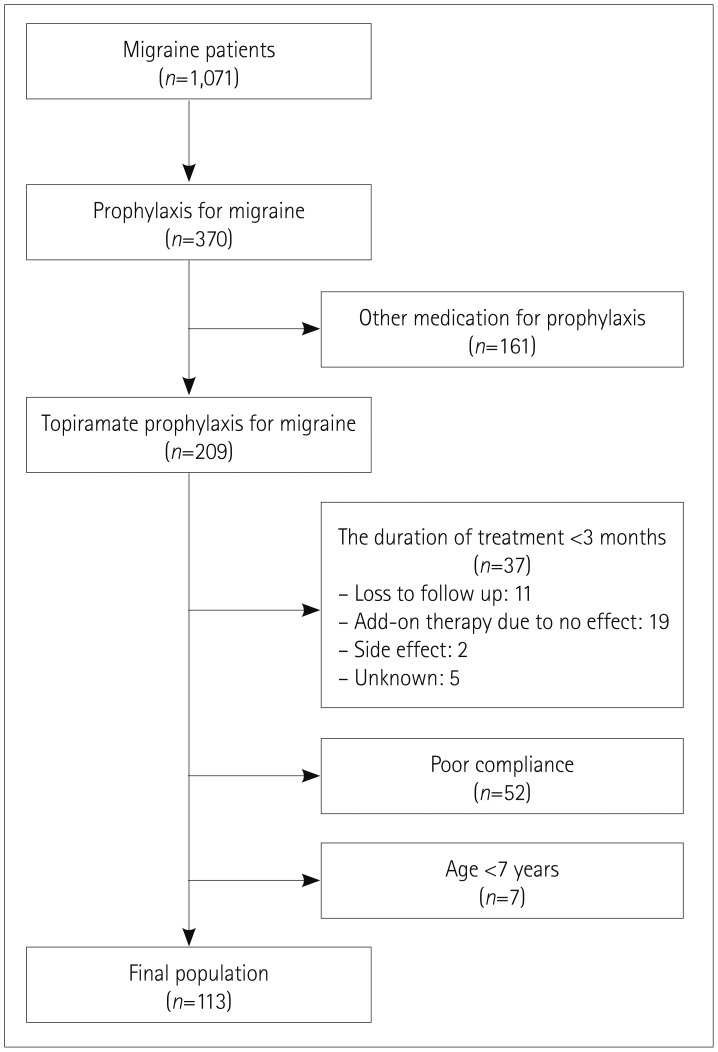
One hundred and thirteen patients who were older than 7 years and received topiramate for at least 3 months were recruited from the Seoul National University Bundang Hospital outpatient clinic from 2005 to 2014. A positive response was defined as a reduction of more than 50% in the number of migraine episodes after topiramate treatment. Proposed predictive factors such as migraine characteristics including severity and frequency were assessed, as were other data on sex, disease duration, associated symptoms, family history, and impairment of daily activities.
Seventy patients (61.9%) responded to prophylactic treatment with topiramate. Patients who experienced significant impairment in daily activities showed significant benefit from the treatment (p=0.004). Sex, the severity, frequency, and duration of migraine episodes, disease duration, treatment duration, age at onset, and associated symptoms were not significantly related to a response to topiramate treatment.
Migraine characteristics and associated symptoms were not significantly related to a response to topiramate treatment. However, patients with significant impairment in daily activities showed significant benefit from the treatment, and so prophylactic topiramate treatment should be strongly encouraged in this patient group.
很少有研究调查与偏头痛预防性治疗相关的预测因素,且结果并不一致。本研究旨在确定可预测偏头痛患儿托吡酯预防性治疗反应的因素。
从2005年至2014年,从首尔国立大学盆唐医院门诊招募了113名年龄大于7岁且接受托吡酯治疗至少3个月的患者。阳性反应定义为托吡酯治疗后偏头痛发作次数减少超过50%。评估了诸如偏头痛特征(包括严重程度和频率)等拟议的预测因素,以及关于性别、病程、相关症状、家族史和日常活动受损情况的其他数据。
70名患者(61.9%)对托吡酯预防性治疗有反应。日常活动有显著受损的患者从治疗中获益显著(p = 0.004)。性别、偏头痛发作的严重程度、频率和持续时间、病程、治疗持续时间、发病年龄和相关症状与托吡酯治疗反应无显著相关性。
偏头痛特征和相关症状与托吡酯治疗反应无显著相关性。然而,日常活动有显著受损的患者从治疗中获益显著,因此应强烈鼓励该患者群体进行托吡酯预防性治疗。