Van Naarden Braun K, Grazel R, Koppel R, Lakshminrusimha S, Lohr J, Kumar P, Govindaswami B, Giuliano M, Cohen M, Spillane N, Jegatheesan P, McClure D, Hassinger D, Fofah O, Chandra S, Allen D, Axelrod R, Blau J, Hudome S, Assing E, Garg L F
National Center on Birth Defects and Developmental Disabilities, Centers for Disease Control and Prevention, Atlanta, GA, USA.
New Jersey Department of Health, Trenton, NJ, USA.
J Perinatol. 2017 Oct;37(10):1117-1123. doi: 10.1038/jp.2017.105. Epub 2017 Jul 27.
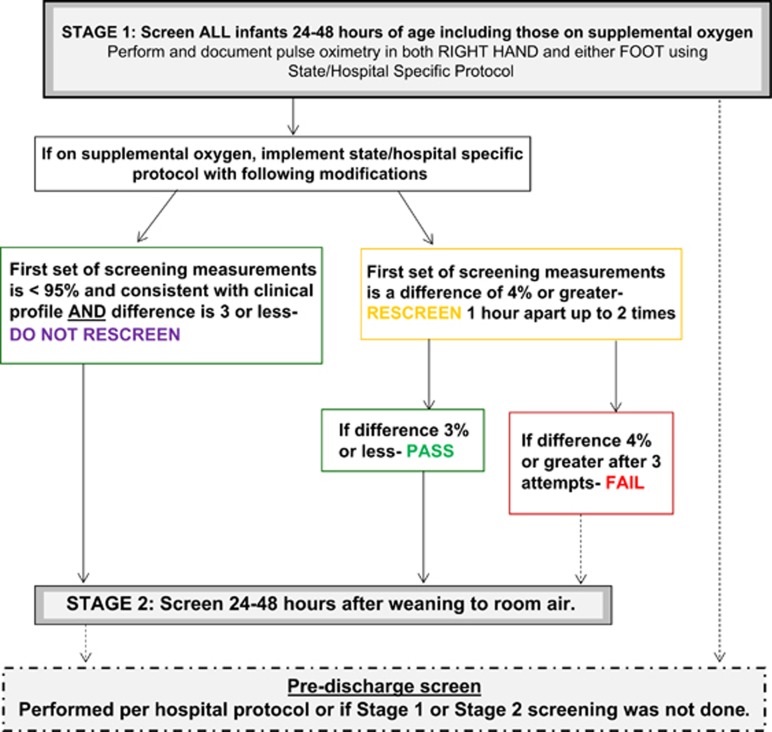
To evaluate the implementation of early screening for critical congenital heart defects (CCHDs) in the neonatal intensive care unit (NICU) and potential exclusion of sub-populations from universal screening.
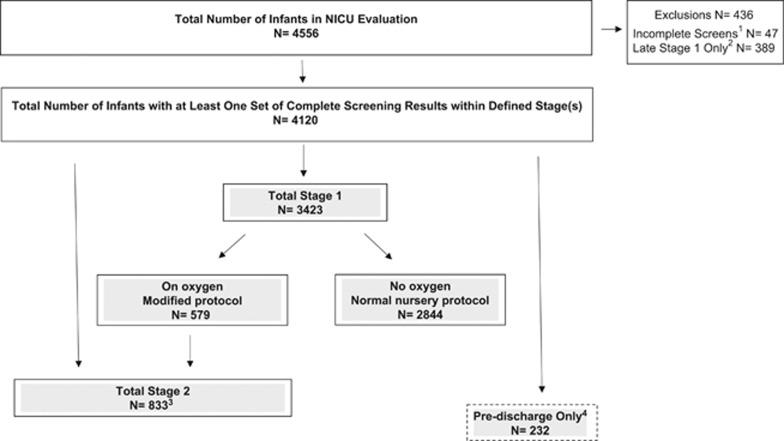
Prospective evaluation of CCHD screening at multiple time intervals was conducted in 21 NICUs across five states (n=4556 infants).
Of the 4120 infants with complete screens, 92% did not have prenatal CHD diagnosis or echocardiography before screening, 72% were not receiving oxygen at 24 to 48 h and 56% were born ⩾2500 g. Thirty-seven infants failed screening (0.9%); none with an unsuspected CCHD. False positive rates were low for infants not receiving oxygen (0.5%) and those screened after weaning (0.6%), yet higher among infants born at <28 weeks (3.8%). Unnecessary echocardiograms were minimal (0.2%).
Given the majority of NICU infants were ⩾2500 g, not on oxygen and not preidentified for CCHD, systematic screening at 24 to 48 h may be of benefit for early detection of CCHD with minimal burden.
评估新生儿重症监护病房(NICU)中对严重先天性心脏病(CCHD)进行早期筛查的实施情况,以及从普遍筛查中潜在排除亚人群的情况。
在五个州的21个新生儿重症监护病房对CCHD筛查进行了多个时间间隔的前瞻性评估(n = 4556名婴儿)。
在4120名完成筛查的婴儿中,92%在筛查前没有产前先天性心脏病诊断或超声心动图检查,72%在24至48小时未吸氧,56%出生体重≥2500克。37名婴儿筛查未通过(0.9%);无一例患有未被怀疑的CCHD。未吸氧婴儿(0.5%)和断奶后筛查的婴儿(0.6%)的假阳性率较低,但在孕周<28周的婴儿中较高(3.8%)。不必要的超声心动图检查极少(0.2%)。
鉴于大多数新生儿重症监护病房的婴儿出生体重≥2500克、未吸氧且未预先确定患有CCHD,在24至48小时进行系统筛查可能有助于以最小负担早期检测CCHD。