Kim Hosu, Kim Tae Hyuk, Kim Hye In, Park So Young, Kim Young Nam, Kim Seonwoo, Kim Min-Ji, Jin Sang-Man, Hur Kyu Yeon, Kim Jae Hyeon, Lee Moon-Kyu, Min Yong-Ki, Chung Jae Hoon, Kang Mira, Kim Sun Wook
Division of Endocrinology & Metabolism, Department of Medicine, Thyroid Center, Samsung Medical Center, Sungkyunkwan University School of Medicine, Seoul, Korea.
Division of Endocrinology, Department of Medicine, Gyeongsang National University Changwon Hospital, Changwon, Korea.
PLoS One. 2017 Jul 27;12(7):e0182090. doi: 10.1371/journal.pone.0182090. eCollection 2017.
The effect of subclinical thyroid dysfunction on vascular atherosclerosis remains uncertain. The objective of this study was to elucidate the association between sustained subclinical thyroid dysfunction and carotid plaques, which are an early surrogate marker of systemic atherosclerosis.
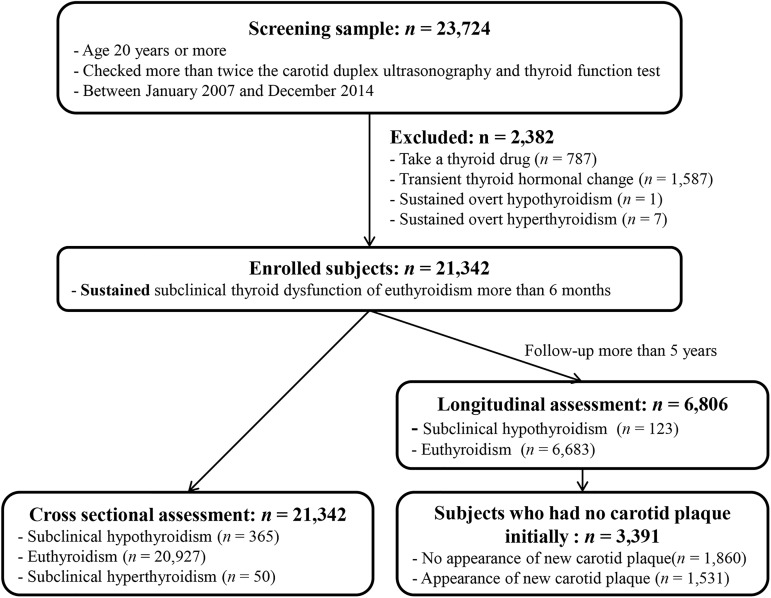
The study included 21,342 adults with consistent thyroid hormonal status on serial thyroid function tests (TFTs) and carotid artery duplex ultrasonography at a health screening center between 2007 and 2014. The effect of subclinical thyroid dysfunction on baseline carotid plaques and newly developed carotid plaques during 5-year follow-up was determined by logistic regression analyses and GEE (Generalized Estimating Equations), respectively.
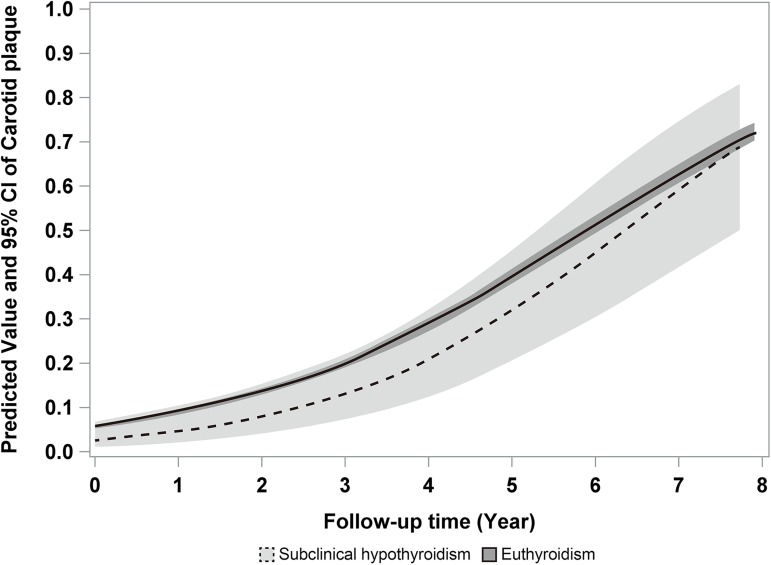
Carotid plaques were more common in the subclinical hypothyroidism (55.6%) than the euthyroidism (47.8%) at baseline. However, in multivariable analysis, thyroid status was not a significant risk for the carotid plaques at baseline. Instead, traditional cardiovascular risk factors, such as age (P <0.001), systolic blood pressure (P = 0.023), fasting blood glucose (P = 0.030), and creatinine (P = 0.012) were associated with baseline carotid plaques in subclinical hypothyroidism. In longitudinal analyses of subjects who were followed up for more than 5 years, there was no significant difference in the cumulative incidence of new carotid plaques according to time between subjects with subclinical hypothyroidism and those with euthyroidism (P = 0.392).
Sustained subclinical thyroid dysfunction did not affect the baseline or development of carotid plaques in healthy individuals.
亚临床甲状腺功能障碍对血管动脉粥样硬化的影响仍不确定。本研究的目的是阐明持续性亚临床甲状腺功能障碍与颈动脉斑块之间的关联,颈动脉斑块是系统性动脉粥样硬化的早期替代标志物。
该研究纳入了2007年至2014年间在一家健康筛查中心进行系列甲状腺功能测试(TFT)且甲状腺激素状态一致以及接受颈动脉双功超声检查的21342名成年人。亚临床甲状腺功能障碍对基线颈动脉斑块以及5年随访期间新出现的颈动脉斑块的影响分别通过逻辑回归分析和广义估计方程(GEE)来确定。
在基线时,亚临床甲状腺功能减退患者中颈动脉斑块(55.6%)比甲状腺功能正常患者(47.8%)更常见。然而,在多变量分析中,甲状腺状态不是基线时颈动脉斑块的显著风险因素。相反,传统心血管危险因素,如年龄(P<0.001)、收缩压(P = 0.023)、空腹血糖(P = 0.030)和肌酐(P = 0.012)与亚临床甲状腺功能减退患者的基线颈动脉斑块相关。在对随访超过5年的受试者进行的纵向分析中,亚临床甲状腺功能减退患者和甲状腺功能正常患者之间新颈动脉斑块的累积发病率随时间无显著差异(P = 0.392)。
持续性亚临床甲状腺功能障碍对健康个体的基线颈动脉斑块或其发展没有影响。