Department of Nephrology and Endocrinology, Dongzhimen Hospital, Beijing University of Chinese Medicine, Beijing, China.
Department of Respiratory Disease, Dongzhimen Hospital, Beijing University of Chinese Medicine, Beijing, China.
Front Endocrinol (Lausanne). 2024 Mar 22;15:1345267. doi: 10.3389/fendo.2024.1345267. eCollection 2024.
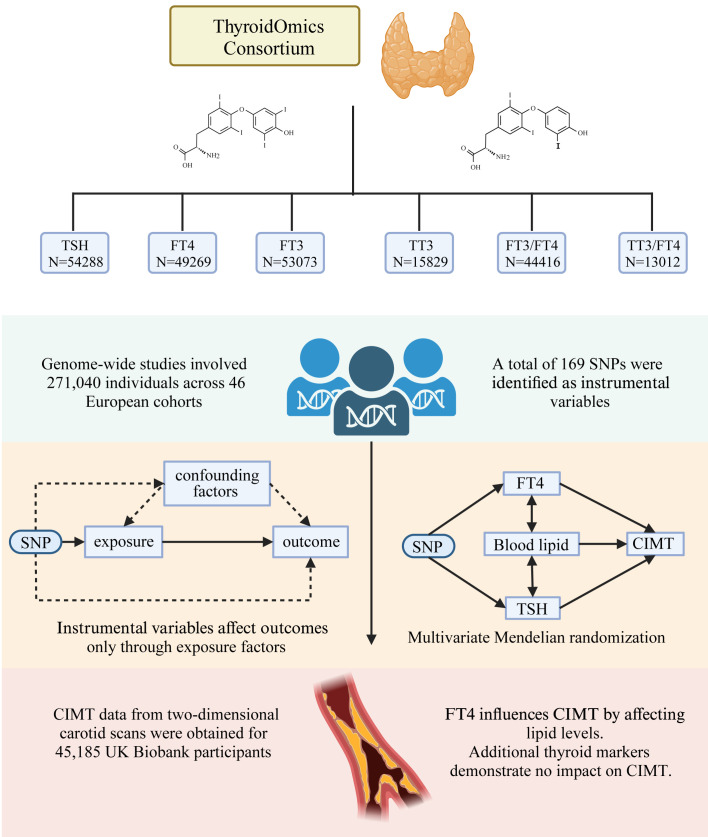
Carotid Intima-Media Thickness (CIMT) is a key marker for atherosclerosis, with its modulation being crucial for cardiovascular disease (CVD) risk assessment. While thyroid function's impact on cardiovascular health is recognized, the causal relationship and underlying mechanisms influencing CIMT remain to be elucidated.
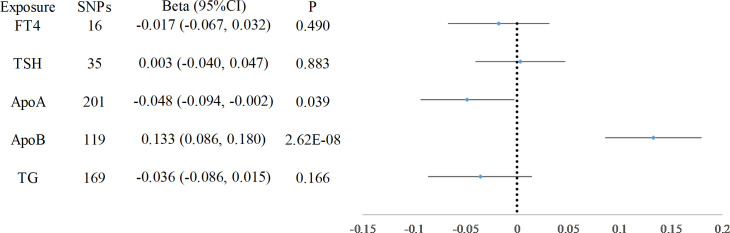
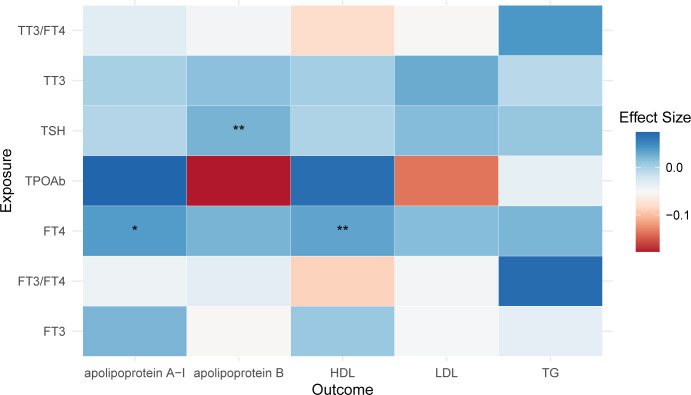
In this study, Mendelian Randomization (MR) was employed to assess the causal relationship between thyroid function and CIMT. Thyroid hormone data were sourced from the Thyroidomics Consortium, while lipid traits and CIMT measurements were obtained from the UK Biobank. The primary analysis method was a two-sample MR using multiplicative random effects inverse variance weighting (IVW-MRE). Additionally, the study explored the influence of thyroid hormones on lipid profiles and assessed their potential mediating role in the thyroid function-CIMT relationship through multivariate MR analysis.
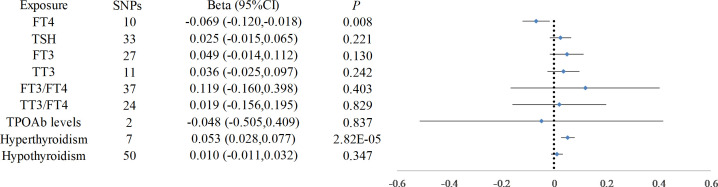
The study revealed that lower levels of Free Thyroxine (FT4) within the normal range are significantly associated with increased CIMT. This association was not observed with free triiodothyronine (FT3), thyroid-stimulating hormone (TSH), or TPOAb. Additionally, mediation analysis suggested that apolipoprotein A-I and B are involved in the relationship between thyroid function and CIMT. The findings indicate a potential U-shaped curve relationship between FT4 levels and CIMT, with thyroid hormone supplementation in hypothyroid patients showing benefits in reducing CIMT.
This research establishes a causal link between thyroid function and CIMT using MR methods, underscoring the importance of monitoring thyroid function for early cardiovascular risk assessment. The results advocate for the consideration of thyroid hormone supplementation in hypothyroid patients as a strategy to mitigate the risk of carotid atherosclerosis. These insights pave the way for more targeted approaches in managing patients with thyroid dysfunction to prevent cardiovascular complications.
颈动脉内膜-中层厚度(CIMT)是动脉粥样硬化的一个关键标志物,其调节对于心血管疾病(CVD)风险评估至关重要。虽然甲状腺功能对心血管健康的影响已得到认可,但影响 CIMT 的因果关系和潜在机制仍有待阐明。
本研究采用孟德尔随机化(MR)评估甲状腺功能与 CIMT 之间的因果关系。甲状腺激素数据来自甲状腺组学联盟,而血脂特征和 CIMT 测量值来自英国生物库。主要分析方法是使用乘法随机效应逆方差加权(IVW-MRE)的两样本 MR。此外,该研究还探讨了甲状腺激素对血脂谱的影响,并通过多变量 MR 分析评估了它们在甲状腺功能-CIMT 关系中的潜在中介作用。
研究表明,正常范围内较低的游离甲状腺素(FT4)水平与 CIMT 增加显著相关。而游离三碘甲状腺原氨酸(FT3)、促甲状腺激素(TSH)或 TPOAb 与 CIMT 无关联。此外,中介分析表明载脂蛋白 A-I 和 B 参与了甲状腺功能与 CIMT 之间的关系。研究结果表明,FT4 水平与 CIMT 之间存在潜在的 U 形曲线关系,甲状腺激素补充治疗甲状腺功能减退症患者可降低 CIMT。
本研究使用 MR 方法确立了甲状腺功能与 CIMT 之间的因果关系,强调了监测甲状腺功能对早期心血管风险评估的重要性。研究结果主张在甲状腺功能减退症患者中考虑甲状腺激素补充治疗作为降低颈动脉粥样硬化风险的策略。这些发现为管理甲状腺功能障碍患者以预防心血管并发症的更具针对性的方法铺平了道路。