Neil Samantha, Montgomery Janet, Evans Jane, Cook Gordon T, Scarre Chris
Department of Archaeology, Durham University, South Road, Durham, DH1 3LE, United Kingdom.
NERC Isotope Geosciences Laboratory, Keyworth, Nottingham, NG12 5GG, United Kingdom.
Am J Phys Anthropol. 2017 Oct;164(2):371-393. doi: 10.1002/ajpa.23279. Epub 2017 Jul 28.
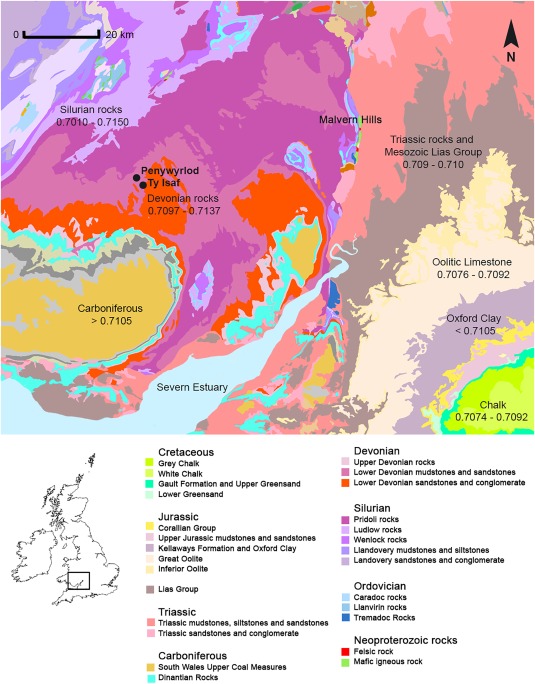
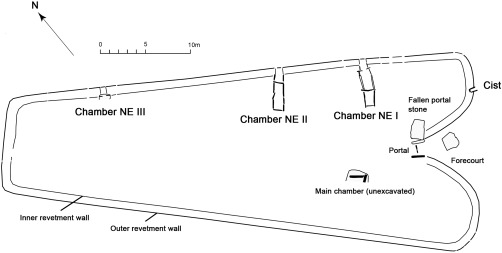
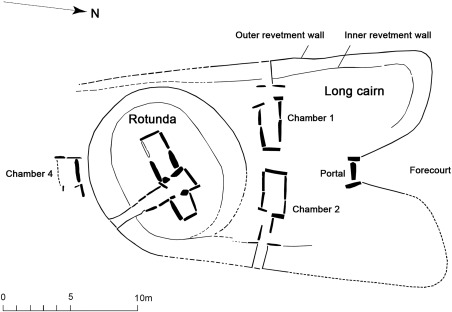
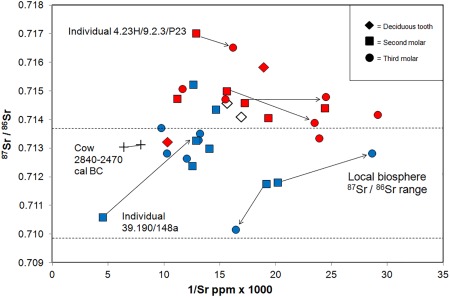
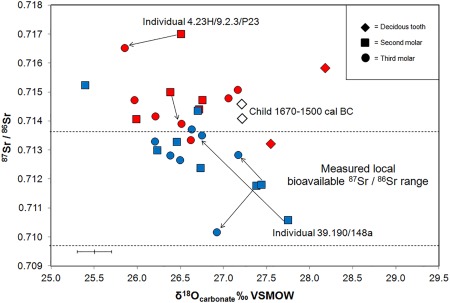
The nature of land use and mobility during the transition to agriculture has often been debated. Here, we use isotope analysis of tooth enamel from human populations buried in two different Neolithic burial monuments, Penywyrlod and Ty Isaf, in south-east Wales, to examine patterns of land use and to evaluate where individuals obtained their childhood diet.
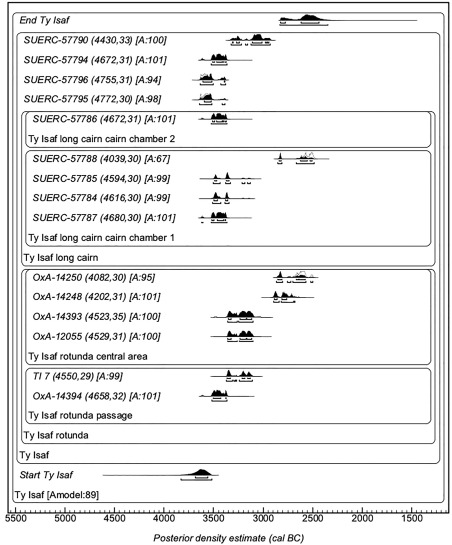
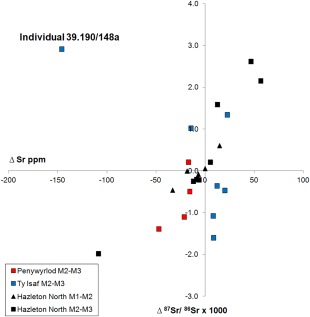
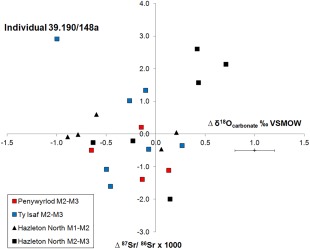
We employ strontium ( Sr/ Sr) and oxygen (δ O) and carbon (δ C) isotope analysis of enamel from adjacent molars. We compare strontium isotope values measured in enamel to locally bioavailable Sr/ Sr values. We combine discussion of these results with evaluation of new radiocarbon dates obtained from both sites.
The majority of enamel samples from Penywyrlod have strontium isotope ratios above 0.7140. In contrast, the majority of those from Ty Isaf have Sr/ Sr values below 0.7140. At Penywyrlod oxygen isotope ratios range between 25.9 and 28.2 ‰ (mean 26.7 ± 0.6 ‰, 1σ, n = 15) and enamel δ C values range between -18.0 and -15.0 ‰ (mean -16.0 ± 0.8 ‰, 1σ, n = 15). At Ty Isaf oxygen isotope ratios exhibited by Neolithic individuals range between 25.4 and 27.7 ‰ (mean 26.7 ± 0.6 ‰, 1σ, n = 15) and enamel δ C values range between -16.9 and -14.9 ‰ (mean -16.0 ± 0.6 ‰, 1σ, n = 15).
The strontium isotope results suggest that the majority of individuals buried at Penywyrlod did not source their childhood diet locally. One individual in this group has strontium isotope ratios that exceed all current known biosphere values within England and Wales. This individual is radiocarbon dated to the first few centuries of the 4 millennium BC, consistent with the period in which agriculture was initiated in Wales: the results therefore provide evidence for migration during the transition to farming in Wales. In contrast, all individuals sampled from Ty Isaf post-date the period in which agriculture is considered to have been initiated and could have sourced their childhood diet from the local region in which they were buried.
向农业过渡期间土地利用和流动性的本质一直存在争议。在此,我们对埋葬于威尔士东南部两座不同新石器时代墓葬纪念碑(佩尼维尔洛德和蒂伊萨夫)中的人类群体的牙釉质进行同位素分析,以研究土地利用模式,并评估个体童年饮食的获取地点。
我们对相邻磨牙的牙釉质进行锶(Sr/Sr)、氧(δO)和碳(δC)同位素分析。我们将牙釉质中测得的锶同位素值与当地生物可利用的Sr/Sr值进行比较。我们将这些结果的讨论与对从两个遗址获得的新放射性碳年代测定结果的评估相结合。
佩尼维尔洛德的大多数牙釉质样本的锶同位素比率高于0.7140。相比之下,蒂伊萨夫的大多数样本的Sr/Sr值低于0.7140。在佩尼维尔洛德,氧同位素比率在25.9‰至28.2‰之间(平均值26.7±0.6‰,1σ,n = 15),牙釉质δC值在 -18.0‰至 -15.0‰之间(平均值 -16.0±0.8‰,1σ,n = 15)。在蒂伊萨夫,新石器时代个体的氧同位素比率在25.4‰至27.7‰之间(平均值26.7±0.6‰,1σ,n = 15),牙釉质δC值在 -16.9‰至 -14.9‰之间(平均值 -16.0±0.6‰),1σ,n = 15)。
锶同位素结果表明,埋葬在佩尼维尔洛德的大多数个体童年饮食并非来自当地。该群体中的一个个体的锶同位素比率超过了英格兰和威尔士目前所有已知的生物圈值。这个个体的放射性碳年代测定为公元前4千年的最初几个世纪,与威尔士农业开始的时期一致:因此,这些结果为威尔士向农业过渡期间的移民提供了证据。相比之下,从蒂伊萨夫采集样本的所有个体都晚于被认为农业开始的时期,并且他们童年的饮食可能来自他们被埋葬的当地地区。