Laboratorio de Paleoecología Humana, Instituto Interdisciplinario de Ciencias Básicas (ICB), Consejo Nacional de Investigaciones Científicas y Técnicas (CONICET), Facultad de Ciencias Exactas y Naturales, Universidad Nacional de Cuyo, Mendoza, Argentina.
Facultad de Filosofía y Letras, Universidad Nacional de Cuyo, Mendoza, Argentina.
Sci Rep. 2020 Dec 3;10(1):21171. doi: 10.1038/s41598-020-78013-x.
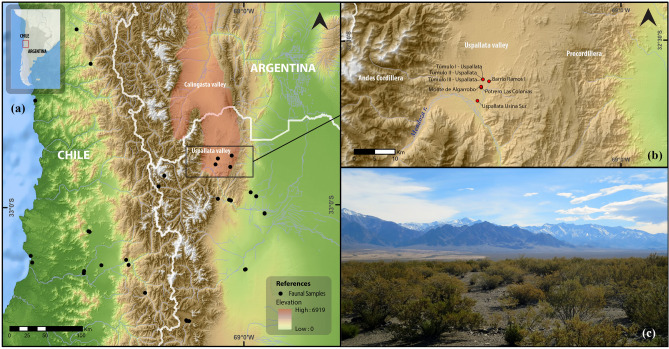
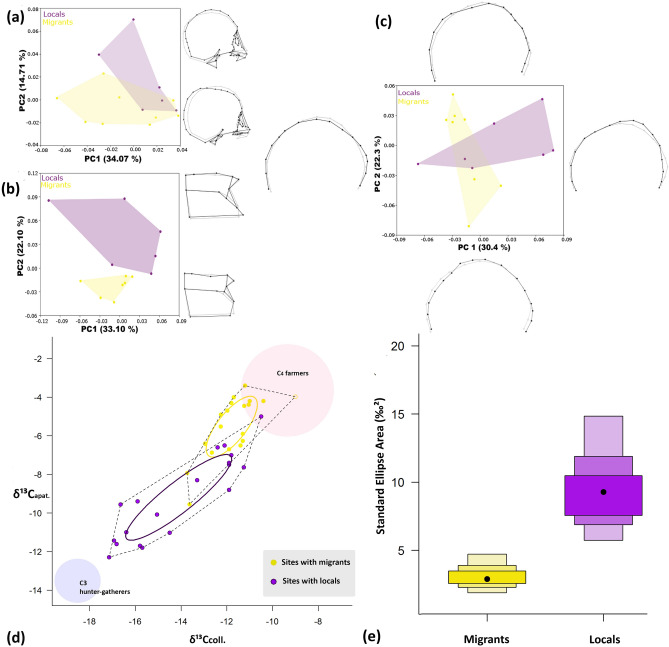
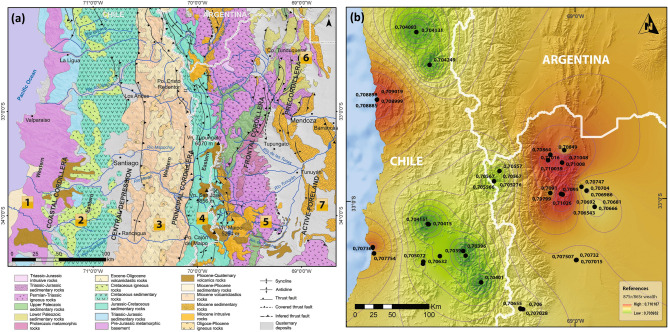
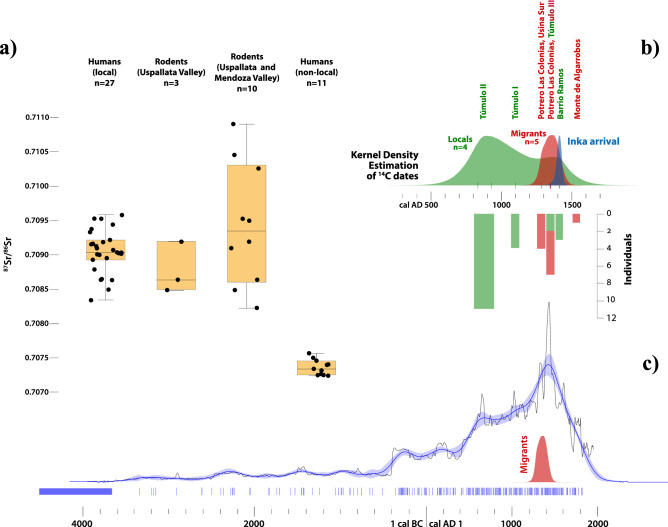
We present isotopic and morphometric evidence suggesting the migration of farmers in the southern Andes in the period AD 1270-1420, leading up to the Inka conquest occurring ~ AD 1400. This is based on the interdisciplinary study of human remains from archaeological cemeteries in the Andean Uspallata Valley (Argentina), located in the southern frontier of the Inka Empire. The studied samples span AD 800-1500, encompassing the highly dynamic Late Intermediate Period and culminating with the imperial expansion. Our research combines a macro-regional study of human paleomobility and migration based on a new strontium isoscape across the Andes that allows identifying locals and migrants, a geometric morphometric analysis of cranio-facial morphology suggesting separate ancestral lineages, and a paleodietary reconstruction based on stable isotopes showing that the migrants had diets exceptionally high in C plants and largely based on maize agriculture. Significantly, this migration influx occurred during a period of regional demographic increase and would have been part of a widespread period of change in settlement patterns and population movements that preceded the Inka expansion. These processes increased local social diversity and may have been subsequently utilized by the Inka to channel interaction with the local societies.
我们提出了同位素和形态计量学证据,表明公元 1270-1420 年间,南方安第斯山脉的农民发生了迁徙,这导致了公元 1400 年左右印加人的征服。这是基于对安第斯乌斯帕拉塔山谷(阿根廷)考古墓地人类遗骸的跨学科研究得出的,该山谷位于印加帝国的南部边界。研究样本跨越公元 800-1500 年,包括高度动态的晚期中间期,并以帝国扩张达到顶峰。我们的研究结合了基于整个安第斯山脉新的锶同位素地理景观的人类古迁移和迁移的宏观区域研究,这使得能够识别本地人和移民,颅面形态的几何形态计量分析表明存在不同的祖先谱系,以及稳定同位素的古饮食重建表明移民的饮食中 C 植物含量异常高,并且主要以玉米农业为基础。重要的是,这种移民潮发生在区域人口增长的时期,这将是印加扩张之前普遍的定居模式和人口流动变化时期的一部分。这些过程增加了当地社会的多样性,可能随后被印加人利用来引导与当地社会的互动。