Department of Archaeology, Durham University, Durham, UK.
G.I. Tarha, Departamento de Ciencias Históricas, Universidad de Las Palmas de Gran Canaria, Las Palmas, Spain.
Sci Rep. 2021 Jun 4;11(1):11857. doi: 10.1038/s41598-021-90795-2.
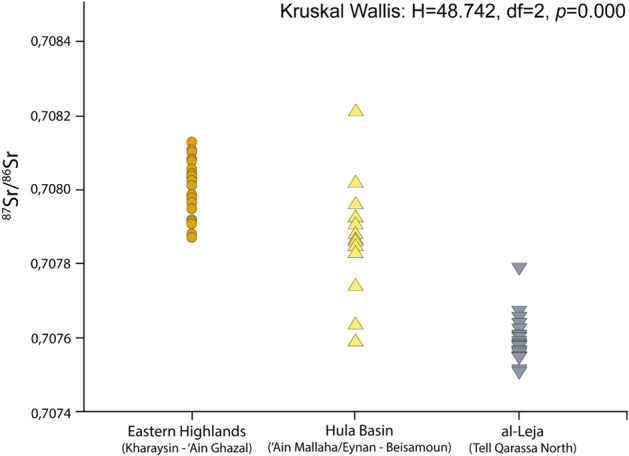
Human mobility and migration are thought to have played essential roles in the consolidation and expansion of sedentary villages, long-distance exchanges and transmission of ideas and practices during the Neolithic transition of the Near East. Few isotopic studies of human remains dating to this early complex transition offer direct evidence of mobility and migration. The aim of this study is to identify first-generation non-local individuals from Natufian to Pre-Pottery Neolithic C periods to explore the scope of human mobility and migration during the Neolithic transition in the Southern Levant, an area that is central to this historical process. The study adopted a multi-approach resorting to strontium (Sr/Sr), oxygen (δ18O) and carbon (δC) isotope ratio analyses of tooth enamel of 67 human individuals from five sites in Jordan, Syria, and Israel. The isotope ratios point both to a significant level of human migration and/or mobility in the Final Natufian which is compatible with early sedentarism and seasonal mobility and with population aggregation in early sedentary hamlets. The current findings, in turn, offer evidence that most individuals dating to the Pre-Pottery Neolithic were local to their respective settlements despite certain evidence of non-locals. Interestingly, isotopic data suggest that two possible non-local individuals benefitted from particular burial practices. The results underscore a decrease in human mobility and migration as farming became increasingly dominant among the subsistence strategies throughout the Neolithic transition of the Southern Levant.
人类的流动和迁移被认为在新石器时代近东 sedentary villages 的巩固和扩张、长距离交流以及思想和实践的传播中发挥了重要作用。很少有关于人类遗骸的同位素研究为这一早期复杂转型中的流动性和迁移提供了直接证据。本研究的目的是确定从纳图夫时期到前陶器新石器时代 C 期的第一代非本地个体,以探索新石器时代转型期间人类在黎凡特南部(这一历史进程的核心地区)的流动和迁移范围。该研究采用了一种多方法的方法,对来自约旦、叙利亚和以色列的五个地点的 67 个人类个体的牙齿珐琅质进行锶(Sr/Sr)、氧(δ18O)和碳(δC)同位素比分析。同位素比率不仅指向最终纳图夫时期存在显著的人类迁移和/或流动性,这与早期的定居主义和季节性流动性以及早期定居小村庄的人口聚集相兼容。反过来,目前的发现提供了证据,表明尽管有一些非本地人的证据,但大多数可追溯到前陶器新石器时代的个体都在各自的定居点附近。有趣的是,同位素数据表明,两个可能的非本地个体受益于特定的埋葬习俗。这些结果强调了随着农业在整个黎凡特南部新石器时代转型中越来越成为主导的生计策略,人类的流动和迁移减少了。