1 National Acoustic Laboratories and the HEARing CRC, Macquarie University, New South Wales, Australia.
Trends Hear. 2017 Jan-Dec;21:2331216517706395. doi: 10.1177/2331216517706395.
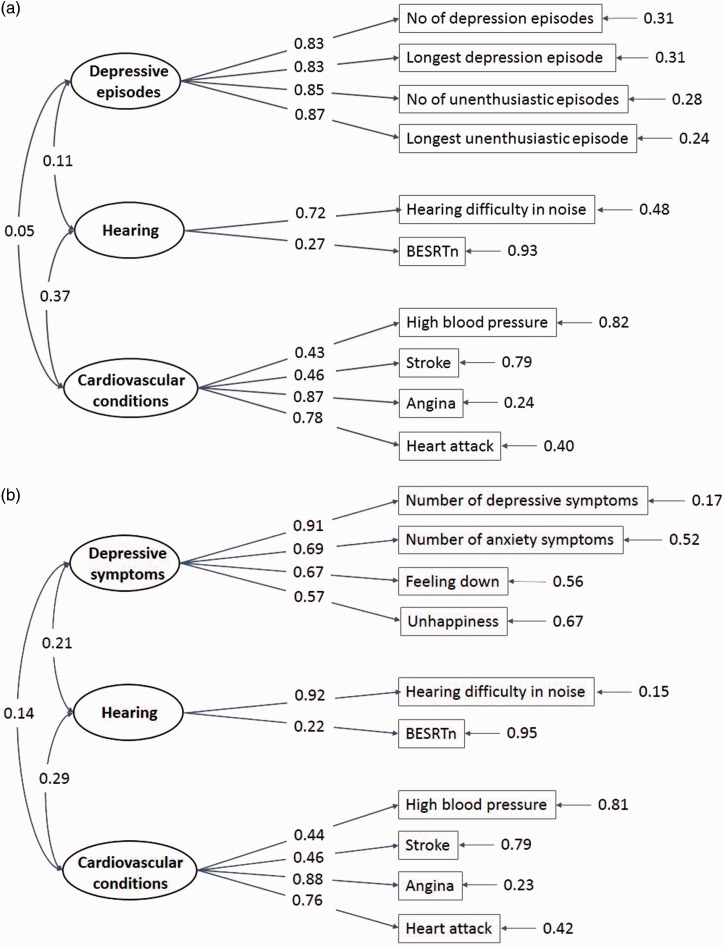
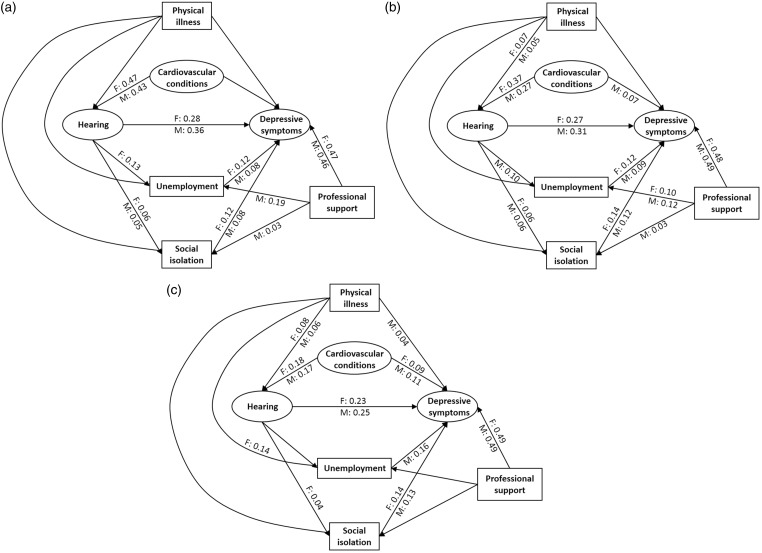
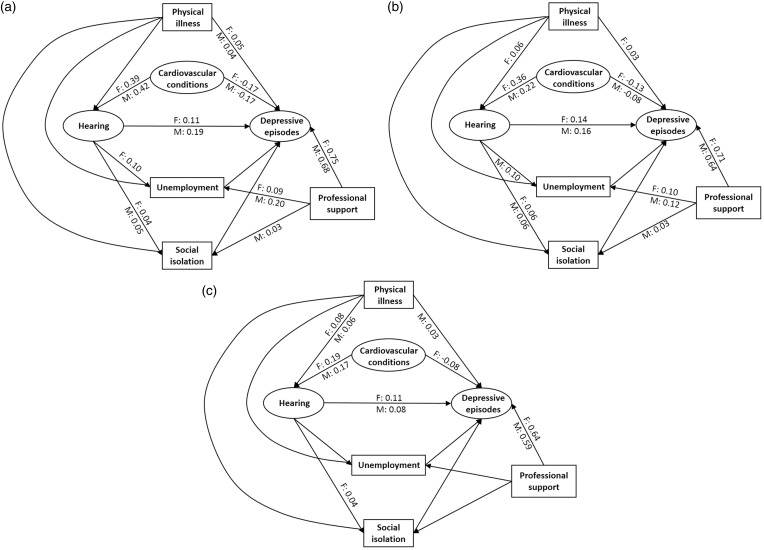
Recent epidemiological data suggest the relation between hearing difficulty and depression is more evident in younger and middle-aged populations than in older adults. There are also suggestions that the relation may be more evident in specific subgroups; that is, other factors may influence a relationship between hearing and depression in different subgroups. Using cross-sectional data from the UK Biobank on 134,357 community-dwelling people and structural equation modelling, this study examined the potential mediating influence of social isolation and unemployment and the confounding influence of physical illness and cardiovascular conditions on the relation between a latent hearing variable and both a latent depressive episodes variable and a latent depressive symptoms variable. The models were stratified by age (40s, 50s, and 60s) and gender and further controlled for physical illness and professional support in associations involving social isolation and unemployment. The latent hearing variable was primarily defined by reported hearing difficulty in noise. For all subgroups, poor hearing was significantly related to both more depressive episodes and more depressive symptoms. In all models, the direct and generally small association exceeded the indirect associations via physical health and social interaction. Significant (depressive episodes) and near significant (depressive symptoms) higher direct associations were estimated for males in their 40s and 50s than for males in their 60s. There was at each age-group no significant difference in estimated associations across gender. Irrespective of the temporal order of variables, findings suggest that audiological services should facilitate psychosocial counselling.
最近的流行病学数据表明,听力困难与抑郁之间的关系在年轻和中年人群中比在老年人群中更为明显。也有研究表明,这种关系在特定亚组中可能更为明显,也就是说,其他因素可能会影响不同亚组中听力与抑郁之间的关系。本研究使用英国生物库中 134357 名居住在社区的人群的横断面数据和结构方程模型,检验了社会隔离和失业的潜在中介影响以及身体疾病和心血管疾病对潜在听力变量与潜在抑郁发作变量和潜在抑郁症状变量之间关系的混杂影响。该模型按年龄(40 多岁、50 多岁和 60 多岁)和性别分层,并进一步控制了社会隔离和失业相关的身体疾病和专业支持。潜在的听力变量主要由报告的噪音环境中的听力困难来定义。对于所有亚组,听力差与更多的抑郁发作和更多的抑郁症状显著相关。在所有模型中,直接和通常较小的关联大于通过身体健康和社会互动的间接关联。与 60 多岁的男性相比,40 多岁和 50 多岁的男性的直接关联(抑郁发作)和接近显著的直接关联(抑郁症状)更高。在每个年龄组中,性别之间的关联估计没有显著差异。无论变量的时间顺序如何,研究结果表明,听力服务应该促进社会心理咨询。