Kang Jung-A, Chun Min Ho, Choi Su Jin, Chang Min Cheol, Yi You Gyoung
Department of Rehabilitation Medicine, Asan Medical Center, University of Ulsan College of Medicine, Seoul, Korea.
Ann Rehabil Med. 2017 Jun;41(3):347-353. doi: 10.5535/arm.2017.41.3.347. Epub 2017 Jun 29.
To investigate the effects of mirror therapy using a tablet PC for post-stroke central facial paresis.
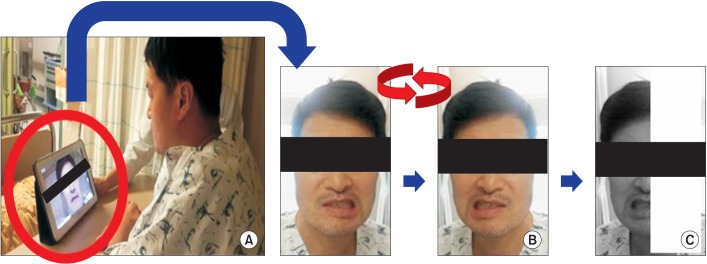
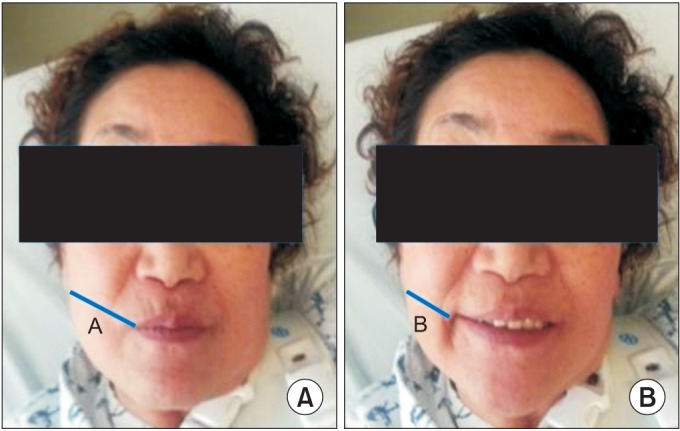
A prospective, randomized controlled study was performed. Twenty-one post-stroke patients were enrolled. All patients performed 15 minutes of orofacial exercise twice daily for 14 days. The mirror group (n=10) underwent mirror therapy using a tablet PC while exercising, whereas the control group (n=11) did not. All patients were evaluated using the Regional House-Brackmann Grading Scale (R-HBGS), and the length between the corner of the mouth and the ipsilateral earlobe during rest and smiling before and after therapy were measured bilaterally. We calculated facial movement by subtracting the smile length from resting length. Differences and ratios between bilateral sides of facial movement were evaluated as the final outcome measure.
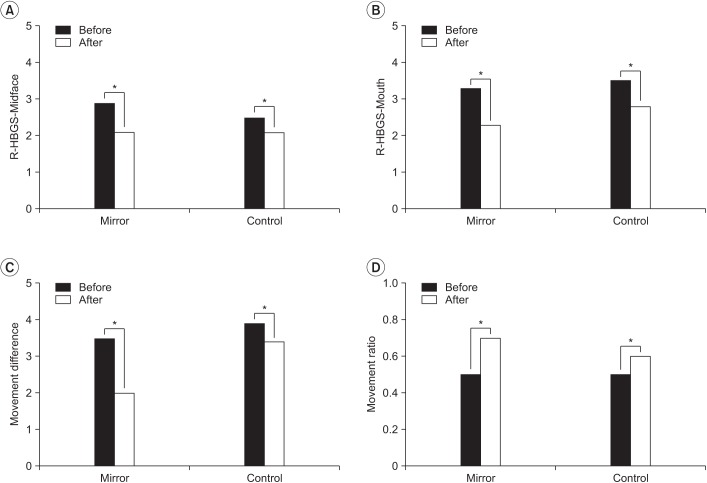
Baseline characteristics were similar for the two groups. There were no differences in the scores for the basal Modified Barthel Index, the Korean version of Mini-Mental State Examination, National Institutes of Health Stroke Scale, R-HBGS, and bilateral differences and ratios of facial movements. The R-HBGS as well as the bilateral differences and ratios of facial movement showed significant improvement after therapy in both groups. The degree of improvement of facial movement was significantly larger in the mirror group than in the control group.
Mirror therapy using a tablet PC might be an effective tool for treating central facial paresis after stroke.
探讨使用平板电脑进行镜像疗法对脑卒中后中枢性面瘫的影响。
进行一项前瞻性随机对照研究。纳入21例脑卒中后患者。所有患者每天进行两次15分钟的口面部运动,共持续14天。镜像组(n = 10)在运动时使用平板电脑进行镜像疗法,而对照组(n = 11)则不进行。所有患者均使用区域House - Brackmann分级量表(R - HBGS)进行评估,并测量治疗前后静息和微笑时双侧口角与同侧耳垂之间的长度。我们通过用静息长度减去微笑长度来计算面部运动。将面部运动双侧的差异和比率作为最终结局指标进行评估。
两组的基线特征相似。在基础改良Barthel指数、韩国版简易精神状态检查表、美国国立卫生研究院卒中量表、R - HBGS以及面部运动的双侧差异和比率得分方面,两组之间均无差异。两组治疗后R - HBGS以及面部运动的双侧差异和比率均有显著改善。镜像组面部运动的改善程度明显大于对照组。
使用平板电脑进行镜像疗法可能是治疗脑卒中后中枢性面瘫的有效工具。