Adolph Timon E, Grander Christoph, Grabherr Felix, Tilg Herbert
Department of Internal Medicine I, Gastroenterology, Hepatology & Endocrinology, Medical University Innsbruck, A-6020 Innsbruck, Austria.
Int J Mol Sci. 2017 Jul 29;18(8):1649. doi: 10.3390/ijms18081649.
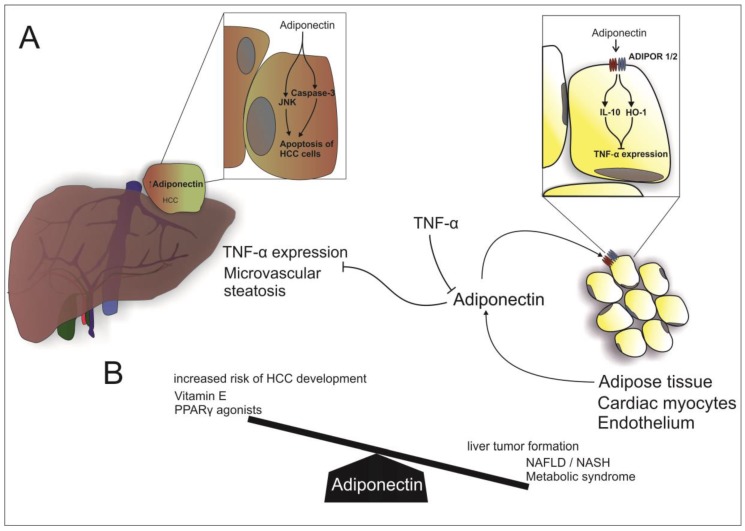
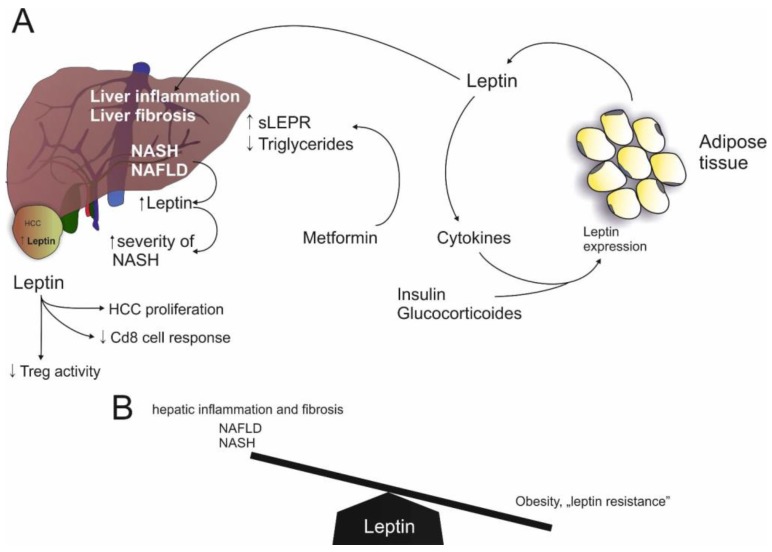
Accumulating evidence links obesity with low-grade inflammation which may originate from adipose tissue that secretes a plethora of pro- and anti-inflammatory cytokines termed adipokines. Adiponectin and leptin have evolved as crucial signals in many obesity-related pathologies including non-alcoholic fatty liver disease (NAFLD). Whereas adiponectin deficiency might be critically involved in the pro-inflammatory state associated with obesity and related disorders, overproduction of leptin, a rather pro-inflammatory mediator, is considered of equal relevance. An imbalanced adipokine profile in obesity consecutively contributes to metabolic inflammation in NAFLD, which is associated with a substantial risk for developing hepatocellular carcinoma (HCC) also in the non-cirrhotic stage of disease. Both adiponectin and leptin have been related to liver tumorigenesis especially in preclinical models. This review covers recent advances in our understanding of some adipokines in NAFLD and associated HCC.
越来越多的证据表明肥胖与低度炎症有关,这种炎症可能源于分泌大量促炎和抗炎细胞因子(称为脂肪因子)的脂肪组织。脂联素和瘦素已成为许多肥胖相关疾病(包括非酒精性脂肪性肝病,NAFLD)中的关键信号。脂联素缺乏可能与肥胖及相关疾病的促炎状态密切相关,而瘦素作为一种促炎介质,其过量产生也被认为具有同等重要性。肥胖时脂肪因子谱失衡继而导致NAFLD中的代谢性炎症,这也与疾病非肝硬化阶段发生肝细胞癌(HCC)的重大风险相关。脂联素和瘦素都与肝脏肿瘤发生有关,尤其是在临床前模型中。本综述涵盖了我们对NAFLD及相关HCC中一些脂肪因子理解的最新进展。