Müller Lisa, Gonaus Christoph, Perner Christoph, Müller Erich, Raschner Christian
Department of Sport Science, University of Innsbruck, Innsbruck, Tyrol, Austria.
Department of Sport Science and Kinesiology, University of Salzburg, Salzburg, Austria.
PLoS One. 2017 Jul 31;12(7):e0181810. doi: 10.1371/journal.pone.0181810. eCollection 2017.
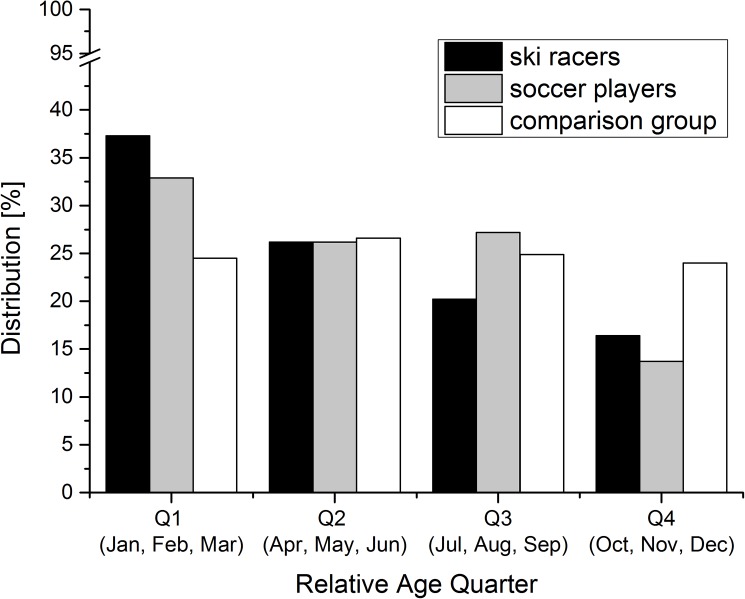
Since the relative age effect (RAE) characterizes a problem in all age categories of alpine ski racing and soccer and the fact that, yet, to date the underlying factors have not been well investigated, the aim of the present study was to assess the influence of the biological maturity status on the RAE among youth alpine ski racers (YSR) and soccer players (SP). In total, 183 male and female YSR selected for national final races and 423 male SP selected for Elite Youth Development Centres were investigated. Additionally, a comparison group of 413 non-athletes was evaluated. The birth months were split into four relative age quarters. The biological maturity status was assessed by the age at peak height velocity (APHV) method; according to the M±SD of the comparison group, the athletes were divided into normal, early and late maturing. Chi2-tests indicated a significant RAE among YSR (χ2(3,N = 183) = 18.0; p<0.001; ω = 0.31) and SP (χ2(3,N = 423) = 33.1; p<0.001; ω = 0.28). In total, only a small number of late maturing athletes were present (0.5-2.3%). Among relatively younger athletes, high percentages of early maturing athletes were found (43.1-43.3%). The findings indicate that relatively younger and less mature athletes are marginalized or totally excluded in alpine ski racing and soccer. Thus, selection criteria in both sports are effectively based on early biological development and relatively older age, both of which should be considered in future in the talent selection process. In this context, the easy feasible method of assessing the APHV can be used.
由于相对年龄效应(RAE)在高山滑雪比赛和足球运动的所有年龄组中都是一个问题,且迄今为止其潜在因素尚未得到充分研究,因此本研究的目的是评估生物成熟状态对青年高山滑雪运动员(YSR)和足球运动员(SP)中RAE的影响。总共对183名入选全国决赛的男女YSR和423名入选精英青年发展中心的男性SP进行了调查。此外,还评估了一个由413名非运动员组成的对照组。出生月份被分为四个相对年龄季度。通过身高增长峰值年龄(APHV)方法评估生物成熟状态;根据对照组的M±SD,将运动员分为正常成熟、早熟和晚熟。卡方检验表明YSR(χ2(3,N = 183) = 18.0;p<0.001;ω = 0.31)和SP(χ2(3,N = 423) = 33.1;p<0.001;ω = 0.28)中存在显著的RAE。总体而言,晚熟运动员的数量很少(0.5 - 2.3%)。在相对年轻的运动员中,早熟运动员的比例较高(43.1 - 43.3%)。研究结果表明,在高山滑雪比赛和足球运动中,相对年轻且成熟度较低的运动员被边缘化或完全排除在外。因此,这两项运动的选拔标准实际上都基于早期生物发育和相对较大的年龄,未来在人才选拔过程中应同时考虑这两个因素。在此背景下,可以使用评估APHV这种简单可行的方法。