Sher Roger B
Department of Neurobiology and Behavior, Stony Brook University, Stony Brook, NY, USA.
Neural Regen Res. 2017 Jun;12(6):902-905. doi: 10.4103/1673-5374.208564.
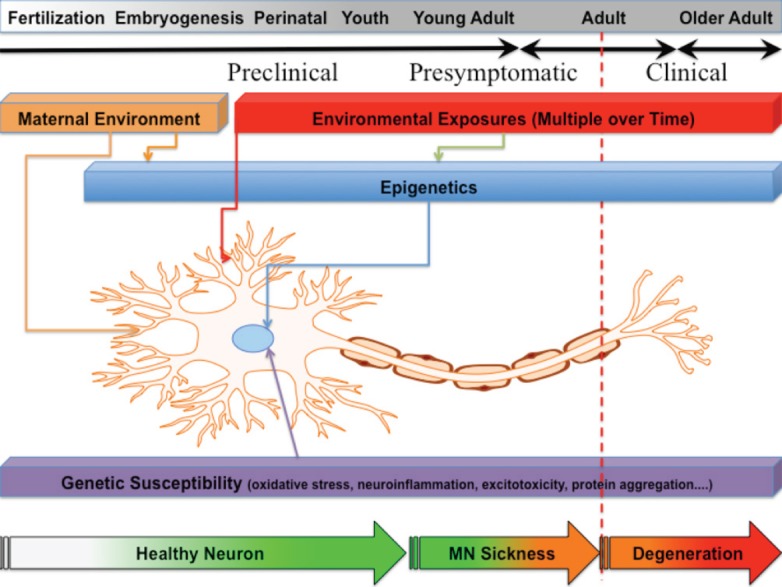
Amyotrophic lateral sclerosis (ALS) is a devastating neurodegenerative disease that results in the progressive death of motor neurons, leading to paralysis and eventual death. There is presently no cure for ALS, and only two drugs are available, neither of which provide significant extension of life. The wide variation in onset and progression of the disease, both in sporadic and even in strongly penetrant monogenic familial forms of ALS, indicate that in addition to background genetic variation impacting the disease process, environmental exposures are likely contributors. Epidemiological evidence worldwide implicates exposures to bacterial toxins, heavy metals, pesticides, and trauma as probable environmental factors. Here, we review current advances in gene-environment interactions in ALS animal models. We report our recent discoveries in a zebrafish model of ALS in relation to exposure to the cyanobacterial toxin BMAA, and discuss several results from mouse models that show interactions with exposure to mercury and statin drugs, both leading to acceleration of the disease process. The increasing research into this combinatorial gene-environment process is just starting, but shows early promise to uncover the underlying biochemical pathways that instigate the initial motor neuron defects and lead to their rapidly progressive dysfunction.
肌萎缩侧索硬化症(ALS)是一种毁灭性的神经退行性疾病,会导致运动神经元逐渐死亡,进而引发瘫痪并最终导致死亡。目前尚无治愈ALS的方法,仅有两种药物可用,但这两种药物都无法显著延长患者生命。无论是散发性ALS,还是单基因家族性ALS(即使是强外显型),其发病和进展都存在很大差异,这表明除了影响疾病进程的背景基因变异外,环境暴露也可能是致病因素。全球范围内的流行病学证据表明,接触细菌毒素、重金属、农药和创伤可能是环境因素。在此,我们综述了ALS动物模型中基因 - 环境相互作用的当前进展。我们报告了我们最近在斑马鱼ALS模型中关于接触蓝藻毒素β-甲氨基-L-丙氨酸(BMAA)的发现,并讨论了小鼠模型中的几个结果,这些结果表明与接触汞和他汀类药物存在相互作用,两者都会加速疾病进程。对这种基因 - 环境组合过程的研究日益增多,目前才刚刚起步,但已初步显示出有望揭示引发初始运动神经元缺陷并导致其快速进展性功能障碍的潜在生化途径。