Nielsen Amalie Bach, Nielsen Ole Haagen, Hendel Jakob
Department of Gastroenterology, Herlev Hospital, University of Copenhagen,Denmark.
BMJ Open Gastroenterol. 2017 Jun 1;4(1):e000142. doi: 10.1136/bmjgast-2017-000142. eCollection 2017.
Previous studies have shown colonoscopy withdrawal time (WT) to be a reliable surrogate indicator for polyp detection rate (PDR) and adenoma detection rate (ADR) in colonoscopy. Our aim was to assess the impact of feedback and monitoring of WT on PDR in routine colonoscopies with long-term follow-up.
A total of 307 colonoscopies were performed in three separate clinical scenarios. First, PDR and WT were recorded without the staff being aware of the specific objective of the study. Before the second scenario, the staff was given interventional information and feedback on WTs and PDRs from the first scenario and was encouraged to aim for a minimum WT of 8 min. Retention of knowledge gained was reassessed in the third scenario 1 year later.
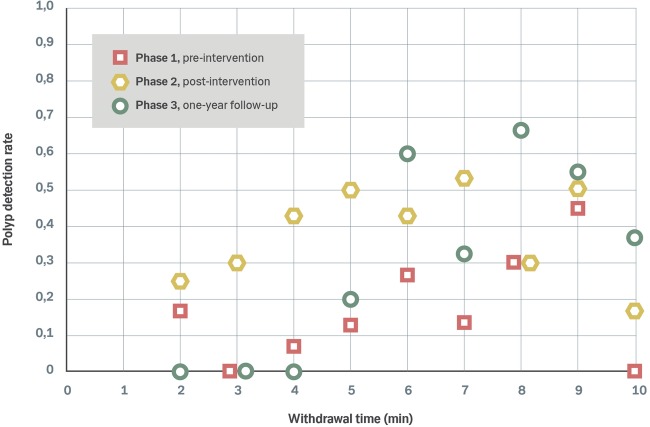
The PDR in the first two scenarios differed significantly (p<0.01), with a more than 90% increase in PDR after intervention from 22% to 42% (95% CI 1.44 to 4.95), although the mean WT did not change (6.8 vs 7.2 min; p>0.05). The increase in PDR between the first and second scenarios was retained in the third follow-up scenario 1 year later where the WT of both polyp-positive and polyp-negative colonoscopies was found to be longer.
PDR almost doubled from the first to the second scenario of a real-life colonoscopy setting, indicating that awareness of WT is crucial. The knowledge gained from this intervention in routine practice was even retained after a year.
既往研究表明,结肠镜检查的退镜时间(WT)是结肠镜检查中息肉检出率(PDR)和腺瘤检出率(ADR)的可靠替代指标。我们的目的是评估在长期随访的常规结肠镜检查中,WT的反馈和监测对PDR的影响。
在三种不同的临床场景下共进行了307例结肠镜检查。首先,在工作人员不知道该研究具体目的的情况下记录PDR和WT。在第二种场景之前,向工作人员提供了来自第一种场景的关于WT和PDR的干预信息及反馈,并鼓励他们将最短WT目标设定为8分钟。1年后在第三种场景中重新评估所获得知识的保留情况。
前两种场景下的PDR有显著差异(p<0.01),干预后PDR增加了90%以上,从22%增至42%(95%CI 1.44至4.95),尽管平均WT没有变化(6.8对7.2分钟;p>0.05)。第一种和第二种场景之间PDR的增加在1年后的第三次随访场景中得以保持,在该场景中发现息肉阳性和息肉阴性结肠镜检查的WT均更长。
在现实生活中的结肠镜检查场景中,从第一种场景到第二种场景,PDR几乎翻倍,这表明对WT的认知至关重要。在常规实践中从这种干预中获得的知识甚至在一年后仍得以保留。