Belavý Daniel L, Ohshima Hiroshi, Rittweger Jörn, Felsenberg Dieter
Centre of Muscle and Bone Research, Charité Universitätsmedizin Berlin, Hindenburgdamm, Berlin, Germany.
School of Exercise and Nutrition Sciences, Institute for Physical Activity and Nutrition, Deakin University, Burwood, Victoria, Australia.
BMJ Open Sport Exerc Med. 2017 Jul 24;3(1):e000196. doi: 10.1136/bmjsem-2016-000196. eCollection 2017.
To investigate differential muscle atrophy during bed-rest, the impact of a high-intensity concentric-eccentric (flywheel) resistance exercise countermeasure and muscle recovery after bed-rest.
Twenty-five healthy male subjects underwent 90 dayshead-down tilt bed-rest. Volume of individual lower-limb muscles was measured via MRI before, twice during and four times up to 1 year after bed-rest. Subjects were either inactive (n=16) or performed flywheel exercise every third day of bed-rest (n=9). Functional performance was assessed via countermovement jump.
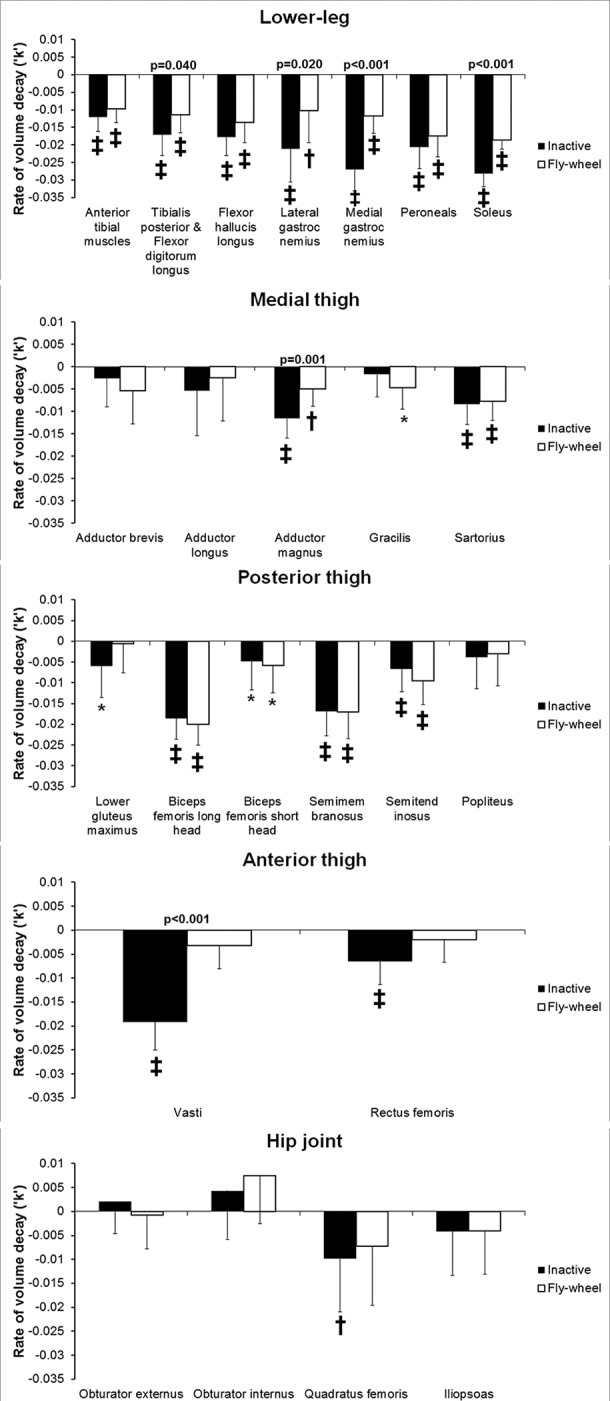
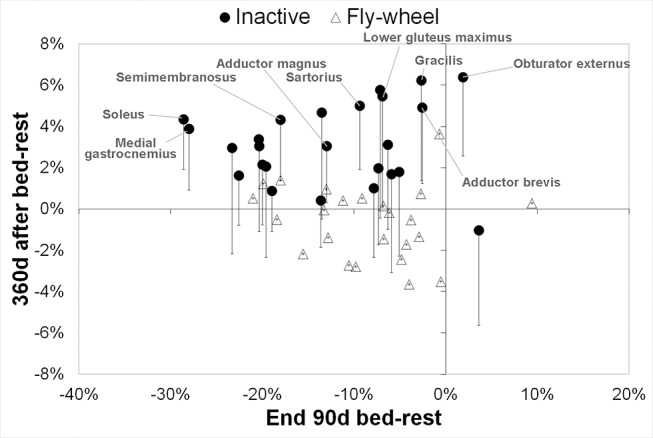
On 'intent-to-treat' analysis, flywheel prevented atrophy in the vasti (p<0.001) and reduced atrophy in the hip adductor/extensor adductor magnus (p=0.001) and ankle dorsiflexors/toe flexors (soleus (p<0.001), gastrocnemius medialis (p<0.001), gastrocnemius lateralis (p=0.02), and tibialis posterior with flexor digitorum longus (p=0.04)). Flywheel exercise was not effective for the hamstrings, gracilis, sartorius, peroneals and anterior tibial muscles. Muscle atrophy in vasti, soleus, gastrocnemius medialis, gastrocnemius lateralis and adductor magnus correlated with losses in countermovement jump performance. Muscle volume recovered within 90 days after bed-rest, however long-term after bed-rest, the inactive subjects only showed significantly increased muscle volume versus prebed-rest in a number of muscles including soleus (+4.3%), gastrocnemius medialis (+3.9%) and semimembranosus (+4.3%). This was not associated with greater countermovement jump performance.
The exercise countermeasure was effective in preventing or reducing atrophy in the vasti, adductor magnus and ankle dorsiflexors/toe flexors but not the hamstrings, medial thigh muscles or peroneals and dorsiflexor muscles.
NCT00311571; results.
研究卧床休息期间的肌肉萎缩差异、高强度向心-离心(飞轮)抗阻运动对策的影响以及卧床休息后的肌肉恢复情况。
25名健康男性受试者接受了90天的头低位卧床休息。在卧床休息前、期间两次以及卧床休息后长达1年的时间内,通过磁共振成像(MRI)测量各个下肢肌肉的体积。受试者分为不进行运动组(n = 16)或在卧床休息的每第三天进行飞轮运动组(n = 9)。通过纵跳评估功能表现。
在“意向性分析”中,飞轮运动可防止股四头肌萎缩(p < 0.001),并减少髋内收肌/内收大肌萎缩(p = 0.001)以及踝背屈肌/趾屈肌萎缩(比目鱼肌(p < 0.001)、腓肠肌内侧头(p < 0.001)、腓肠肌外侧头(p = 0.02)以及胫骨后肌与趾长屈肌(p = 0.04))。飞轮运动对腘绳肌、股薄肌、缝匠肌、腓骨肌和胫骨前肌无效。股四头肌、比目鱼肌、腓肠肌内侧头、腓肠肌外侧头和内收大肌的肌肉萎缩与纵跳表现的下降相关。卧床休息后90天内肌肉体积恢复,但在卧床休息后的长期阶段,不进行运动的受试者仅在包括比目鱼肌(+4.3%)、腓肠肌内侧头(+3.9%)和半膜肌(+4.3%)在内的一些肌肉中显示出与卧床休息前相比显著增加的肌肉体积。这与更好的纵跳表现无关。
运动对策可有效预防或减少股四头肌、内收大肌和踝背屈肌/趾屈肌的萎缩,但对腘绳肌、大腿内侧肌肉、腓骨肌和背屈肌无效。
NCT00311571;结果