Henon Clémence, Lissa Delphine, Paoletti Xavier, Thibault Constance, Le Tourneau Christophe, Lanoy Emilie, Hollebecque Antoine, Massard Christophe, Soria Jean-Charles, Postel-Vinay Sophie
Drug Development department (DITEP), Gustave Roussy Cancer Campus, Paris-Saclay University, Villejuif, France.
Biostatistics and Epidemiology Department, Gustave Roussy Cancer Campus, Villejuif, France.
ESMO Open. 2017 Jun 23;2(2):e000148. doi: 10.1136/esmoopen-2016-000148. eCollection 2017.
Phase I experts recommend revisiting dose-limiting toxicity (DLT) definition to include chronic and cumulative toxicities induced by new molecularly targeted therapies. Patient's assessment of late toxicities' tolerability is, however, unknown.
A prospective survey on adverse events (AEs) tolerability on 23 National Cancer InstituteCommon Terminology Criteria for Adverse Event, Version 4 (NCI-CTCAE.v4) items was conducted at Gustave Roussy's Phase I department. Patients' maximum tolerability duration was recorded at baseline, during trial and at trial completion. Results were compared with the corresponding physicians' survey.
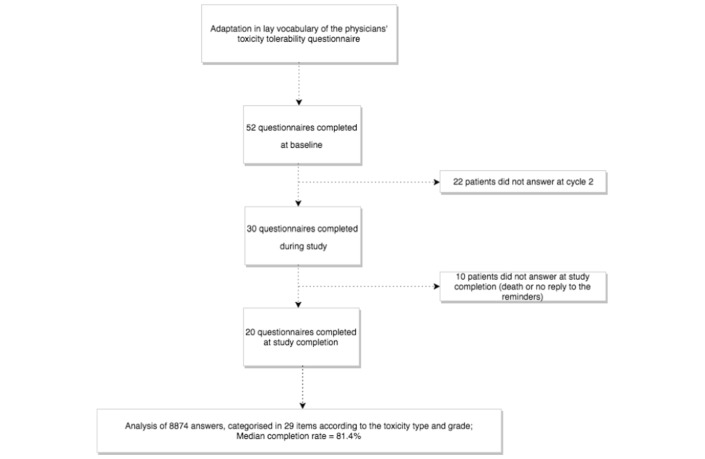
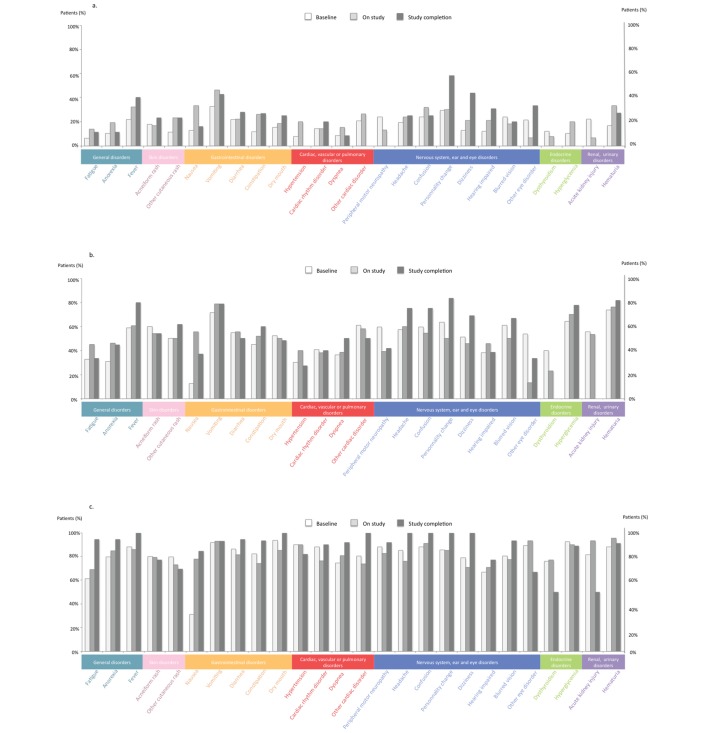
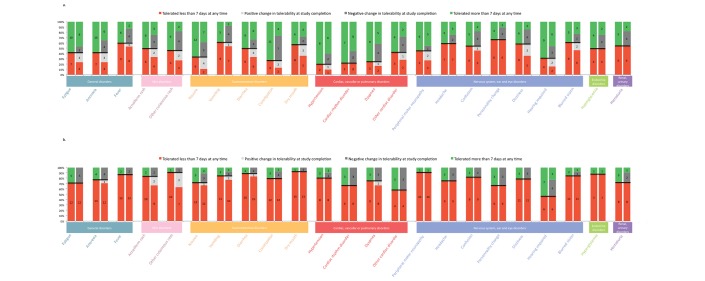
52 patients enrolled in 27 Phase I trials between May 2014 and November 2015 completed 102 forms. At baseline, the most feared G2/G3 AEs were haematuria (74%), vomiting (71%) and hyperglycemia (64%)/dry mouth (94%), hyperglycemia (92%) and vomiting (92%). At trial completion, the most feared G2/G3 AEs were personality change (83.3%), haematuria (82%) and fever (80%)/dry mouth, fever and dizziness (100% each). Tolerability score did not differ over time. More previous treatments and occurrence of severe AEs were associated with better tolerability at study completion (p=0.0234 and p=0.0153, respectively, in multivariate analysis). Patient's tolerability differed from physician's assessment.
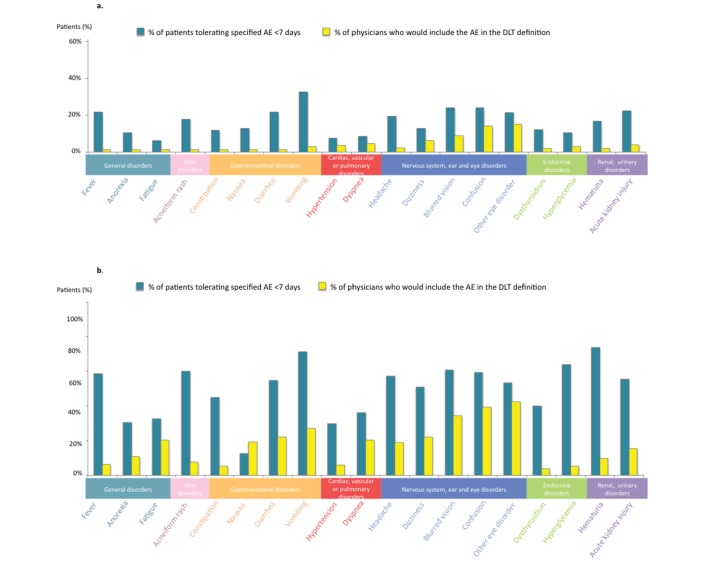
AEs considered intolerable by patients are toxicities that directly impact their quality of life and differ from those feared by physicians or included in DLT definition. Patient-reported tolerability of AEs may help in optimising drug development.
I期临床试验专家建议重新审视剂量限制毒性(DLT)的定义,将新的分子靶向疗法所诱导的慢性和累积毒性纳入其中。然而,患者对晚期毒性耐受性的评估尚不清楚。
在古斯塔夫·鲁西I期临床试验部门,针对23项美国国立癌症研究所不良事件通用术语标准第4版(NCI-CTCAE.v4)项目进行了一项关于不良事件(AE)耐受性的前瞻性调查。在基线期、试验期间和试验结束时记录患者的最大耐受持续时间。将结果与相应医生的调查结果进行比较。
2014年5月至2015年11月期间,52名患者参与了27项I期临床试验,共完成102份表格。在基线期,最令人担忧的2/3级AE为血尿(74%)、呕吐(71%)以及高血糖(64%)/口干(94%)、高血糖(92%)和呕吐(92%)。试验结束时,最令人担忧的2/3级AE为性格改变(83.3%)、血尿(82%)和发热(80%)/口干、发热和头晕(均为100%)。耐受性评分随时间无差异。在多因素分析中,既往治疗次数越多以及严重AE的发生与试验结束时更好的耐受性相关(分别为p=0.0234和p=0.0153)。患者的耐受性与医生的评估不同。
患者认为无法耐受的AE是直接影响其生活质量的毒性,与医生所担忧的或DLT定义中所包含的不同。患者报告的AE耐受性可能有助于优化药物研发。