Guo Jia, Liu Changmei, Zhou Xiaoman, Xu Xiaoqiang, Deng Linhong, Li Xiang, Guan Feng
Institute of Biomedical Engineering and Health Sciences, Changzhou University, Changzhou 213164, China.
Key Laboratory of Carbohydrate Chemistry and Biotechnology, Ministry of Education, School of Biotechnology, Jiangnan University, Wuxi 214122, China.
Int J Mol Sci. 2017 Aug 1;18(8):1528. doi: 10.3390/ijms18081528.
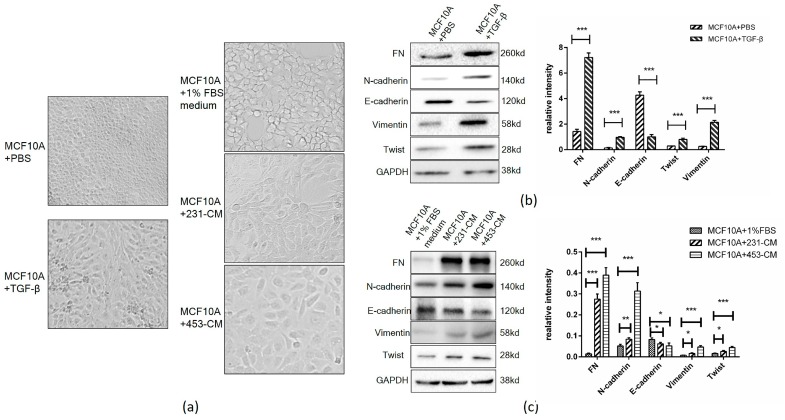
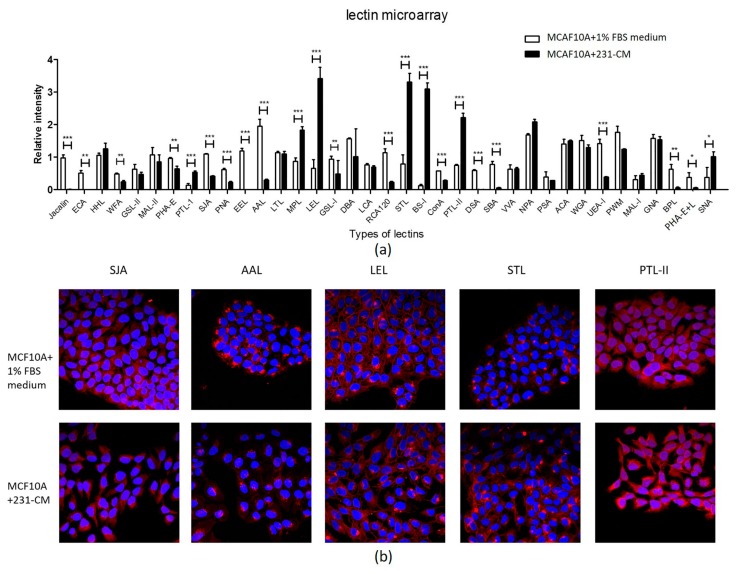
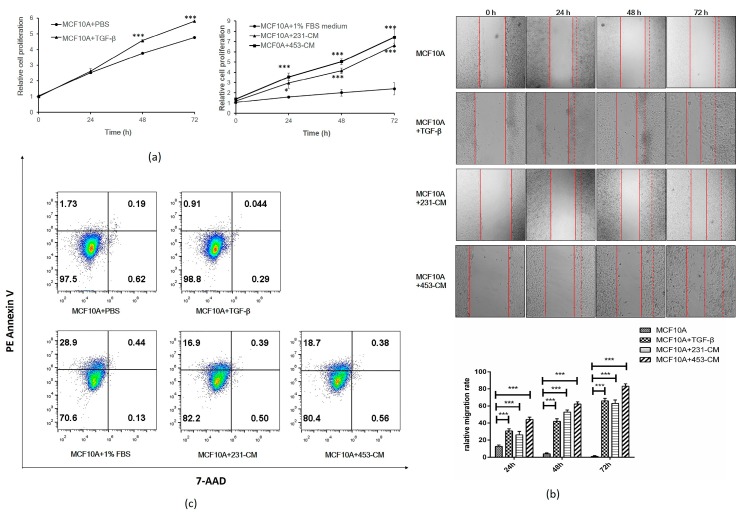
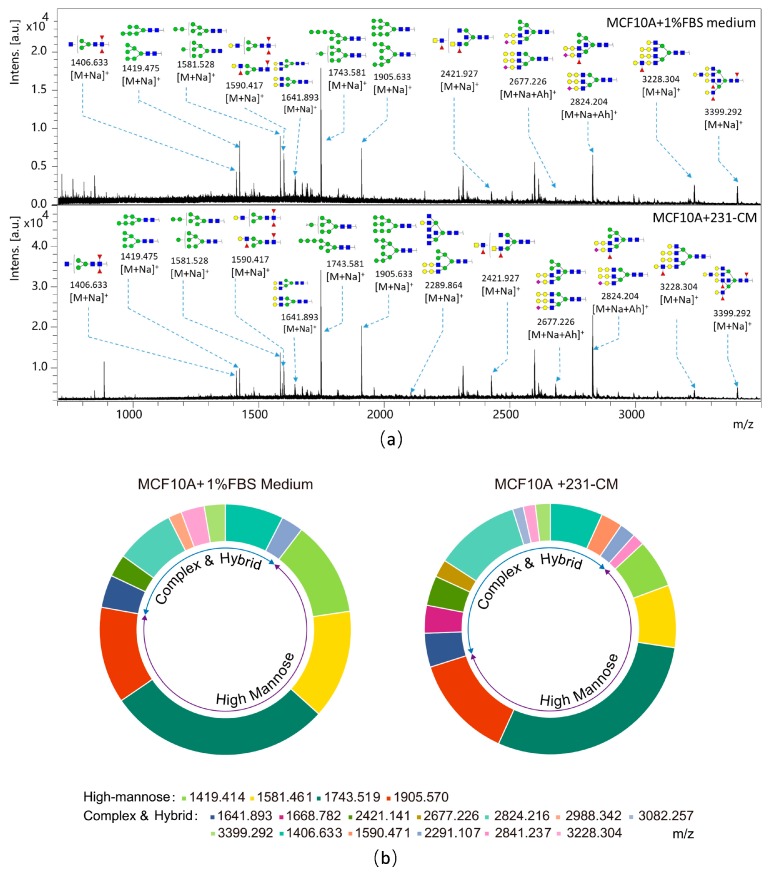
Epithelial-mesenchymal transition (EMT) is a key process in cancer development and progression. Communication (crosstalk) between cancer cells and normal (nonmalignant) cells may facilitate cancer progression. Conditioned medium (CM) obtained from cultured cancer cells contains secreted factors capable of affecting phenotypes and the behaviors of normal cells. In this study, a culture of normal breast epithelial MCF10A cells with CM from malignant breast cancer cells (termed 231-CM and 453-CM) resulted in an alteration of morphology. CM-treated MCF10A, in comparison with control cells, showed a reduced expression of the epithelial marker E-cadherin, increased expression of the mesenchymal markers fibronectin, vimentin, -cadherin, and TWIST1, meanwhile cell proliferation and migration were enhanced while cell apoptosis was decreased. -glycan profiles of 231-CM-treated and control MCF10A cells were compared by MALDI-TOF/TOF-MS (Matrix-Assisted Laser Desorption/ Ionization Time of Flight Mass Spectrometry) and a lectin microarray analysis. The treated cells showed lower levels of high-mannose-type -glycan structures, and higher levels of complex-type and hybrid-type structures. Altered -glycan profiles were also detected in 453-CM-treated and non-treated MCF10A cells by MALDI-TOF/TOF-MS, and we found that the expression of five fucosylated -glycan structures (/ 1406.663, 1590.471, 1668.782, 2421.141, and 2988.342) and one high-mannose structure / 1743.722 have the same pattern as 231-CM-treated MCF10A cells. Our findings, taken together, show that CM derived from breast cancer cells induced an EMT-like process in normal epithelial cells and altered their -glycan profile.
上皮-间质转化(EMT)是癌症发生和发展的关键过程。癌细胞与正常(非恶性)细胞之间的通讯(相互作用)可能促进癌症进展。从培养的癌细胞中获得的条件培养基(CM)含有能够影响正常细胞表型和行为的分泌因子。在本研究中,用恶性乳腺癌细胞的CM(称为231-CM和453-CM)培养正常乳腺上皮MCF10A细胞导致形态改变。与对照细胞相比,经CM处理的MCF10A细胞显示上皮标志物E-钙黏蛋白表达降低,间质标志物纤连蛋白、波形蛋白、N-钙黏蛋白和TWIST1表达增加,同时细胞增殖和迁移增强而细胞凋亡减少。通过基质辅助激光解吸/电离飞行时间质谱(MALDI-TOF/TOF-MS)和凝集素微阵列分析比较了经231-CM处理和对照的MCF10A细胞的N-聚糖谱。处理后的细胞显示高甘露糖型N-聚糖结构水平较低,而复合型和杂合型结构水平较高。通过MALDI-TOF/TOF-MS在经453-CM处理和未处理的MCF10A细胞中也检测到了改变的N-聚糖谱,并且我们发现五种岩藻糖基化N-聚糖结构(m/z 1406.663、1590.471、1668.782、2421.141和2988.342)和一种高甘露糖结构m/z 1743.722的表达与经231-CM处理的MCF10A细胞具有相同模式。综合我们的研究结果表明,源自乳腺癌细胞的CM在正常上皮细胞中诱导了类似EMT的过程并改变了它们的N-聚糖谱。