Department of Physiology, Faculty of Health Sciences, University of Pretoria, Private Bag X323, Arcadia, Pretoria, 0007, South Africa.
Biol Res. 2019 Mar 27;52(1):15. doi: 10.1186/s40659-019-0224-9.
Tumourigenic cells modify metabolic pathways in order to facilitate increased proliferation and cell survival resulting in glucose- and glutamine addiction. Previous research indicated that glutamine deprivation resulted in potential differential activity targeting tumourigenic cells more prominently. This is ascribed to tumourigenic cells utilising increased glutamine quantities for enhanced glycolysis- and glutaminolysis. In this study, the effects exerted by glutamine deprivation on reactive oxygen species (ROS) production, mitochondrial membrane potential, cell proliferation and cell death in breast tumourigenic cell lines (MCF-7, MDA-MB-231, BT-20) and a non-tumourigenic breast cell line (MCF-10A) were investigated.
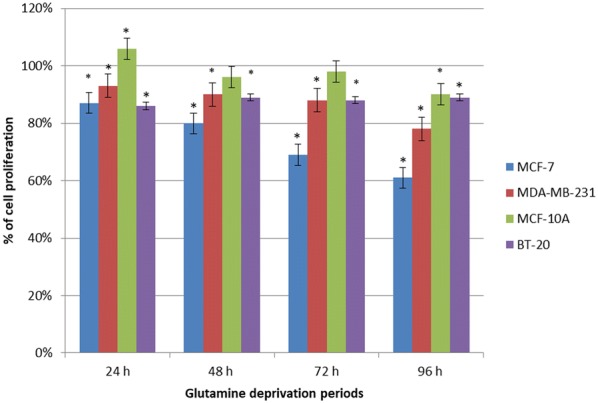
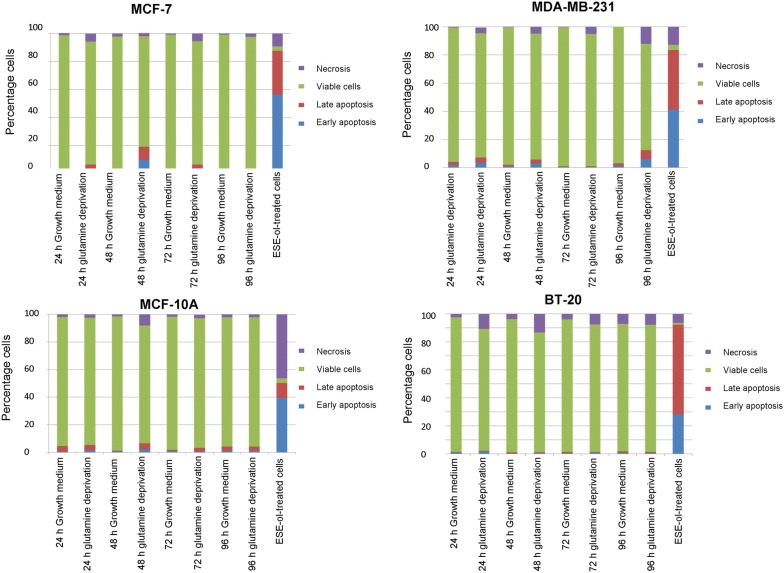
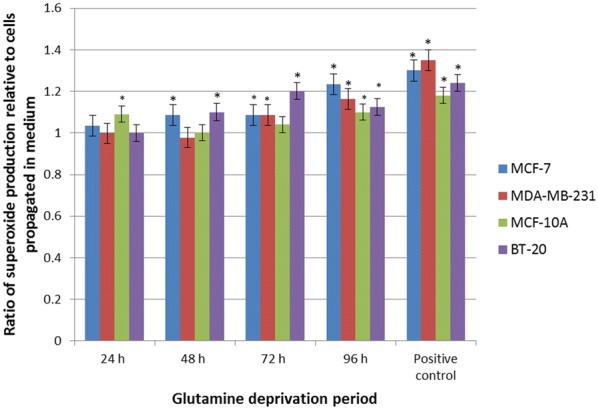
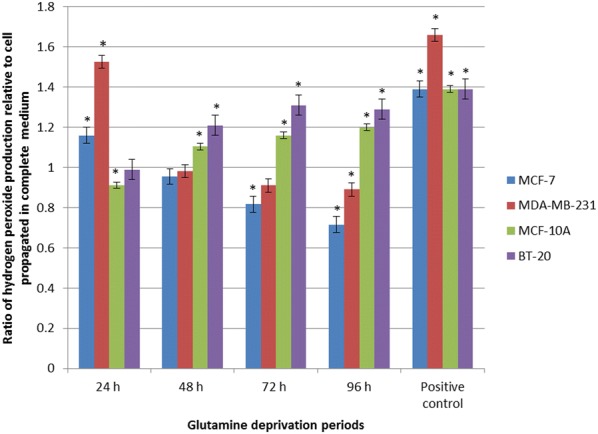
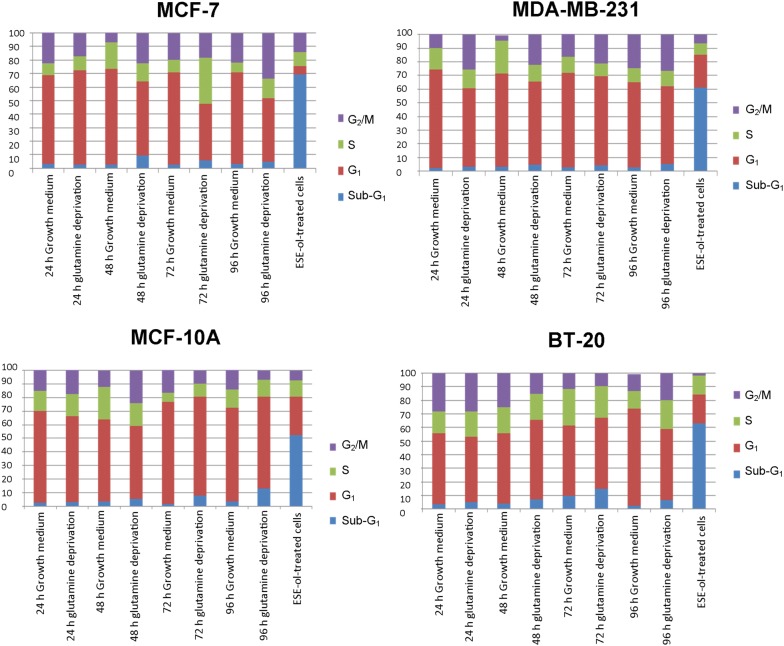
Spectrophotometry demonstrated that glutamine deprivation resulted in decreased cell growth in a time-dependent manner. MCF-7 cell growth was decreased to 61% after 96 h of glutamine deprivation; MDA-MB-231 cell growth was decreased to 78% cell growth after 96 h of glutamine deprivation, MCF-10A cell growth was decreased 89% after 96 h of glutamine deprivation and BT-20 cell growth decreased to 86% after 24 h of glutamine deprivation and remained unchanged until 96 h of glutamine deprivation. Glutamine deprivation resulted in oxidative stress where superoxide levels were significantly elevated after 96 h in the MCF-7- and MDA-MB-231 cell lines. Time-dependent production of hydrogen peroxide was accompanied by aberrant mitochondrial membrane potential. The effects of ROS and mitochondrial membrane potential were more prominently observed in the MCF-7 cell line when compared to the MDA-MB-231-, MCF-10A- and BT-20 cell lines. Cell cycle progression revealed that glutamine deprivation resulted in a significant increase in the S-phase after 72 h of glutamine deprivation in the MCF-7 cell line. Apoptosis induction resulted in a decrease in viable cells in all cell lines following glutamine deprivation. In the MCF-7 cells, 87.61% of viable cells were present after 24 h of glutamine deprivation.
This study demonstrates that glutamine deprivation resulted in decreased cell proliferation, time-dependent- and cell line-dependent ROS generation, aberrant mitochondrial membrane potential and disrupted cell cycle progression. In addition, the estrogen receptor positive MCF-7 cell line was more prominently affected. This study contributes to knowledge regarding the sensitivity of breast cancer cells and non-tumorigenic cells to glutamine deprivation.
肿瘤细胞会改变代谢途径,以促进增殖和细胞存活,从而导致葡萄糖和谷氨酰胺成瘾。先前的研究表明,谷氨酰胺剥夺会导致针对肿瘤细胞的潜在差异活性更加明显。这归因于肿瘤细胞利用增加的谷氨酰胺量来增强糖酵解和谷氨酰胺分解。在这项研究中,研究了谷氨酰胺剥夺对乳腺肿瘤细胞系(MCF-7、MDA-MB-231、BT-20)和非肿瘤性乳腺细胞系(MCF-10A)中活性氧(ROS)产生、线粒体膜电位、细胞增殖和细胞死亡的影响。
分光光度法表明,谷氨酰胺剥夺会导致细胞生长随时间呈时间依赖性下降。MCF-7 细胞生长在 96 小时的谷氨酰胺剥夺后下降至 61%;MDA-MB-231 细胞生长在 96 小时的谷氨酰胺剥夺后下降至 78%,MCF-10A 细胞生长在 96 小时的谷氨酰胺剥夺后下降至 89%,BT-20 细胞生长在 24 小时的谷氨酰胺剥夺后下降至 86%,并保持不变,直到 96 小时的谷氨酰胺剥夺。谷氨酰胺剥夺导致氧化应激,其中超氧水平在 MCF-7 和 MDA-MB-231 细胞系中 96 小时后显著升高。过氧化氢的时间依赖性产生伴随着异常的线粒体膜电位。与 MDA-MB-231、MCF-10A 和 BT-20 细胞系相比,ROS 和线粒体膜电位的影响在 MCF-7 细胞系中更为明显。细胞周期进展表明,MCF-7 细胞系在谷氨酰胺剥夺 72 小时后,谷氨酰胺剥夺导致 S 期显著增加。细胞凋亡诱导导致所有细胞系在谷氨酰胺剥夺后活细胞数量减少。在 MCF-7 细胞中,24 小时的谷氨酰胺剥夺后,有 87.61%的活细胞存在。
本研究表明,谷氨酰胺剥夺会导致细胞增殖减少、时间依赖性和细胞系依赖性 ROS 生成、线粒体膜电位异常和细胞周期进程中断。此外,雌激素受体阳性 MCF-7 细胞系受到的影响更为明显。本研究有助于了解乳腺癌细胞和非肿瘤细胞对谷氨酰胺剥夺的敏感性。