Murray Kelvin J, Le Grande Michael R, Ortega de Mues Arantxa, Azari Michael F
School of Health & Biomedical Sciences, RMIT University, PO Box 71, Bundoora, Melbourne, VIC 3083, Australia.
Australian Centre for Heart Health, Melbourne, Australia.
BMC Musculoskelet Disord. 2017 Aug 1;18(1):330. doi: 10.1186/s12891-017-1696-9.
Degenerative joint disease (DJD) in the lumbar spine is a common condition that is associated with chronic low back pain. Excessive loading of lumbar joints is a risk factor for DJD. Changes in lumbar lordosis significantly redistribute the forces of weight-bearing on the facet joints and the intervertebral discs. However, the relationship between lumbar lordosis and DJD has not been characterized in men and women.
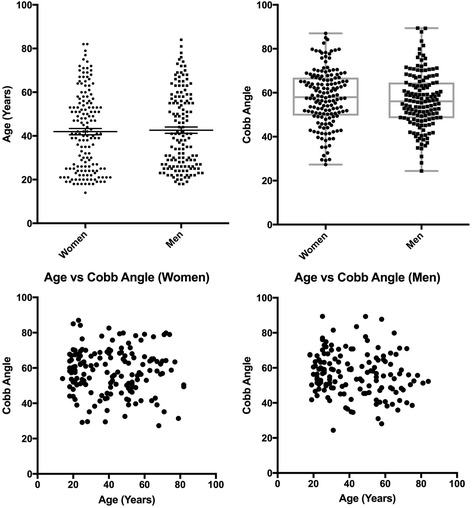
We characterised the correlation between standing lumbar lordosis and DJD in standing radiographic images from 301 adult female and male chiropractic patients. DJD was rated using the Kellgren-Lawrence scale, and lordosis was measured using the Cobb angle. Linear and curvilinear correlations were investigated while controlling for age and sex.
We found a highly significant curvilinear correlation between lordosis and DJD of the lower lumbar spine in both sexes, but especially in women, irrespective of the effects of age. We found the effect size of lordosis on lower lumbar DJD to be between 17.4 and 18.1% in women and 12.9% in older men. In addition, lordosis of 65 (95% CI 55.3-77.7) and 68 (98% CI 58.7-73.3) degrees were associated with minimal DJD in the lower lumbar spine of women and men respectively, and were therefore considered 'optimal'. This optimal lordotic angle was 73 (95% CI 58.8-87.2) degrees in older men.
Both hypo- and hyper-lordosis correlate with DJD in the lumbar spine, particularly in women and in older men. These findings may well be of relevance to spinal pain management and spinal rehabilitation.
腰椎退行性关节病(DJD)是一种常见病症,与慢性下腰痛相关。腰椎关节负荷过重是DJD的一个危险因素。腰椎前凸的改变会显著重新分配小关节和椎间盘上的负重力量。然而,腰椎前凸与DJD之间的关系在男性和女性中尚未得到明确阐述。
我们对301名成年男女脊椎按摩治疗患者站立位X线影像中站立位腰椎前凸与DJD之间的相关性进行了分析。使用Kellgren-Lawrence量表对DJD进行评分,并用Cobb角测量前凸。在控制年龄和性别的同时,研究线性和曲线相关性。
我们发现,无论年龄影响如何,两性尤其是女性的腰椎前凸与下腰椎DJD之间存在高度显著的曲线相关性。我们发现,腰椎前凸对女性下腰椎DJD的效应大小在17.4%至18.1%之间,对老年男性为12.9%。此外,女性和男性下腰椎最小DJD分别与65°(95%可信区间55.3 - 77.7)和68°(98%可信区间58.7 - 73.3)的前凸相关,因此被认为是“最佳”的。老年男性的最佳前凸角度为73°(95%可信区间58.8 - 87.2)。
腰椎前凸不足和过度均与腰椎DJD相关,尤其是在女性和老年男性中。这些发现可能与脊柱疼痛管理和脊柱康复密切相关。