Walton Kelly L, Johnson Katharine E, Harrison Craig A
Growth Factor Therapeutics Laboratory, Department of Physiology, Monash University, ClaytonVIC, Australia.
Front Pharmacol. 2017 Jul 14;8:461. doi: 10.3389/fphar.2017.00461. eCollection 2017.
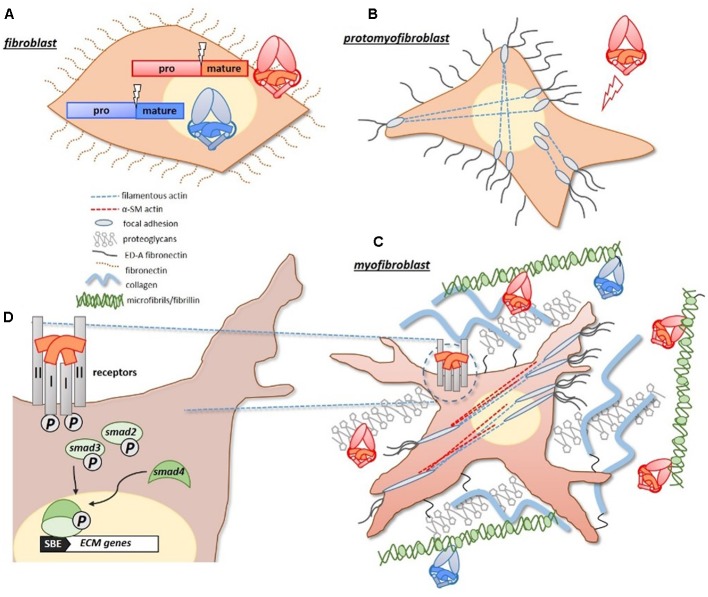
Fibrosis occurs when there is an imbalance in extracellular matrix (ECM) deposition and degradation. Excessive ECM deposition results in scarring and thickening of the affected tissue, and interferes with tissue and organ homeostasis - mimicking an exaggerated "wound healing" response. Many transforming growth factor-β (TGF-β) ligands are potent drivers of ECM deposition, and additionally, have a natural affinity for the ECM, creating a concentrated pool of pro-fibrotic factors at the site of injury. Consequently, TGF-β ligands are upregulated in many human fibrotic conditions and, as such, are attractive targets for fibrosis therapy. Here, we will discuss the contribution of TGF-β proteins in the pathogenesis of fibrosis, and promising anti-fibrotic approaches that target TGF-β ligands.
当细胞外基质(ECM)沉积与降解失衡时,纤维化便会发生。过量的ECM沉积会导致受影响组织形成瘢痕并增厚,进而干扰组织和器官的内稳态,类似一种过度的“伤口愈合”反应。许多转化生长因子-β(TGF-β)配体是ECM沉积的强效驱动因子,此外,它们对ECM具有天然亲和力,在损伤部位形成一个促纤维化因子的集中池。因此,TGF-β配体在许多人类纤维化病症中上调,正因如此,它们是纤维化治疗的有吸引力的靶点。在此,我们将讨论TGF-β蛋白在纤维化发病机制中的作用,以及靶向TGF-β配体的有前景的抗纤维化方法。