Li Yan, Meng Jingjing, Yang Sha, Guo Feng, Zhang Jialei, Geng Yun, Cui Li, Wan Shubo, Li Xinguo
Biotechnology Research Center, Shandong Academy of Agricultural SciencesJinan, China.
Shandong Provincial Key Laboratory of Crop Genetic Improvement, Ecology and Physiology, Shandong Academy of Agricultural SciencesJinan, China.
Front Plant Sci. 2017 Jul 14;8:1241. doi: 10.3389/fpls.2017.01241. eCollection 2017.
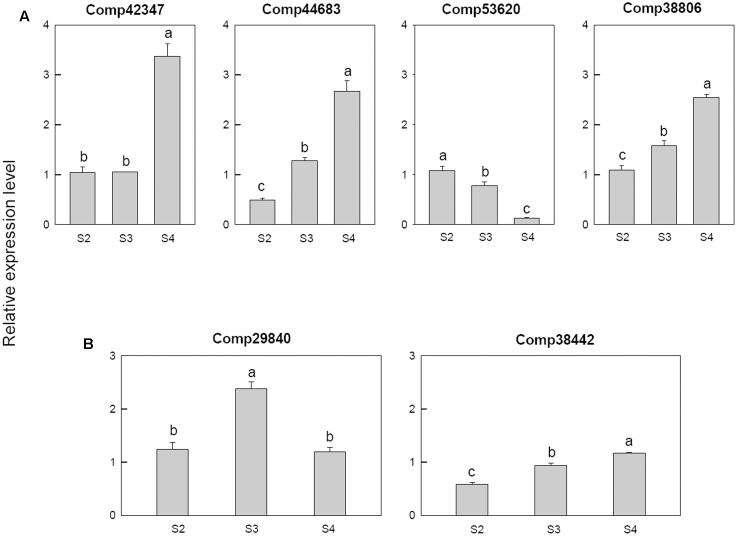
Peanut is one of the calciphilous plants. Calcium serves as a ubiquitous central hub in a large number of signaling pathways. In the field, free calcium ion (Ca)-deficient soil can result in unfilled pods. Four pod stages were analyzed to determine the relationship between Ca excretion and pod development. Peanut shells showed Ca excretion at all four stages; however, both the embryo of Stage 4 (S4) and the red skin of Stage 3 (S3) showed Ca absorbance. These results showed that embryo and red skin of peanut need Ca during development. In order to survey the relationship among calcium, hormone and seed development from gene perspective, we further analyzed the seed transcriptome at Stage 2 (S2), S3, and S4. About 70 million high quality clean reads were generated, which were assembled into 58,147 unigenes. By comparing these three stages, total 4,457 differentially expressed genes were identified. In these genes, 53 Ca related genes, 40 auxin related genes, 15 gibberellin genes, 20 ethylene related genes, 2 abscisic acid related genes, and 7 cytokinin related genes were identified. Additionally, a part of them were validated by qRT-PCR. Most of their expressions changed during the pod development. Since some reports showed that Ca signal transduction pathway is involved in hormone regulation pathway, these results implied that peanut seed development might be regulated by the collaboration of Ca signal transduction pathway and hormone regulation pathway.
花生是喜钙植物之一。钙在大量信号通路中起着普遍的核心枢纽作用。在田间,土壤中游离钙离子(Ca)缺乏会导致荚果空瘪。分析了四个荚果发育阶段以确定钙排泄与荚果发育之间的关系。花生壳在所有四个阶段都表现出钙排泄;然而,第4阶段(S4)的胚和第3阶段(S3)的种皮表现出钙吸收。这些结果表明,花生的胚和种皮在发育过程中需要钙。为了从基因角度探究钙、激素与种子发育之间的关系,我们进一步分析了第2阶段(S2)、S3和S4的种子转录组。共产生了约7000万个高质量的clean reads,这些reads被组装成58147个单基因。通过比较这三个阶段,共鉴定出4457个差异表达基因。在这些基因中,鉴定出53个与钙相关的基因、40个与生长素相关的基因、15个与赤霉素相关的基因、20个与乙烯相关的基因、2个与脱落酸相关的基因和7个与细胞分裂素相关的基因。此外,其中一部分通过qRT-PCR进行了验证。它们中的大多数在荚果发育过程中表达发生变化。由于一些报道表明钙信号转导途径参与激素调节途径,这些结果暗示花生种子发育可能受钙信号转导途径和激素调节途径协同作用的调控。