Saradadevi Renu, Palta Jairo A, Siddique Kadambot H M
School of Agriculture and Environment, The University of Western Australia, PerthWA, Australia.
The UWA Institute of Agriculture, The University of Western Australia, PerthWA, Australia.
Front Plant Sci. 2017 Jul 18;8:1251. doi: 10.3389/fpls.2017.01251. eCollection 2017.
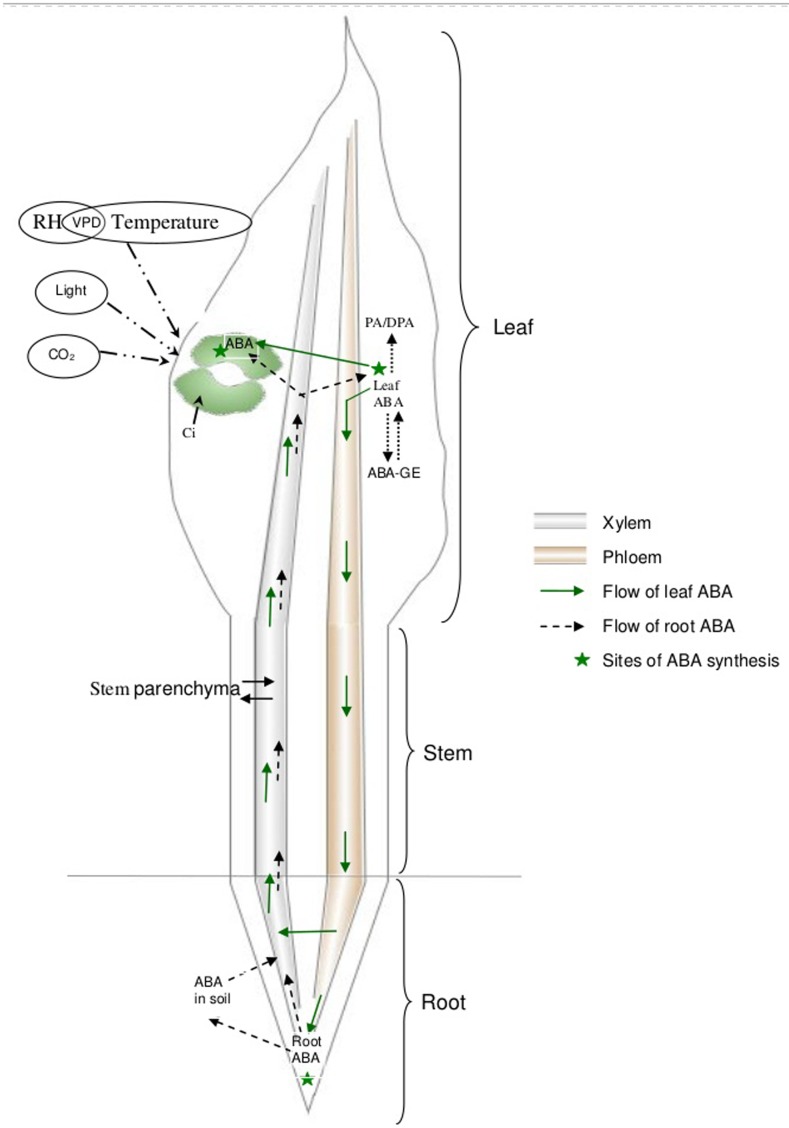
End-of-season drought or "terminal drought," which occurs after flowering, is considered the most significant abiotic stress affecting crop yields. Wheat crop production in Mediterranean-type environments is often exposed to terminal drought due to decreasing rainfall and rapid increases in temperature and evapotranspiration during spring when wheat crops enter the reproductive stage. Under such conditions, every millimeter of extra soil water extracted by the roots benefits grain filling and yield and improves water use efficiency (WUE). When terminal drought develops, soil dries from the top, exposing the top part of the root system to dry soil while the bottom part is in contact with available soil water. Plant roots sense the drying soil and produce signals, which on transmission to shoots trigger stomatal closure to regulate crop water use through transpiration. However, transpiration is linked to crop growth and productivity and limiting transpiration may reduce potential yield. While an early and high degree of stomatal closure affects photosynthesis and hence biomass production, a late and low degree of stomatal closure exhausts available soil water rapidly which results in yield losses through a reduction in post-anthesis water use. The plant hormone abscisic acid (ABA) is considered the major chemical signal involved in stomatal regulation. Wheat genotypes differ in their ability to produce ABA under drought and also in their stomatal sensitivity to ABA. In this viewpoint article we discuss the possibilities of exploiting genotypic differences in ABA response to soil drying in regulating the use of water under terminal drought. Root density distribution in the upper drying layers of the soil profile is identified as a candidate trait that can affect ABA accumulation and subsequent stomatal closure. We also examine whether leaf ABA can be designated as a surrogate characteristic for improved WUE in wheat to sustain grain yield under terminal drought. Ease of collecting leaf samples to quantify ABA compared to extracting xylem sap will facilitate rapid screening of a large number of germplasm for drought tolerance.
季末干旱或“终末期干旱”发生在开花之后,被认为是影响作物产量的最主要非生物胁迫因素。在地中海型环境下种植小麦时,由于降雨减少,且在小麦进入生殖阶段的春季气温迅速升高、蒸发散加剧,小麦生产常常遭受终末期干旱。在这种情况下,根系多吸收每一毫米的土壤水分都有利于籽粒灌浆和提高产量,并提升水分利用效率(WUE)。当终末期干旱出现时,土壤从表层开始变干,根系上部暴露于干燥土壤中,而根系下部仍与可利用的土壤水分接触。植物根系感知到干燥土壤后会产生信号,这些信号传递到地上部分后会触发气孔关闭,从而通过蒸腾作用来调节作物的水分利用。然而,蒸腾作用与作物生长和生产力相关,限制蒸腾作用可能会降低潜在产量。早期且高度的气孔关闭会影响光合作用,进而影响生物量生产,而晚期且低度的气孔关闭会迅速耗尽可用土壤水分,导致花后水分利用减少,造成产量损失。植物激素脱落酸(ABA)被认为是参与气孔调节的主要化学信号。小麦基因型在干旱条件下产生ABA的能力以及对ABA的气孔敏感性存在差异。在这篇观点文章中,我们探讨了利用ABA对土壤干燥响应的基因型差异来调控终末期干旱条件下水分利用的可能性。土壤剖面上部干燥层的根系密度分布被确定为一个可能影响ABA积累及随后气孔关闭的候选性状。我们还研究了叶片ABA是否可以作为提高小麦水分利用效率的替代特征,以便在终末期干旱条件下维持籽粒产量。与提取木质部汁液相比,采集叶片样本以定量ABA更加简便,这将有助于快速筛选大量耐旱种质资源。