Ecke Frauke, Angeler David G, Magnusson Magnus, Khalil Hussein, Hörnfeldt Birger
Department of Wildlife, Fish, and Environmental Studies Swedish University of Agricultural Sciences Umeå Sweden.
Department of Aquatic Sciences and Assessment Swedish University of Agricultural Sciences Uppsala Sweden.
Ecol Evol. 2017 Jun 9;7(14):5331-5342. doi: 10.1002/ece3.3074. eCollection 2017 Jul.
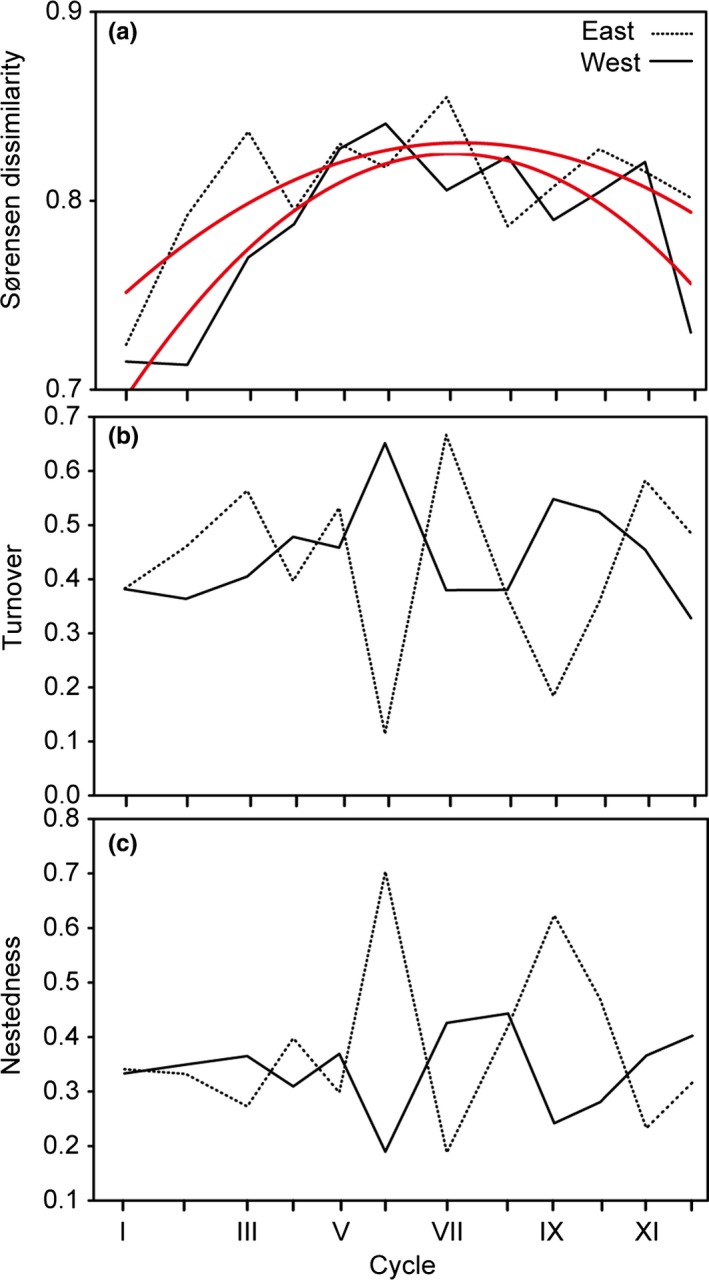
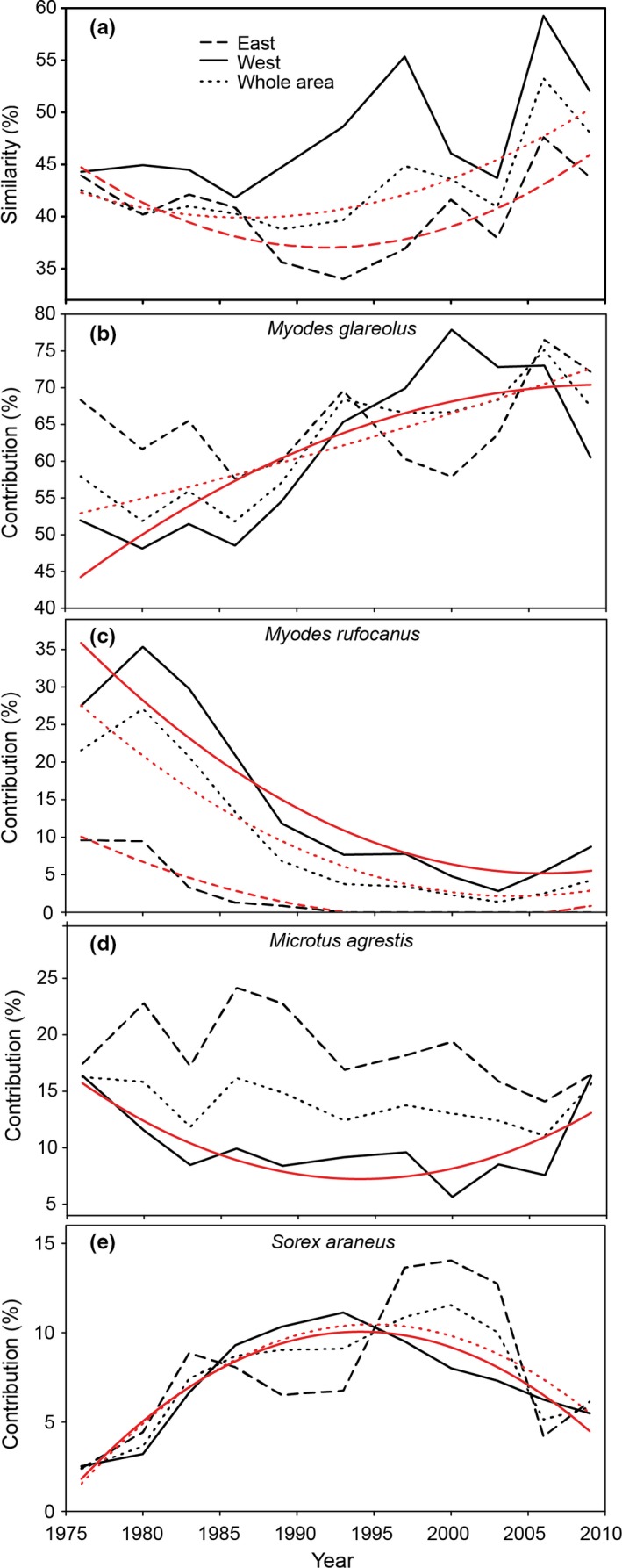
Long-term decline and depression of density in cyclic small rodents is a recent widespread phenomenon. These observed changes at the population level might have cascading effects at the ecosystem level. Here, we assessed relationships between changing boreal landscapes and biodiversity changes of small mammal communities. We also inferred potential effects of observed community changes for increased transmission risk of Puumala virus (PUUV) spread, causing the zoonotic disease nephropatica epidemica in humans. Analyses were based on long-term (1971-2013) monitoring data of shrews and voles representing 58 time series in northern Sweden. We calculated richness, diversity, and evenness at alpha, beta, and gamma level, partitioned beta diversity into turnover (species replacement) and nestedness (species addition/removal), used similarity percentages (SIMPER) analysis to assess community structure, and calculated the cumulated number of PUUV-infected bank voles and average PUUV prevalence (percentage of infected bank voles) per vole cycle. Alpha, beta, and gamma richness and diversity of voles, but not shrews, showed long-term trends that varied spatially. The observed patterns were associated with an increase in community contribution of bank vole (), a decrease of gray-sided vole () and field vole () and a hump-shaped variation in contribution of common shrew (). Long-term biodiversity changes were largely related to changes in forest landscape structure. Number of PUUV-infected bank voles in spring was negatively related to beta and gamma diversity, and positively related to turnover of shrews (replaced by voles) and to community contribution of bank voles. The latter was also positively related to average PUUV prevalence in spring. We showed that long-term changes in the boreal landscape contributed to explain the decrease in biodiversity and the change in structure of small mammal communities. In addition, our results suggest decrease in small mammal diversity to have knock-on effects on dynamics of infectious diseases among small mammals with potential implications for disease transmission to humans.
周期性小型啮齿动物密度的长期下降和降低是最近普遍存在的现象。在种群水平上观察到的这些变化可能会在生态系统水平上产生连锁反应。在这里,我们评估了北方景观变化与小型哺乳动物群落生物多样性变化之间的关系。我们还推断了观察到的群落变化对普马拉病毒(PUUV)传播增加的风险的潜在影响,该病毒会导致人类感染人畜共患疾病流行性肾病。分析基于瑞典北部代表58个时间序列的鼩鼱和田鼠的长期(1971 - 2013年)监测数据。我们计算了α、β和γ水平的丰富度、多样性和均匀度,将β多样性划分为周转率(物种替代)和嵌套性(物种增加/移除),使用相似性百分比(SIMPER)分析来评估群落结构,并计算每个田鼠周期中感染PUUV的棕背田鼠的累积数量和平均PUUV患病率(感染棕背田鼠的百分比)。田鼠的α、β和γ丰富度及多样性呈现出长期的空间变化趋势,而鼩鼱则没有。观察到的模式与棕背田鼠()群落贡献的增加、灰侧田鼠()和草原田鼠()的减少以及普通鼩鼱()贡献的驼峰状变化有关。长期生物多样性变化在很大程度上与森林景观结构的变化有关。春季感染PUUV的棕背田鼠数量与β和γ多样性呈负相关,与鼩鼱(被田鼠替代)的周转率以及棕背田鼠的群落贡献呈正相关。后者也与春季的平均PUUV患病率呈正相关。我们表明,北方景观的长期变化有助于解释生物多样性的减少和小型哺乳动物群落结构的变化。此外,我们的结果表明小型哺乳动物多样性的降低对小型哺乳动物传染病动态有连锁反应,可能对疾病传播给人类产生影响。