Hamada Kenta, Ishihara Ryu, Yamasaki Yasushi, Hanaoka Noboru, Yamamoto Sachiko, Arao Masamichi, Suzuki Sho, Iwatsubo Taro, Kato Minoru, Tonai Yusuke, Shichijo Satoki, Matsuura Noriko, Nakahira Hiroko, Kanesaka Takashi, Akasaka Tomofumi, Takeuchi Yoji, Higashino Koji, Uedo Noriya, Iishi Hiroyasu, Kanayama Naoyuki, Hirata Takero, Kawaguchi Yoshifumi, Konishi Koji, Teshima Teruki
Department of Gastrointestinal Oncology, Osaka International Cancer Institute, Osaka, Japan.
Department of Gastroenterology and Hepatology, Okayama University Graduate School of Medicine, Dentistry and Pharmaceutical Sciences, Okayama, Japan.
Clin Transl Gastroenterol. 2017 Aug 3;8(8):e110. doi: 10.1038/ctg.2017.36.
The reported 1- and 3-year overall survival rates after esophagectomy for stage I superficial esophageal squamous cell carcinoma (SESCC) are 95-97% and 86%, and those after definitive chemoradiotherapy (CRT) are 98% and 89%, respectively. This study was performed to elucidate the efficacy and safety of another treatment option for SESCC: endoscopic resection (ER) followed by CRT.
We retrospectively reviewed the overall survival, recurrence, and grade ≥3 adverse events of consecutive patients who refused esophagectomy and underwent ER followed by CRT for SESCC from 1 January 2006 to 31 December 2012.
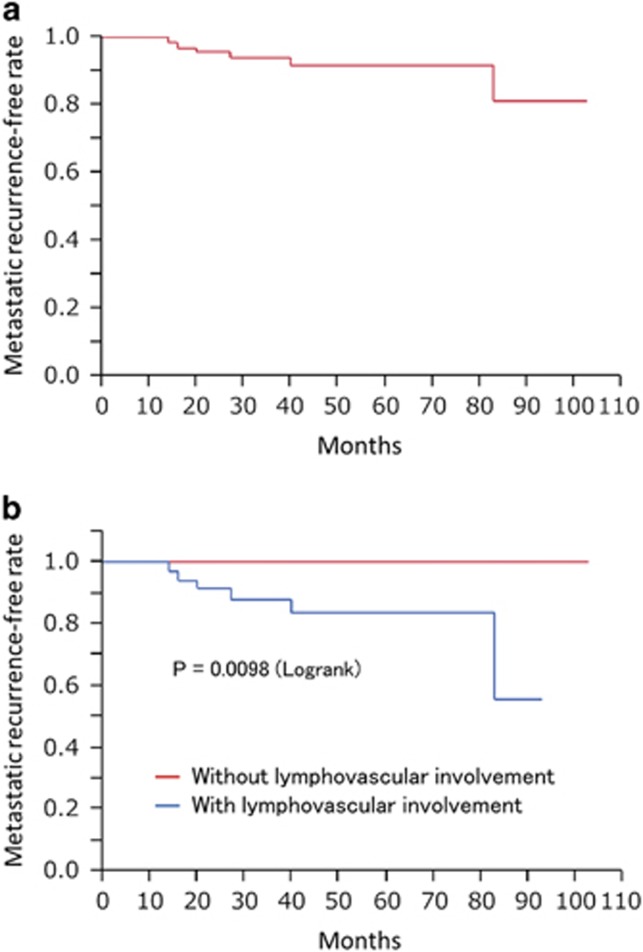
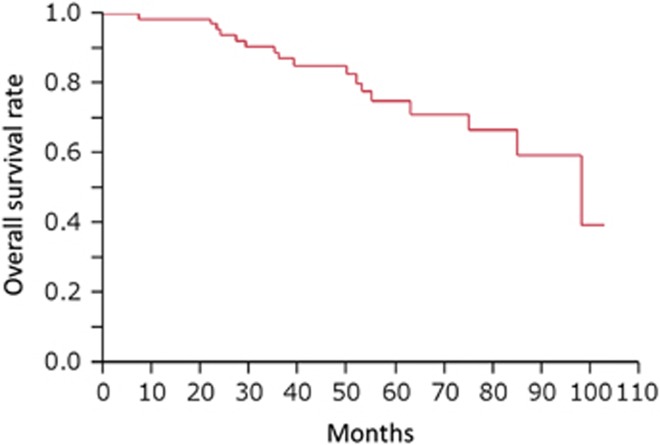
In total, 66 patients with SESCC underwent ER followed by CRT during the study period, and complete follow-up data were available for all patients. The median age was 67 (range, 45-82) years, and the median observation period was 51 (range, 7-103) months. Local and metastatic recurrences occurred in 2 (3%) and 6 (9%) patients, respectively, and 17 (26%) patients died. The 1-, 3-, and 5-year overall survival rates were 98%, 87%, and 75%, respectively. One of the 23 patients with mucosal cancer and 5 of 43 with submucosal cancer developed metastatic recurrences (P=0.65). Five of the 61 patients with negative vertical resection margin and 1 of 5 with positive vertical resection margin developed metastatic recurrences (P=0.39). None of the 30 patients without lymphovascular involvement developed metastatic recurrences; however, 6 of 36 patients with lymphovascular involvement developed metastatic recurrences (P=0.0098). Grade ≥3 adverse events occurred in 21 (32%) patients and all adverse events were associated with CRT, hematological adverse events in 13 (20%), and non-hematological adverse events in 9 (14%).
ER followed by CRT provides survival comparable with that of esophagectomy or definitive CRT and has a low local recurrence rate. A particularly favorable outcome is expected for cancers without lymphovascular involvement.
据报道,I期浅表食管鳞状细胞癌(SESCC)行食管切除术后1年和3年的总生存率分别为95 - 97%和86%,而行根治性放化疗(CRT)后的总生存率分别为98%和89%。本研究旨在阐明SESCC的另一种治疗方案的疗效和安全性:内镜切除(ER)后行CRT。
我们回顾性分析了2006年1月1日至2012年12月31日期间连续的拒绝食管切除术并接受ER后行CRT治疗SESCC患者的总生存率、复发情况和≥3级不良事件。
在研究期间,共有66例SESCC患者接受了ER后行CRT治疗,所有患者均有完整的随访数据。中位年龄为67岁(范围45 - 82岁),中位观察期为51个月(范围7 - 103个月)。分别有2例(3%)和6例(9%)患者发生局部和远处转移复发,17例(26%)患者死亡。1年、3年和5年总生存率分别为98%、87%和75%。23例黏膜癌患者中有1例、43例黏膜下癌患者中有5例发生远处转移复发(P = 0.65)。61例垂直切缘阴性的患者中有5例、5例垂直切缘阳性的患者中有1例发生远处转移复发(P = 0.39)。30例无脉管侵犯的患者均未发生远处转移复发;然而,36例有脉管侵犯的患者中有6例发生远处转移复发(P = 0.0098)。21例(32%)患者发生≥3级不良事件,所有不良事件均与CRT相关,血液学不良事件13例(20%),非血液学不良事件9例(14%)。
ER后行CRT的生存率与食管切除术或根治性CRT相当,且局部复发率低。对于无脉管侵犯的癌症,预期预后特别良好。