Fan Ching-Lin, Shang Ming-Chi, Wang Shea-Jue, Hsia Mao-Yuan, Lee Win-Der, Huang Bohr-Ran
Graduate Institute of Electro-Optical Engineering, National Taiwan University of Science and Technology, 43 Sec. 4, Keelung Road, Taipei 106, Taiwan.
Department of Electronic Engineering, National Taiwan University of Science and Technology, 43 Sec. 4, Keelung Road, Taipei 106, Taiwan.
Materials (Basel). 2017 Jul 3;10(7):742. doi: 10.3390/ma10070742.
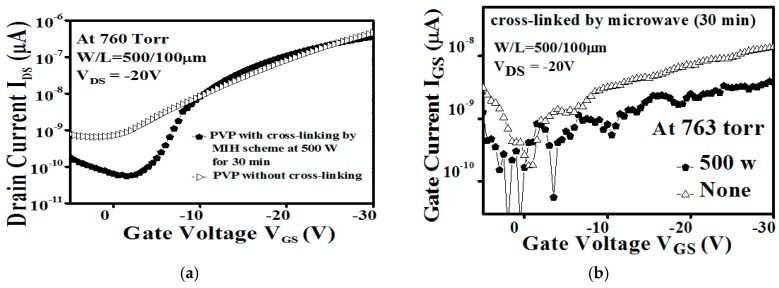
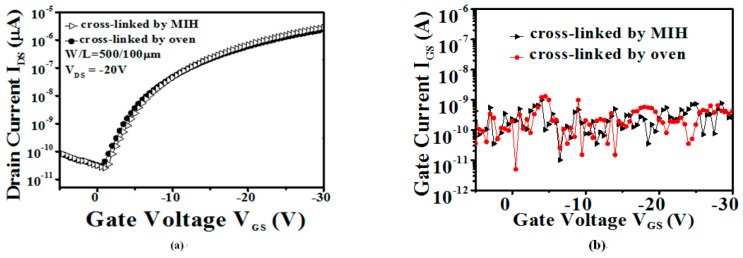
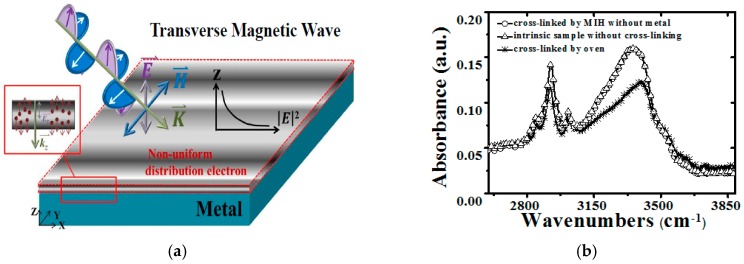
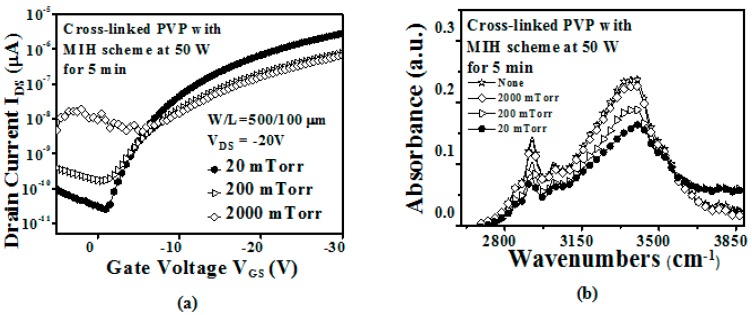
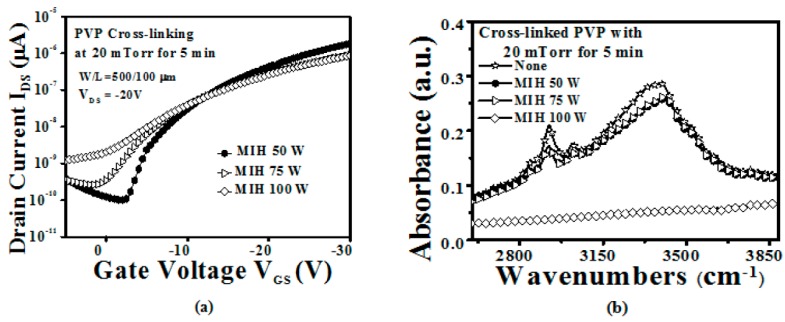
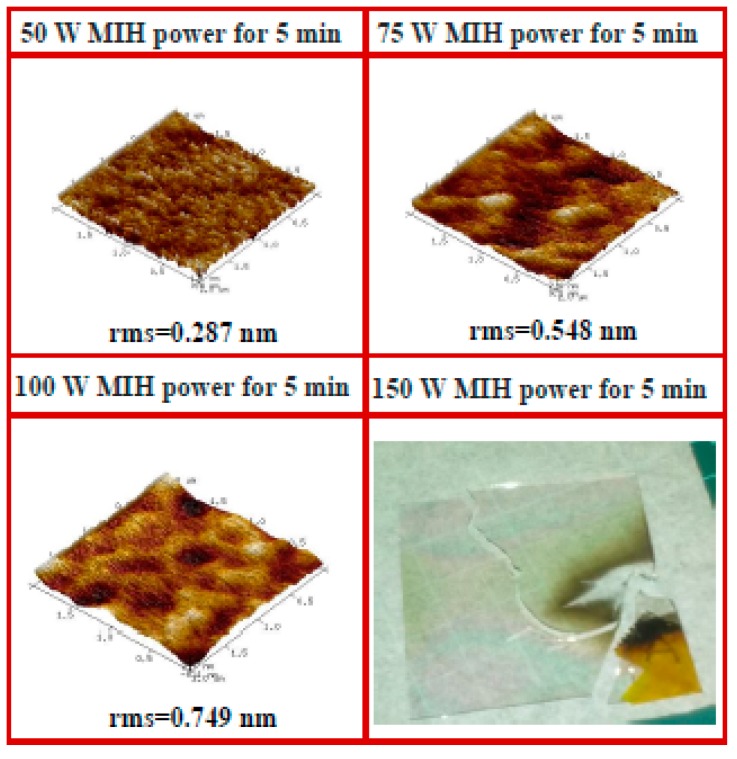
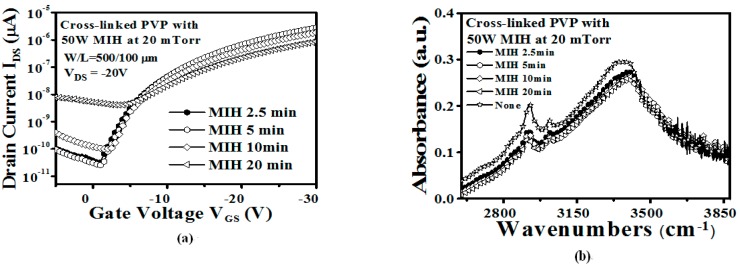
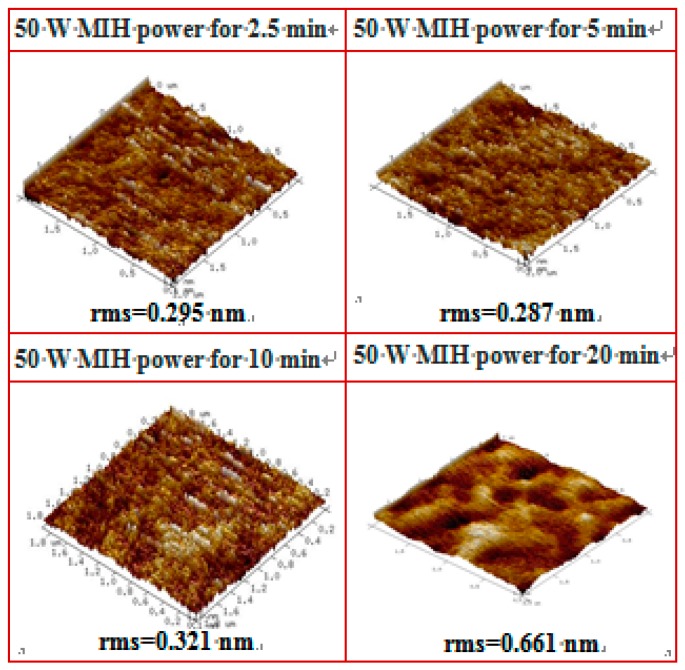
In this study, a proposed Microwave-Induction Heating (MIH) scheme has been systematically studied to acquire suitable MIH parameters including chamber pressure, microwave power and heating time. The proposed MIH means that the thin indium tin oxide (ITO) metal below the Poly(4-vinylphenol) (PVP) film is heated rapidly by microwave irradiation and the heated ITO metal gate can heat the PVP gate insulator, resulting in PVP cross-linking. It is found that the attenuation of the microwave energy decreases with the decreasing chamber pressure. The optimal conditions are a power of 50 W, a heating time of 5 min, and a chamber pressure of 20 mTorr. When suitable MIH parameters were used, the effect of PVP cross-linking and the device performance were similar to those obtained using traditional oven heating, even though the cross-linking time was significantly decreased from 1 h to 5 min. Besides the gate leakage current, the interface trap state density (Nit) was also calculated to describe the interface status between the gate insulator and the active layer. The lowest interface trap state density can be found in the device with the PVP gate insulator cross-linked by using the optimal MIH condition. Therefore, it is believed that the MIH scheme is a good candidate to cross-link the PVP gate insulator for organic thin-film transistor applications as a result of its features of rapid heating (5 min) and low-power microwave-irradiation (50 W).
在本研究中,对一种提出的微波感应加热(MIH)方案进行了系统研究,以获取合适的MIH参数,包括腔室压力、微波功率和加热时间。所提出的MIH是指聚(4-乙烯基苯酚)(PVP)薄膜下方的薄氧化铟锡(ITO)金属通过微波辐射快速加热,加热后的ITO金属栅极可加热PVP栅极绝缘体,从而导致PVP交联。发现微波能量的衰减随着腔室压力的降低而减小。最佳条件是功率为50 W、加热时间为5分钟、腔室压力为20毫托。当使用合适的MIH参数时,PVP交联效果和器件性能与使用传统烘箱加热时相似,尽管交联时间从1小时显著缩短至5分钟。除了栅极漏电流外,还计算了界面陷阱态密度(Nit)来描述栅极绝缘体与有源层之间的界面状态。在采用最佳MIH条件交联PVP栅极绝缘体的器件中可发现最低的界面陷阱态密度。因此,由于其快速加热(5分钟)和低功率微波辐射(50 W)的特点,相信MIH方案是用于有机薄膜晶体管应用中交联PVP栅极绝缘体的良好候选方案。