Tournu Géraldine, Abramowitz Laurent, Couffignal Camille, Juguet Frédéric, Sénéjoux Agnès, Berger Stéphane, Wiart Anne-Laure, Bernard Marc, Provost Françoise, Pillant-Le Moult Hélène, Bouchard Dominique, Aubert Jean-Pierre
General practice department, University Paris Diderot, F-75018, Paris, France.
AP-HP and GREP; Gastroenterology and proctology unit, Bichat University hospital, Paris, France.
BMC Fam Pract. 2017 Aug 3;18(1):78. doi: 10.1186/s12875-017-0649-6.
Anal disorders are largely underestimated in general practice. Studies have shown patients conceal anal symptoms leading to late diagnosis and treatment. Management by general practitioners is poorly described. The aim of this study is to assess the prevalence of anal symptoms and their management in general practice.
In this prospective, observational, national study set in France, all adult patients consulting their general practitioner during 2 days of consultation were included. Anal symptoms, whether spontaneously revealed or not, were systematically collected and assessed. For symptomatic patients, the obstacles to anal examination were evaluated. The general practitioner's diagnosis was collected and a proctologist visit was systematically proposed in case of anal symptoms. If the proctologist was consulted, his or her diagnosis was collected.
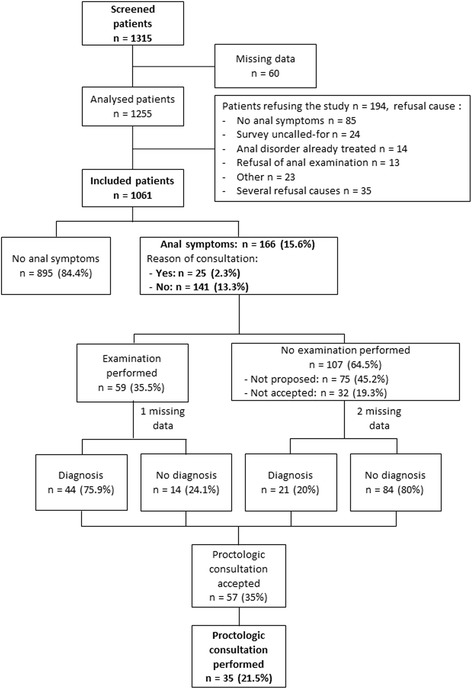
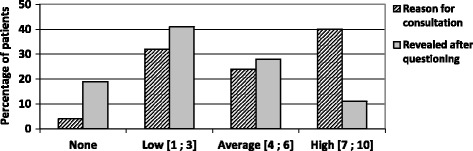
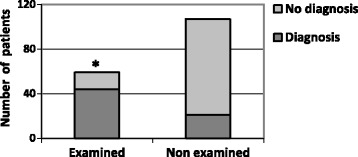
From October 2014 to April 2015, 1061 patients were included by 57 general practitioners. The prevalence of anal symptoms was 15.6% (95% CI: 14-18). However, 85% of these patients did not spontaneously share their symptoms with their doctors, despite a discomfort rating of 3 out of 10 (range 1-5). Although 65% of patients agreed to an anal examination, it was not proposed in 45% of cases with anal symptoms. Performing the examination was associated with a significantly higher diagnosis rate of 76% versus 20% (p < 0.001). Proctologist and general practitioner diagnoses were consistent in 14 out of 17 cases.
Patients' concealed anal symptoms are significant in general practice despite the impact on quality of life. Anal examination is seldom done. Improved training of general practitioners is required to break the taboo.
在全科医疗中,肛门疾病在很大程度上被低估。研究表明,患者会隐瞒肛门症状,导致诊断和治疗延迟。关于全科医生的管理描述甚少。本研究的目的是评估全科医疗中肛门症状的患病率及其管理情况。
在这项于法国开展的前瞻性、观察性全国性研究中,纳入了在两天的会诊期间咨询其全科医生的所有成年患者。系统收集并评估肛门症状,无论这些症状是否是患者主动提及的。对于有症状的患者,评估进行肛门检查的障碍。收集全科医生的诊断结果,若出现肛门症状,则系统地建议患者去看直肠科医生。如果患者咨询了直肠科医生,则收集其诊断结果。
2014年10月至2015年4月,57名全科医生纳入了1061名患者。肛门症状的患病率为15.6%(95%置信区间:14 - 18)。然而,尽管这些患者的不适评分为十分之三(范围为1 - 5),但其中85%的患者并未主动向医生提及他们的症状。尽管65%的患者同意进行肛门检查,但在45%有肛门症状的病例中并未建议进行此项检查。进行检查的诊断率显著更高,为76%,而未检查的诊断率为20%(p < 0.001)。17例中有14例直肠科医生和全科医生的诊断结果一致。
尽管对生活质量有影响,但在全科医疗中患者隐瞒肛门症状的情况很严重。肛门检查很少进行。需要加强对全科医生的培训以打破这一禁忌。