Ju Yeong Jun, Kim Woorim, Lee Sang Ah, Lee Joo Eun, Yoon Hyojung, Park Eun Cheol
Department of Public Health, Graduate School, Yonsei University, Seoul, Korea.
Institute of Health Services Research, Yonsei University, Seoul, Korea.
J Korean Med Sci. 2017 Sep;32(9):1516-1521. doi: 10.3346/jkms.2017.32.9.1516.
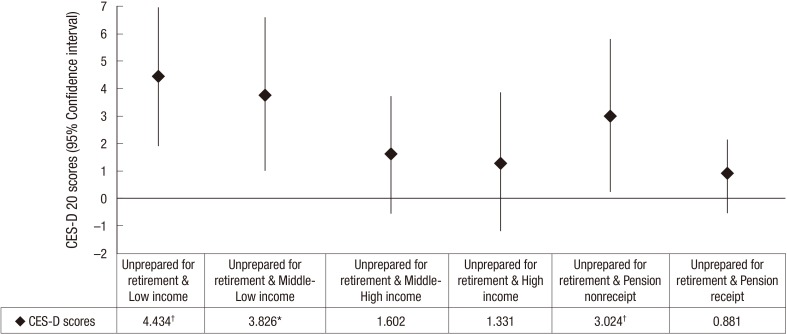
The aim of this study was to investigate the relationship between retirement preparation and depressive symptoms among Koreans 50 years of age or older. We used data from the 2009 to 2013 Korean Retirement and Income Panel Study (KReIS), which included data from the 365 baseline participants of 50 years of age or older. Our sample included only newly retired participants who worked in 2009, but had retired in the 2011 and 2013. To monitor the change in depressive symptoms according to retirement preparation, we used repeated measurement data. We measured depressive symptoms using the Center for Epidemiological Studies Depression (CES-D) 20-item scale. In addition, we measured retirement preparation using a single self-report question asking whether the participant was financially ready for retirement. We evaluated relationship between retirement preparation and depressive symptoms after multivariable adjustment. Compared to subjects who had prepared for retirement (reference group), participants who had not prepared for retirement had increased depression scores (β = 2.49, P < 0.001). In addition, individuals who had not prepared for retirement and who had low household income had the highest increase in depression scores (β = 4.43, P < 0.001). Individuals, who had not prepared for retirement and without a national pension showed a considerable increase in depression scores (β = 3.02, P < 0.001). It is suggested that guaranteed retirement preparation is especially important for mental health of retired elderly individuals with low economic strata.
本研究旨在调查50岁及以上韩国人中退休准备与抑郁症状之间的关系。我们使用了2009年至2013年韩国退休与收入面板研究(KReIS)的数据,其中包括365名50岁及以上的基线参与者的数据。我们的样本仅包括2009年在职但在2011年和2013年退休的新退休参与者。为了监测根据退休准备情况抑郁症状的变化,我们使用了重复测量数据。我们使用流行病学研究中心抑郁量表(CES-D)20项量表来测量抑郁症状。此外,我们使用一个单一的自我报告问题来测量退休准备情况,该问题询问参与者在经济上是否为退休做好了准备。在进行多变量调整后,我们评估了退休准备与抑郁症状之间的关系。与已为退休做好准备的受试者(参照组)相比,未为退休做好准备的参与者抑郁得分有所增加(β = 2.49,P < 0.001)。此外,未为退休做好准备且家庭收入低的个体抑郁得分增加最多(β = 4.43,P < 0.001)。未为退休做好准备且没有国民养老金的个体抑郁得分有相当大的增加(β = 3.02,P < 0.001)。研究表明,有保障的退休准备对于经济阶层较低的退休老年人的心理健康尤为重要。