Breast Disease Center, Peking University First Hospital, Beijing 100034, China.
Department of General Surgery, The Third Hospital of Shijiazhuang, Shijiazhuang, Hebei 050011, China.
Chin Med J (Engl). 2017 Aug 20;130(16):1945-1952. doi: 10.4103/0366-6999.211896.
Current understanding of tumor biology suggests that breast cancer is a group of diseases with different intrinsic molecular subtypes. Anatomic staging system alone is insufficient to provide future outcome information. The American Joint Committee on Cancer (AJCC) expert panel updated the 8th edition of the staging manual with prognostic stage groups by incorporating biomarkers into the anatomic stage groups. In this study, we retrospectively analyzed the data from our center in China using the anatomic and prognostic staging system based on the AJCC 8th edition staging manual.
We reviewed the data from January 2008 to December 2014 for cases with Luminal B Human Epidermal Growth Factor Receptor 2 (HER2)-negative breast cancer in our center. All cases were restaged using the AJCC 8th edition anatomic and prognostic staging system. The Kaplan-Meier method and log-rank test were used to compare the survival differences between different subgroups. SPSS software version 19.0 (IBM Corp., Armonk, NY, USA) was used for the statistical analyses.
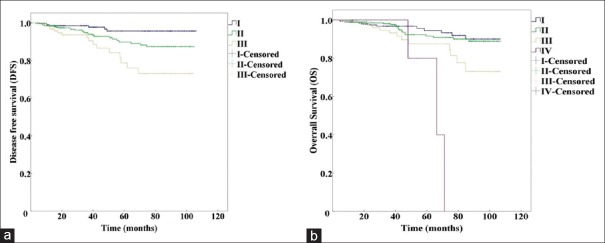
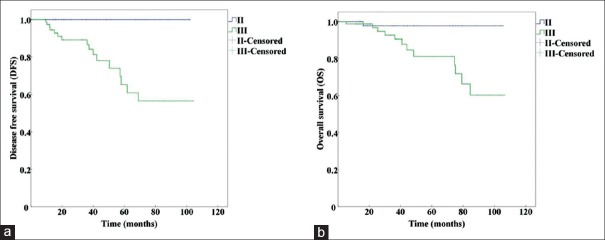
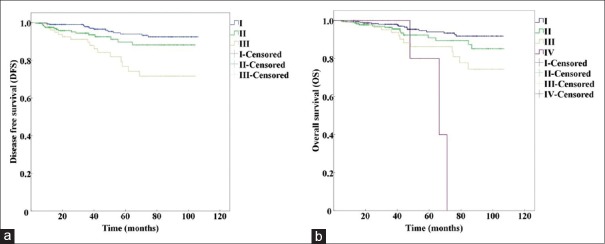
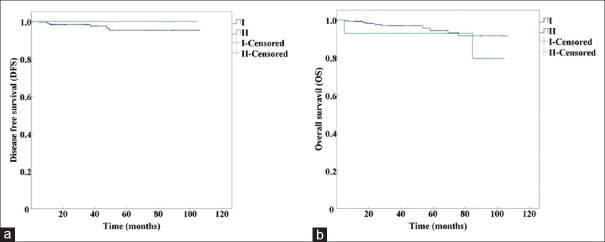
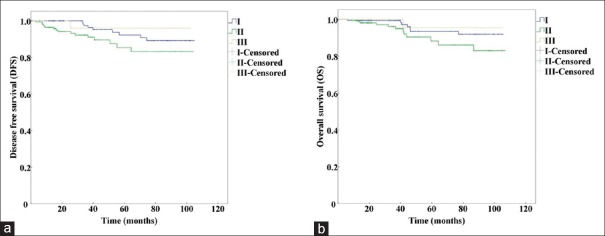
This study consisted of 796 patients with Luminal B HER-negative breast cancer. The 5-year disease-free survival (DFS) of 769 Stage I-III patients was 89.7%, and the 5-year overall survival (OS) of all 796 patients was 91.7%. Both 5-year DFS and 5-year OS were significantly different in the different anatomic and prognostic stage groups. There were 372 cases (46.7%) assigned to a different group. The prognostic Stage II and III patients restaged from anatomic Stage III had significant differences in 5-year DFS (χ2 = 11.319, P= 0.001) and 5-year OS (χ2 = 5.225, P= 0.022). In addition, cases restaged as prognostic Stage I, II, or III from the anatomic Stage II group had statistically significant differences in 5-year DFS (χ2 = 6.510, P= 0.039) but no significant differences in 5-year OS (χ2 = 5.087, P= 0.079). However, the restaged prognostic Stage I and II cases from anatomic Stage I had no statistically significant differences in either 5-year DFS (χ2 = 0.440, P= 0.507) or 5-year OS (χ2 = 1.530, P= 0.216).
The prognostic staging system proposed in the AJCC 8th edition refines the anatomic stage group in Luminal B HER2-negative breast cancer and will lead to a more personalized approach to breast cancer treatment.
目前的肿瘤生物学研究表明,乳腺癌是一组具有不同内在分子亚型的疾病。单纯的解剖分期系统不足以提供未来的预后信息。美国癌症联合委员会(AJCC)专家小组通过将生物标志物纳入解剖分期组,对第 8 版分期手册中的预后分期组进行了更新。在这项研究中,我们使用基于 AJCC 第 8 版分期手册的解剖和预后分期系统,对我们中心中国的数据进行了回顾性分析。
我们回顾了 2008 年 1 月至 2014 年 12 月期间我们中心 Luminal B 型人表皮生长因子受体 2(HER2)阴性乳腺癌患者的数据。所有病例均使用 AJCC 第 8 版解剖和预后分期系统重新分期。采用 Kaplan-Meier 法和对数秩检验比较不同亚组之间的生存差异。采用 SPSS 软件版本 19.0(IBM 公司,纽约州阿蒙克市)进行统计学分析。
本研究共纳入 796 例 Luminal B HER2 阴性乳腺癌患者。769 例Ⅰ-Ⅲ期患者的 5 年无病生存率(DFS)为 89.7%,796 例患者的 5 年总生存率(OS)为 91.7%。不同解剖和预后分期组的 5 年 DFS 和 5 年 OS 均有显著差异。有 372 例(46.7%)患者被分配到不同的组别。从解剖Ⅲ期重新分期为预后Ⅱ期和Ⅲ期的患者,5 年 DFS(χ2=11.319,P=0.001)和 5 年 OS(χ2=5.225,P=0.022)差异有统计学意义。此外,从解剖Ⅱ期重新分期为预后Ⅰ期、Ⅱ期或Ⅲ期的病例,5 年 DFS 差异有统计学意义(χ2=6.510,P=0.039),但 5 年 OS 差异无统计学意义(χ2=5.087,P=0.079)。然而,从解剖Ⅰ期重新分期为预后Ⅰ期和Ⅱ期的病例,5 年 DFS(χ2=0.440,P=0.507)和 5 年 OS(χ2=1.530,P=0.216)差异均无统计学意义。
AJCC 第 8 版提出的预后分期系统细化了 Luminal B HER2 阴性乳腺癌的解剖分期组,将导致更个性化的乳腺癌治疗方法。