Yellappa Vijayashree, Lefèvre Pierre, Battaglioli Tullia, Devadasan Narayanan, Van der Stuyft Patrick
Institute of Public Health, #250, 2nd C Main, 2nd 'C' Cross-, Girinagar I Phase, Bangalore, Karnataka, 560 085, India.
Institute of Tropical Medicine, Nationalestraat, 155, 2000, Antwerp, Belgium.
BMC Public Health. 2017 Aug 4;17(1):635. doi: 10.1186/s12889-017-4627-7.
India's Revised National Tuberculosis (TB) Control Programme (RNTCP) offers free TB diagnosis and treatment. But more than 50% of TB patients seek care from private practitioners (PPs), where TB is managed sub-optimally. In India, there is dearth of studies capturing experiences of TB patients when they navigate through health facilities to seek care. Also, there is less information available on how PPs make decisions to refer TB cases to RNTCP. We conducted this study to understand the factors influencing TB patient's therapeutic itineraries to RNTCP and PP's cross referral practices linked to RNTCP.
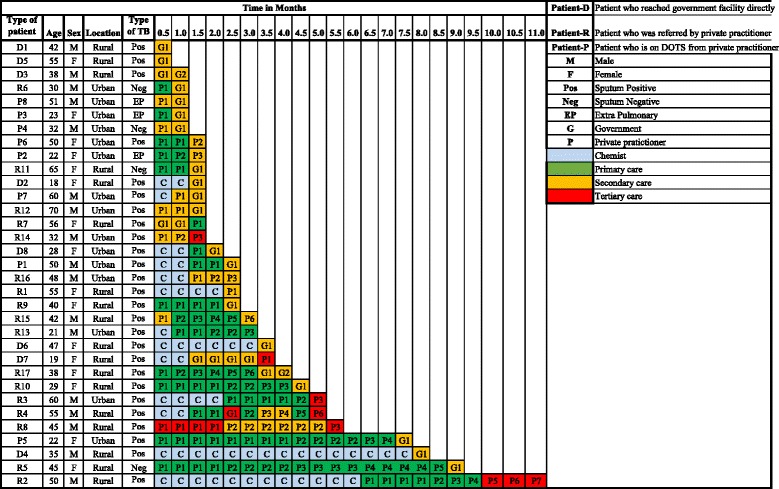
We conducted in-depth interviews on a purposive sample of 33 TB patients and 38 PPs. Patients were categorised into three groups: those who reached RNTCP directly, those who were referred by PPs to RNTCP and patients who took DOT from PPs. We assessed patient's experiences in each category and documented their journey from initial symptoms until they reached RNTCP, where they were diagnosed and started on treatment. PPs were categorised into three groups based on their TB case referrals to RNTCP: actively-referring, minimally-referring and non-referring.
Patients had limited awareness about TB. Patients switched from one provider to the other, since their symptoms were not relieved. A first group of patients, self-medicated by purchasing get rid drugs from private chemists over the counter, before seeking care. A second group sought care from government facilities and had simple itineraries. A third group who sought care from PPs, switched concurrently and/or iteratively from public and private providers in search for relief of symptoms causing important diagnostic delays. Eventually all patients reached RNTCP, diagnosed and started on treatment. PP's cross-referral practices were influenced by patient's paying capacity, familiarity with RNTCP, kickbacks from private labs and chemists, and even to get rid of TB patients. These trade-offs by PPs complicated patient's itineraries to RNTCP.
India aims to achieve universal health care for TB. Our study findings help RNTCP to develop initiatives to promote early detection of TB, by involving PPs and private chemists and establish effective referral systems from private sectors to RNTCP.
印度修订后的国家结核病控制规划(RNTCP)提供免费的结核病诊断和治疗。但超过50%的结核病患者会寻求私人执业医生(PPs)的治疗,而在私人执业医生处,结核病的治疗并不理想。在印度,缺乏关于结核病患者在医疗机构间寻求治疗时的经历的研究。此外,关于私人执业医生如何决定将结核病病例转诊至RNTCP的信息也较少。我们开展这项研究,以了解影响结核病患者前往RNTCP治疗路径的因素,以及私人执业医生与RNTCP相关的交叉转诊做法。
我们对33名结核病患者和38名私人执业医生进行了有目的抽样的深入访谈。患者被分为三组:直接前往RNTCP的患者、由私人执业医生转诊至RNTCP的患者以及接受私人执业医生直接观察治疗(DOT)的患者。我们评估了每组患者的经历,并记录了他们从出现初始症状到抵达RNTCP进行诊断和开始治疗的过程。私人执业医生根据其向RNTCP转诊结核病病例的情况被分为三组:积极转诊、极少转诊和不转诊。
患者对结核病的认知有限。由于症状未缓解,患者会从一个医疗机构转到另一个医疗机构。第一组患者在寻求治疗前,通过从私人药店购买非处方的抗结核药物进行自我治疗。第二组患者前往政府医疗机构就诊,就医路径简单。第三组患者寻求私人执业医生的治疗,他们同时和/或反复在公立和私立医疗机构间辗转,以寻求症状缓解,这导致了重要的诊断延误。最终,所有患者都抵达RNTCP,得到诊断并开始治疗。私人执业医生的交叉转诊做法受到患者支付能力、对RNTCP的熟悉程度、来自私人实验室和药店的回扣,甚至是摆脱结核病患者的影响。私人执业医生的这些权衡使患者前往RNTCP的就医路径变得复杂。
印度旨在实现结核病的全民医疗保健。我们的研究结果有助于RNTCP制定相关举措,通过让私人执业医生和私人药店参与进来,促进结核病的早期发现,并建立从私营部门到RNTCP的有效转诊系统。