Department of Biochemistry and Molecular and Cellular Biology, Faculty of Sciences, and Institute of Biocomputation and Physics of Complex Systems (Joint Units: BIFI-IQFR and GBsC-CSIC), University of Zaragoza, Zaragoza, Spain.
Centro de Investigaciones Biológicas, CSIC, Ramiro de Maeztu 9, Madrid, Spain.
Sci Rep. 2017 Aug 4;7(1):7281. doi: 10.1038/s41598-017-07875-5.
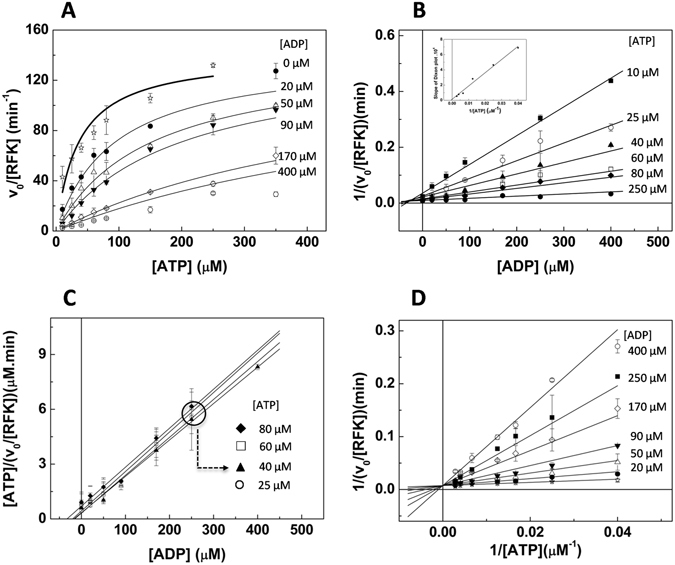
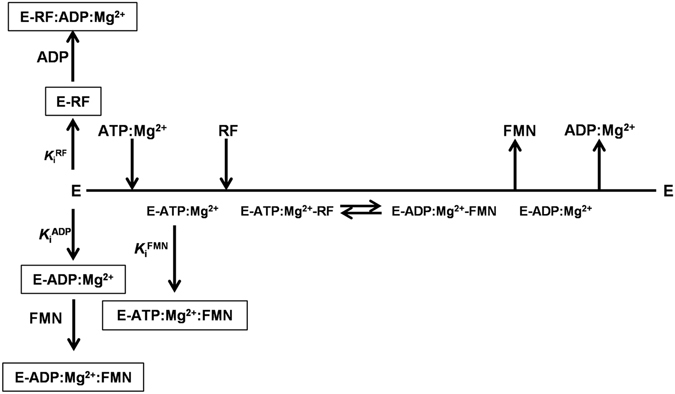
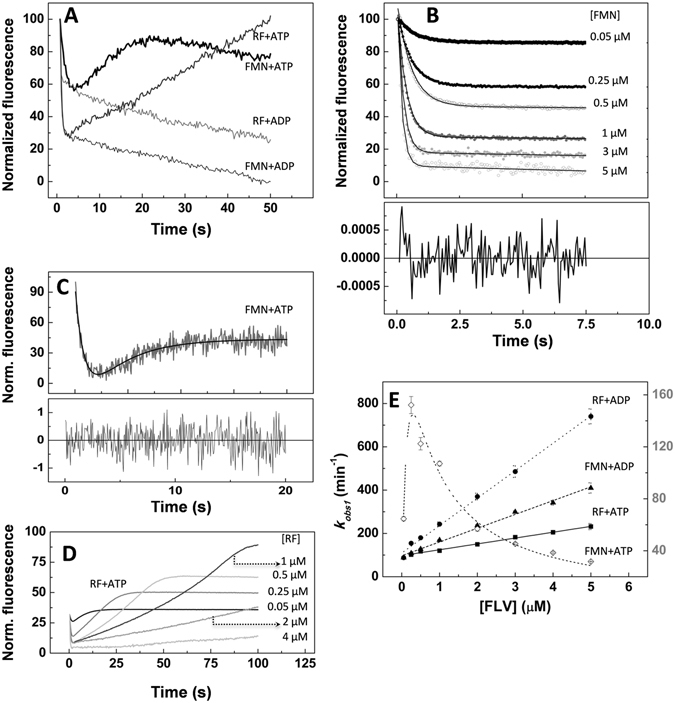
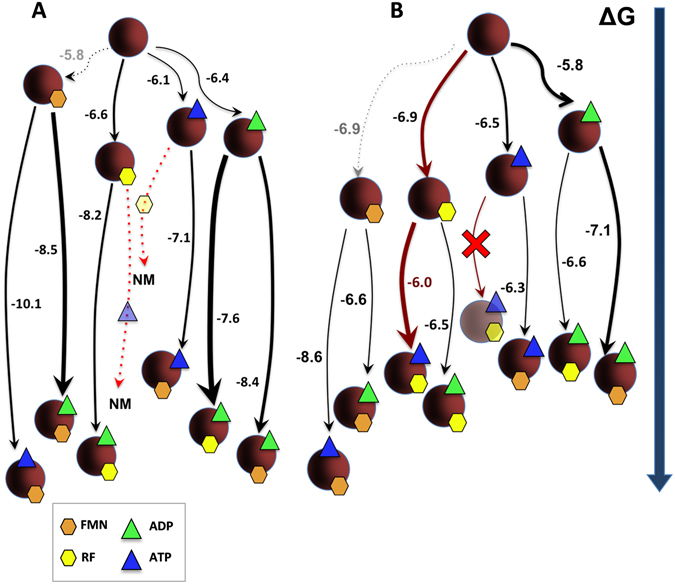
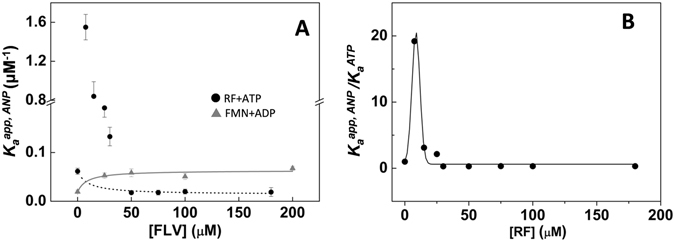
Enzymes known as bifunctional and bimodular prokaryotic type-I FAD synthetase (FADS) exhibit ATP:riboflavin kinase (RFK) and FMN:ATP adenylyltransferase (FMNAT) activities in their C-terminal and N-terminal modules, respectively, and produce flavin mononucleotide (FMN) and flavin adenine dinucleotide (FAD). These act as cofactors of a plethora of flavoproteins in all organisms. Therefore, regulation of their production maintains the cellular flavoproteome homeostasis. Here, we focus on regulation of the FMN synthesis in Corynebacterium ammoniagenes (Ca) by the inhibition of its RFK activity by substrates and products of the reaction. We use a truncated CaFADS variant consisting in the isolated C-terminal RFK module, whose RFK activity is similar to that of the full-length enzyme. Inhibition of the RFK activity by the RF substrate is independent of the FMNAT module, and FMN production, in addition to being inhibited by an excess of RF, is also inhibited by both of the reaction products. Pre-steady-state kinetic and thermodynamic studies reveal key aspects to the substrates induced fit to produce the catalytically competent complex. Among them, the role of Mg in the concerted allocation of substrates for catalysis and the ensemble of non-competent complexes that contribute to the regulated inhibition of the RFK activity are particularly relevant.
已知具有双功能和双模块原核 I 型 FAD 合酶 (FADS) 的酶在其 C 末端和 N 末端模块中分别表现出 ATP:核黄素激酶 (RFK) 和 FMN:ATP 腺苷酰转移酶 (FMNAT) 的活性,并产生黄素单核苷酸 (FMN) 和黄素腺嘌呤二核苷酸 (FAD)。这些在所有生物体中的黄素蛋白作为辅因子。因此,它们的产生的调节维持了细胞黄素蛋白组的动态平衡。在这里,我们专注于通过反应的底物和产物抑制 Corynebacterium ammoniagenes (Ca) 中的 FMN 合成来调节 FMN 合成。我们使用由分离的 C 末端 RFK 模块组成的截断 CaFADS 变体,其 RFK 活性与全长酶相似。RFK 活性的抑制是独立于 FMNAT 模块的,FMN 的产生除了受到 RF 过量的抑制外,还受到两种反应产物的抑制。预稳态动力学和热力学研究揭示了底物诱导契合产生催化活性复合物的关键方面。其中,Mg 在协调分配用于催化的底物以及有助于 RFK 活性调节抑制的非活性复合物集合中的作用特别重要。