Saint Catherine A, Castelli Michelle R, Crannage Andrew J, Stacy Zachary A, Hennessey Erin K
Mercy Hospital St. Louis, St. Louis, MO, USA.
UC San Diego Health, San Diego, CA, USA.
SAGE Open Med. 2017 Jul 18;5:2050312117719628. doi: 10.1177/2050312117719628. eCollection 2017.
Existing research comparing hospital length of stay for patients treated with non-vitamin K oral anticoagulants or parenteral bridging to warfarin has been conducted primarily with the agent rivaroxaban. The objective of this study was to compare hospital length of stay between patients initiated on the non-vitamin K oral anticoagulants, apixaban or rivaroxaban, and patients initiated on parenteral anticoagulation agents plus warfarin for the treatment of venous thromboembolism.
A retrospective cohort study was conducted at an 859-bed, not-for-profit, teaching hospital. Adult patients admitted for a primary diagnosis of venous thromboembolism between 1 November 2012 and 31 August 2015 and treated with apixaban or rivaroxaban or a parenteral anticoagulant plus warfarin were included in the study. Eligible patients were identified using codes for a primary diagnosis of acute thromboses and emboli and medication administration record data. Individuals using anticoagulation therapy prior to admission, released from the emergency department, or treated with thrombectomy or fibrinolytic therapy were excluded.
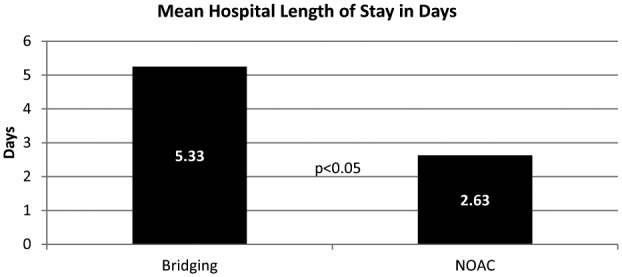
A total of 152 patients were included in this study. Patient characteristics, including renal function, were similar between study arms. Venous thromboembolism treatment with apixaban or rivaroxaban compared to a parenteral anticoagulant plus warfarin was associated with a reduced hospital length of stay (2.63 vs 5.33 days; p < 0.05) and decreased total hospital cost adjusted to 2015 dollars (US$21,694 vs US$38,851; p = 0.013).
These results suggest that treatment with a non-vitamin K anticoagulant may significantly reduce hospital length of stay and total hospital cost compared to a parenteral anticoagulant plus warfarin for patients admitted for venous thromboembolism.
现有的比较接受非维生素K口服抗凝剂治疗的患者或接受肠外桥接华法林治疗的患者的住院时间的研究主要使用利伐沙班进行。本研究的目的是比较开始使用非维生素K口服抗凝剂阿哌沙班或利伐沙班的患者与开始使用肠外抗凝剂加华法林治疗静脉血栓栓塞的患者之间的住院时间。
在一家拥有859张床位的非营利性教学医院进行了一项回顾性队列研究。纳入2012年11月1日至2015年8月31日期间因静脉血栓栓塞的初步诊断入院并接受阿哌沙班或利伐沙班或肠外抗凝剂加华法林治疗的成年患者。使用急性血栓形成和栓塞的初步诊断代码以及药物给药记录数据识别符合条件的患者。排除入院前使用抗凝治疗、从急诊科出院或接受血栓切除术或纤维蛋白溶解治疗的个体。
本研究共纳入152例患者。各研究组之间的患者特征,包括肾功能,相似。与肠外抗凝剂加华法林相比,使用阿哌沙班或利伐沙班治疗静脉血栓栓塞与缩短住院时间相关(2.63天对5.33天;p<0.05),并降低了调整为2015年美元的总住院费用(21,694美元对38,851美元;p=0.013)。
这些结果表明,对于因静脉血栓栓塞入院的患者,与肠外抗凝剂加华法林相比,使用非维生素K抗凝剂治疗可能会显著缩短住院时间并降低总住院费用。