Bachler Egon, Fruehmann Alexander, Bachler Herbert, Aas Benjamin, Nickel Marius, Schiepek Guenter K
PMU Institute Synergetic and Psychotherapy ResearchSalzburg, Austria.
Institute for Psychoanalysis and FamilytherapySalzburg, Austria.
Front Psychol. 2017 Jul 21;8:1221. doi: 10.3389/fpsyg.2017.01221. eCollection 2017.
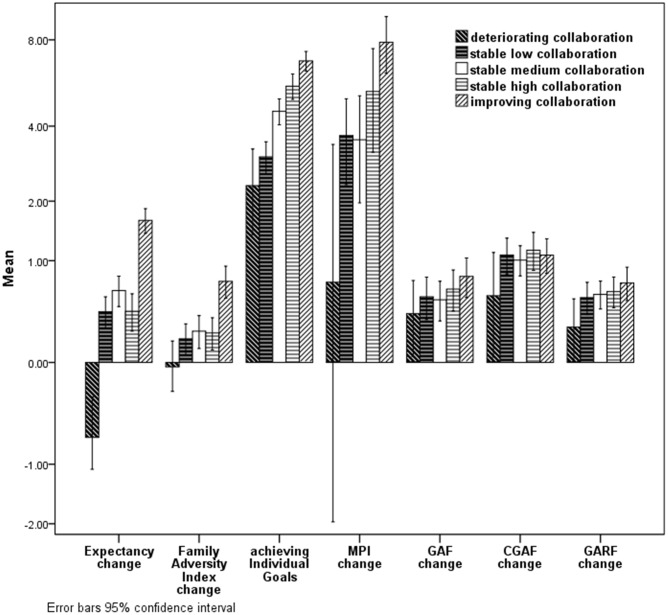
The present study validates the Multi-Problem Family (MPF)-Collaboration Scale), which measures the progress of goal directed collaboration of patients in the treatment of families with MPF and its relation to drop-out rates and treatment outcome. Naturalistic study of symptom and competence-related changes in children of ages 4-18 and their caregivers. Integrative, structural outreach family therapy. The data of five different groups of goal directed collaboration (deteriorating collaboration, stable low collaboration, stable medium collaboration, stable high collaboration, improving collaboration) were analyzed in their relation to treatment expectation, individual therapeutic goals (ITG), family adversity index, severity of problems and global assessment of a caregiver's functioning, child, and relational aspects. From = 810 families, 20% displayed stable high collaboration ( = 162) and 21% had a pattern of improving collaboration. The families with stable high or improving collaboration rates achieved significantly more progress throughout therapy in terms of treatment outcome expectancy ( = 0.96; = 0.43), reaching ITG ( = 1.17; = 0.50), family adversities ( = 0.55; = 0.26), and severity of psychiatric symptoms ( = 0.31; = 0.15). Furthermore, families with stable high or improving collaboration maintained longer treatments and had a bigger chance of finishing the therapy as planned. The odds of having a stable low or deteriorating collaboration throughout treatment were significantly higher for subjects who started treatment with low treatment expectation or high family-related adversities. The positive outcomes of homebased interventions for multi-problem families are closely related to "stable high" and an "improving" collaboration as measured with the MPF-Collaboration Scale. Patients who fall into these groups have a high treatment outcome expectancy and reduce psychological stress. For therapeutic interventions with multi-problem families it seems beneficial to maintain a stable high collaboration or help the collaboration, e.g., by fostering treatment expectation.
本研究验证了多问题家庭(MPF)协作量表,该量表用于衡量MPF家庭治疗中患者目标导向协作的进展情况及其与退出率和治疗结果的关系。对4至18岁儿童及其照顾者的症状和能力相关变化进行自然主义研究。采用综合、结构化的外展家庭治疗方法。分析了五组不同的目标导向协作(协作恶化、稳定低协作、稳定中等协作、稳定高协作、协作改善)的数据与治疗期望、个体治疗目标(ITG)、家庭逆境指数、问题严重程度以及照顾者功能、儿童和关系方面的整体评估之间的关系。在810个家庭中,20%表现出稳定的高协作(n = 162),21%呈现协作改善的模式。协作率稳定高或改善的家庭在整个治疗过程中,在治疗结果期望(r = 0.96;p = 0.43)、实现ITG(r = 1.17;p = 0.50)、家庭逆境(r = 0.55;p = 0.26)和精神症状严重程度(r = 0.31;p = 0.15)方面取得了显著更多的进展。此外,协作率稳定高或改善的家庭治疗时间更长,按计划完成治疗的机会更大。开始治疗时治疗期望低或家庭相关逆境高的受试者在整个治疗过程中协作稳定低或恶化的几率显著更高。多问题家庭的家庭干预积极结果与MPF协作量表所衡量的“稳定高”和“改善”协作密切相关。属于这些组的患者有较高的治疗结果期望并减轻心理压力。对于多问题家庭的治疗干预,维持稳定的高协作或帮助改善协作,例如通过提高治疗期望,似乎是有益的。