Tims Maria, Akkermans Jos
Department of Management and Organization, Faculty of Economics and Business Administration, Vrije Universiteit Amsterdam, Amsterdam, The Netherlands.
PLoS One. 2017 Aug 7;12(8):e0182745. doi: 10.1371/journal.pone.0182745. eCollection 2017.
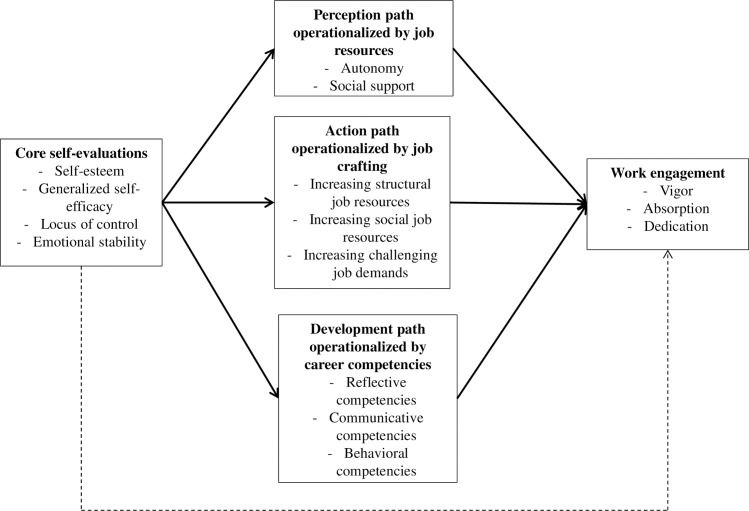
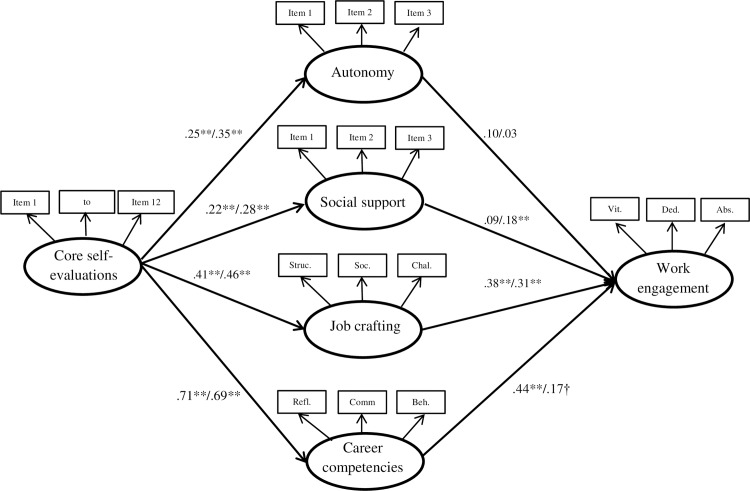
Core self-evaluations (CSE) have predictive value for important work outcomes such as job satisfaction and job performance. However, little is known about the mechanisms that may explain these relationships. The purpose of the present study is to contribute to CSE theory by proposing and subsequently providing a first test of theoretically relevant mediating paths through which CSE may be related to work engagement. Based on approach/avoidance motivation and Job Demands-Resources theory, we examined a perception (via job characteristics), action (via job crafting), and development path (via career competencies). Two independent samples were obtained from employees working in Germany and The Netherlands (N = 303 and N = 404, respectively). When taking all mediators into account, results showed that the perception path represented by autonomy and social support played a minor role in the relationship between CSE and work engagement. Specifically, autonomy did not function as a mediator in both samples while social support played a marginally significant role in the CSE-work engagement relationship in sample 1 and received full support in sample 2. The action path exemplified by job crafting mediated the relationship between CSE and work engagement in both samples. Finally, the development path operationalized with career competencies mediated the relationship between CSE and work engagement in sample 1. The study presents evidence for an action and development path over and above the often tested perception path to explain how CSE is related to work engagement. This is one of the first studies to propose and show that CSE not only influences perceptions but also triggers employee actions and developmental strategies that relate to work engagement.
核心自我评价(CSE)对工作满意度和工作绩效等重要工作成果具有预测价值。然而,对于可能解释这些关系的机制,我们却知之甚少。本研究的目的是通过提出并随后首次检验理论上相关的中介路径,为CSE理论做出贡献,通过这些路径CSE可能与工作投入相关。基于趋近/回避动机和工作需求-资源理论,我们考察了一条认知路径(通过工作特征)、一条行动路径(通过工作重塑)和一条发展路径(通过职业能力)。从在德国和荷兰工作的员工中获取了两个独立样本(分别为N = 303和N = 404)。当将所有中介变量都考虑在内时,结果表明,由自主性和社会支持所代表的认知路径在CSE与工作投入的关系中作用较小。具体而言,在两个样本中自主性都未起到中介作用,而社会支持在样本1的CSE-工作投入关系中起到了边缘显著的作用,在样本2中则得到了完全支持。以工作重塑为例的行动路径在两个样本中都中介了CSE与工作投入的关系。最后,用职业能力来操作化的发展路径在样本1中介了CSE与工作投入的关系。该研究为一条行动和发展路径提供了证据,这条路径超越了经常被检验的认知路径,用以解释CSE如何与工作投入相关。这是首批提出并表明CSE不仅影响认知,还会触发与工作投入相关的员工行动和发展策略的研究之一。