Navarro Mirtha, Zamora William, Quesada Silvia, Azofeifa Gabriela, Alvarado Diego, Monagas Maria
Department of Chemistry, University of Costa Rica (UCR), Sede Rodrigo Facio, San Pedro de Montes de Oca, San José 2060, Costa Rica.
Department of Biochemistry, Faculty of Medicine, University of Costa Rica (UCR), Sede Rodrigo Facio, San Pedro de Montes de Oca, San Jose 2060, Costa Rica.
Antioxidants (Basel). 2017 Jul 28;6(3):60. doi: 10.3390/antiox6030060.
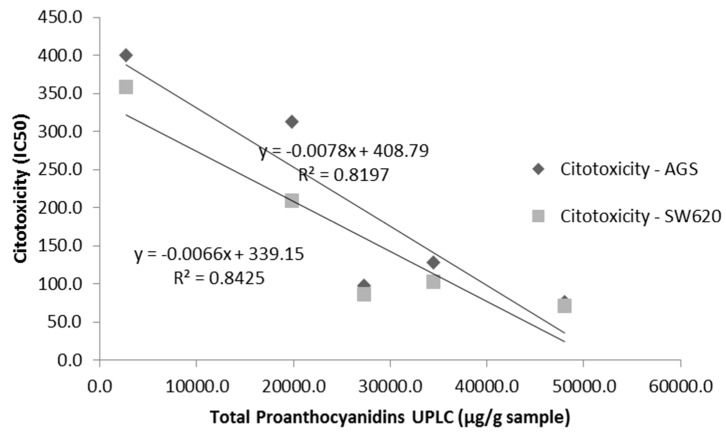
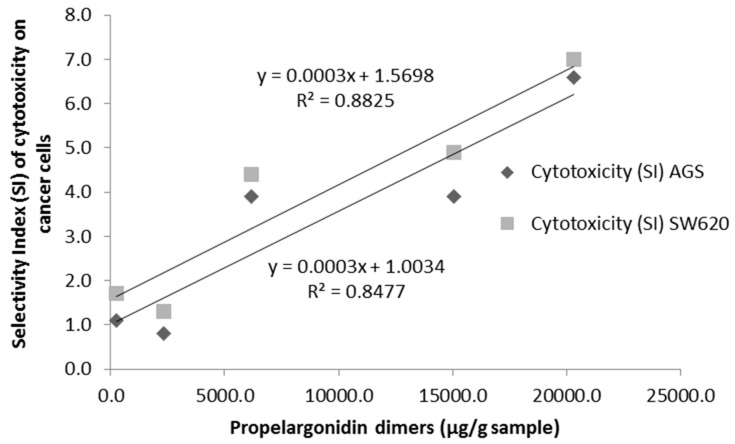
In a previous study, the detailed low-molecular weight polyphenolic profile of the different plant parts (leaves, stem, bark and wood) of was reported, the leaves being the plant part with the highest phenolic content and presenting the most heterogenous proanthocyanidin composition. Further, cytotoxicity of leaves extracts in two cancer cell lines was also found to be higher than in the remaining parts of the plant. In the present study, fractioning of leaves polyphenolic extracts was performed using Diaion HP-20 resin and a detailed characterization and quantification of fractions ( = 5) was achieved using advanced analytical techniques such as Ultra-Performance Liquid Chromatography coupled with Electrospray Ionization and Triple Quadrupole (TQD) Tandem Mass Spectrometry (UPLC/TQ-ESI-MS) and C-NMR. Oxygen Radical Absorbance Capacity (ORAC) and cytotoxicity on gastric adenocarcinoma AGS and colon adenocarcinoma SW20 cell lines were also determined in the different fractions. Results showed selective distribution of 32 non-flavonoid and flavonoid phenolics among the different fractions. ORAC varied between 3.2 and 11.8 μmol TE/mg in the different fractions, whereas IC of cytotoxicity on gastric adenocarcinoma AGS and colon adenocarcinoma SW20 cell lines best values were between 71.4 and 75.6 µg/mL. Fractions rich in proanthocyanidins also showed the highest bioactivity. In fact, significant positive correlation was found between total proanthocyanidins (TP) quantified by UPLC-DAD and ORAC (² = 0.970), whereas significant negative correlation was found between TP and cytotoxicity towards AGS (² = 0.820) and SW620 (² = 0.843) adenocarcinoma cell lines. Among proanthocyanidins, propelargonidin dimers were of particular interest, showing significant correlation with cytotoxic selectivity on both gastric AGS (² = 0.848) and colon SW620 (² = 0.883) adenocarcinoma cell lines. These results show further evidence of the bioactivity of proanthocyanidin extracts and their potential health effects.
在之前的一项研究中,报道了某植物不同部位(叶、茎、树皮和木材)的详细低分子量多酚谱,叶是酚类含量最高的植物部位,且其原花青素组成最为多样。此外,还发现叶提取物对两种癌细胞系的细胞毒性也高于该植物的其他部位。在本研究中,使用Diaion HP - 20树脂对该植物叶多酚提取物进行了分级分离,并采用超高效液相色谱联用电喷雾电离和三重四极杆(TQD)串联质谱(UPLC/TQ - ESI - MS)以及碳核磁共振(C - NMR)等先进分析技术对各馏分(n = 5)进行了详细表征和定量分析。还测定了不同馏分对胃腺癌AGS细胞系和结肠腺癌SW20细胞系的氧自由基吸收能力(ORAC)和细胞毒性。结果表明,32种非黄酮类和黄酮类酚类物质在不同馏分中呈选择性分布。不同馏分的ORAC在3.2至11.8 μmol TE/mg之间变化,而对胃腺癌AGS细胞系和结肠腺癌SW20细胞系的细胞毒性IC50最佳值在71.4至75.6 μg/mL之间。富含原花青素的馏分也表现出最高的生物活性。事实上,通过UPLC - DAD定量的总原花青素(TP)与ORAC之间存在显著正相关(r² = 0.970),而TP与对AGS(r² = 0.82)和SW620(r² = 0.843)腺癌细胞系的细胞毒性之间存在显著负相关。在原花青素中,原天竺葵素二聚体特别受关注,它与对胃AGS(r² = 0.848)和结肠SW620(r² = 0.883)腺癌细胞系的细胞毒性选择性显著相关。这些结果进一步证明了该植物原花青素提取物的生物活性及其潜在的健康影响。