Lopes Adriana A, Coppede Juliana da Silva, Amatto Pedro de Pádua G, Aragon Davi Casale, França Suzelei de Castro, Carmona Fabio, Pereira Ana Maria S
Biotechnology Unit, University of Ribeirão Preto (UNAERP), Ribeirão Preto, São Paulo, Brazil.
Ribeirão Preto Medical School, University of São Paulo, Ribeirão Preto, São Paulo, Brazil.
Front Pharmacol. 2025 May 14;16:1584840. doi: 10.3389/fphar.2025.1584840. eCollection 2025.
(cat's claw) is a medicinal plant with documented immunomodulatory and anti-inflammatory properties. Recent studies suggest potential anticancer effects, but evidence remains fragmented.
This systematic review aimed to assess the cytotoxic effects of different extracts or fractions on normal and cancer cells, summarizing studies.
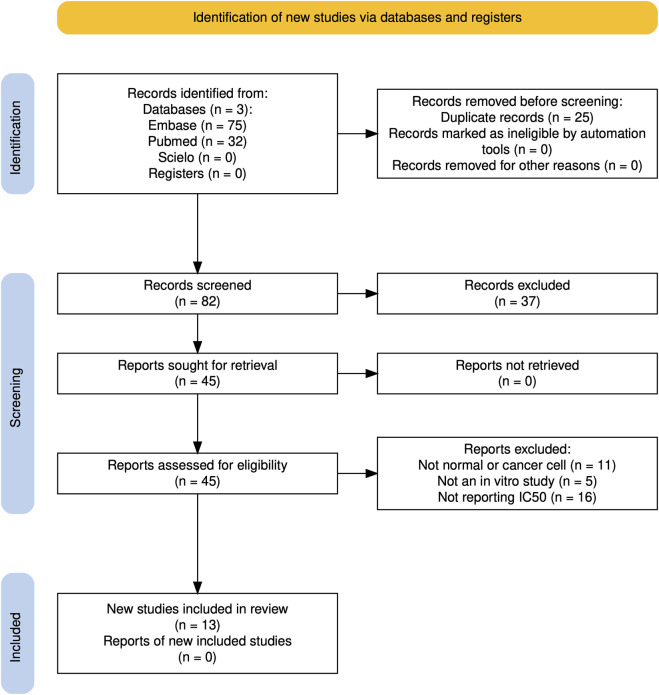
A systematic search was conducted in PubMed, Embase, and Scielo up to January 2025, following PRISMA guidelines. Inclusion criteria comprised studies evaluating extracts or fractions on normal and cancer cells, reporting IC values or equivalent measures. Data on plant part, extraction method, and chemical composition were collected. Risk of bias was assessed using the modified CAMARADES checklist.
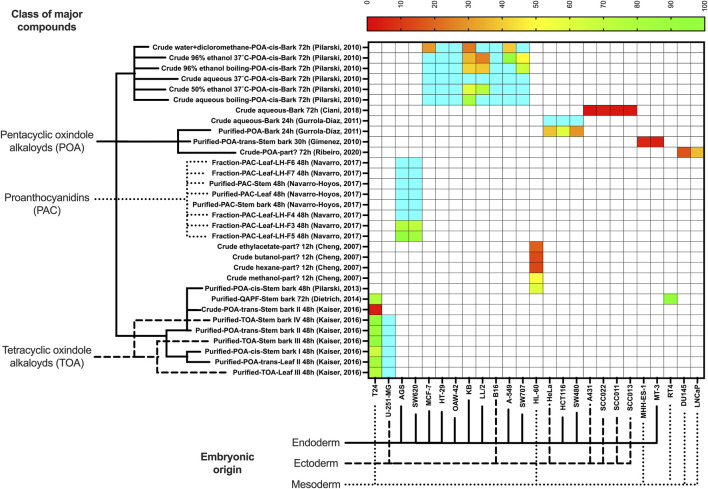
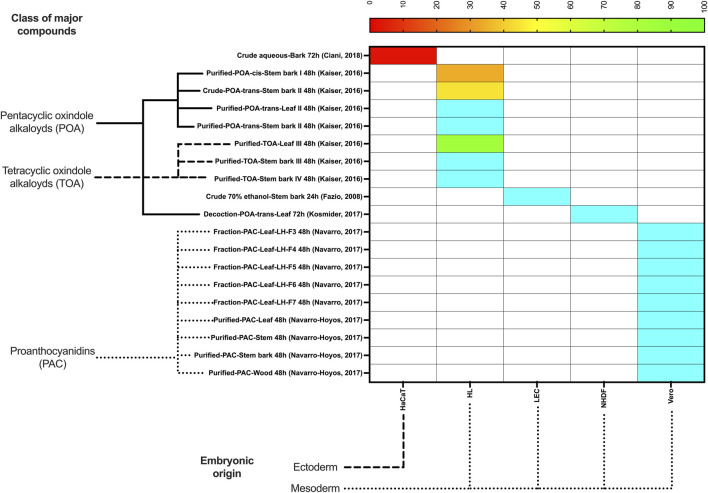
Thirteen studies met the eligibility criteria. extracts exhibited selective cytotoxicity in some cancer cell lines. The most promising findings were observed for crude aqueous bark extracts (72 h incubation) against squamous cell carcinoma and pentacyclic oxindole alkaloid (POA)-rich extracts against prostate cancer and leukemia. In contrast, tetracyclic oxindole alkaloid (TOA)- and proanthocyanidin (PAC)-rich fractions showed limited cytotoxicity. Most extracts were non-toxic to normal cells, except for the crude aqueous bark extract, which exhibited cytotoxicity in keratinocytes.
has potential as a source of selective anticancer agents, particularly through crude aqueous bark and POA-rich extracts. The observed cytotoxic effects vary considerably depending on the extraction method and chemical composition, underscoring the need for standardization in future studies. Further standardized studies and mechanistic investigations are required to validate its therapeutic potential for cancer treatment.
猫爪草是一种具有免疫调节和抗炎特性记录的药用植物。最近的研究表明其具有潜在的抗癌作用,但证据仍然零散。
本系统评价旨在评估不同提取物或馏分对正常细胞和癌细胞的细胞毒性作用,总结相关研究。
按照PRISMA指南,截至2025年1月在PubMed、Embase和Scielo中进行了系统检索。纳入标准包括评估提取物或馏分对正常细胞和癌细胞作用、报告IC值或等效测量指标的研究。收集了关于植物部位、提取方法和化学成分的数据。使用改良的CAMARADES清单评估偏倚风险。
13项研究符合纳入标准。提取物在某些癌细胞系中表现出选择性细胞毒性。最有前景的发现是粗制水树皮提取物(孵育72小时)对鳞状细胞癌的作用,以及富含五环氧化吲哚生物碱(POA)的提取物对前列腺癌和白血病的作用。相比之下,富含四环氧化吲哚生物碱(TOA)和原花青素(PAC)的馏分显示出有限的细胞毒性。除了粗制水树皮提取物对角质形成细胞具有细胞毒性外,大多数提取物对正常细胞无毒。
猫爪草有潜力作为选择性抗癌剂的来源,特别是通过粗制水树皮提取物和富含POA的提取物。观察到的细胞毒性作用因提取方法和化学成分而异,这突出了未来研究中标准化的必要性。需要进一步的标准化研究和机制研究来验证其在癌症治疗中的治疗潜力。