Buchan Iain E, Kontopantelis Evangelos, Sperrin Matthew, Chandola Tarani, Doran Tim
Farr Institute, Faculty of Biology Medicine and Health, University of Manchester, Manchester, UK.
Manchester Academic Health Science Centre, University of Manchester, Manchester, UK.
J Epidemiol Community Health. 2017 Sep;71(9):928-936. doi: 10.1136/jech-2017-209195. Epub 2017 Aug 7.
Social, economic and health disparities between northern and southern England have persisted despite Government policies to reduce them. We examine long-term trends in premature mortality in northern and southern England across age groups, and whether mortality patterns changed after the 2008-2009 Great Recession.
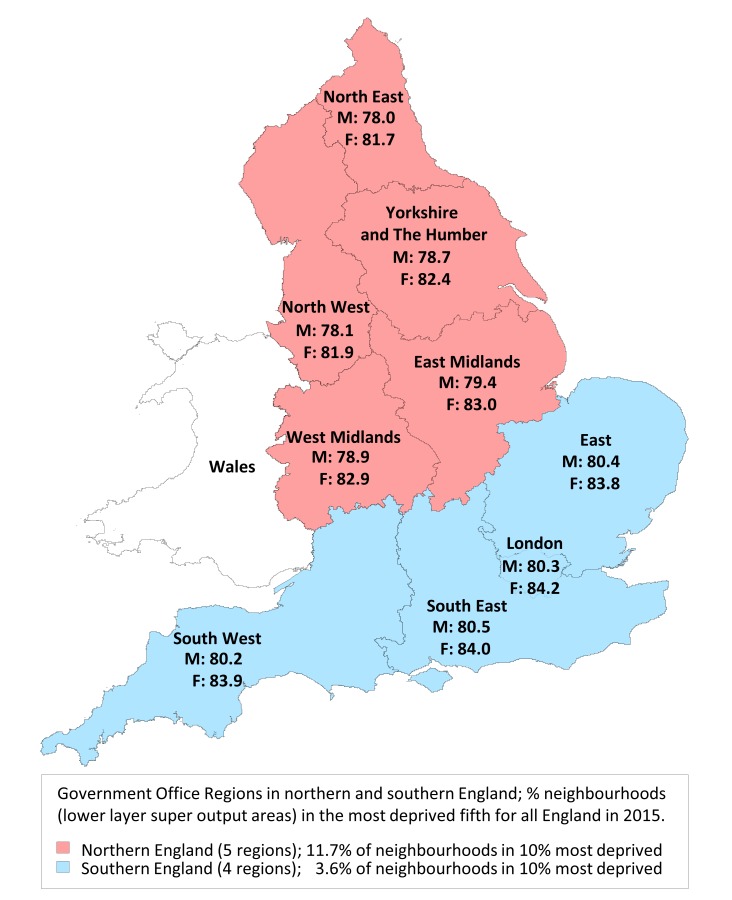
Population-wide longitudinal (1965-2015) study of mortality in England's five northernmost versus four southernmost Government Office Regions - halves of overall population.
directly age-sex adjusted mortality rates; northern excess mortality (percentage excess northern vs southern deaths, age-sex adjusted).
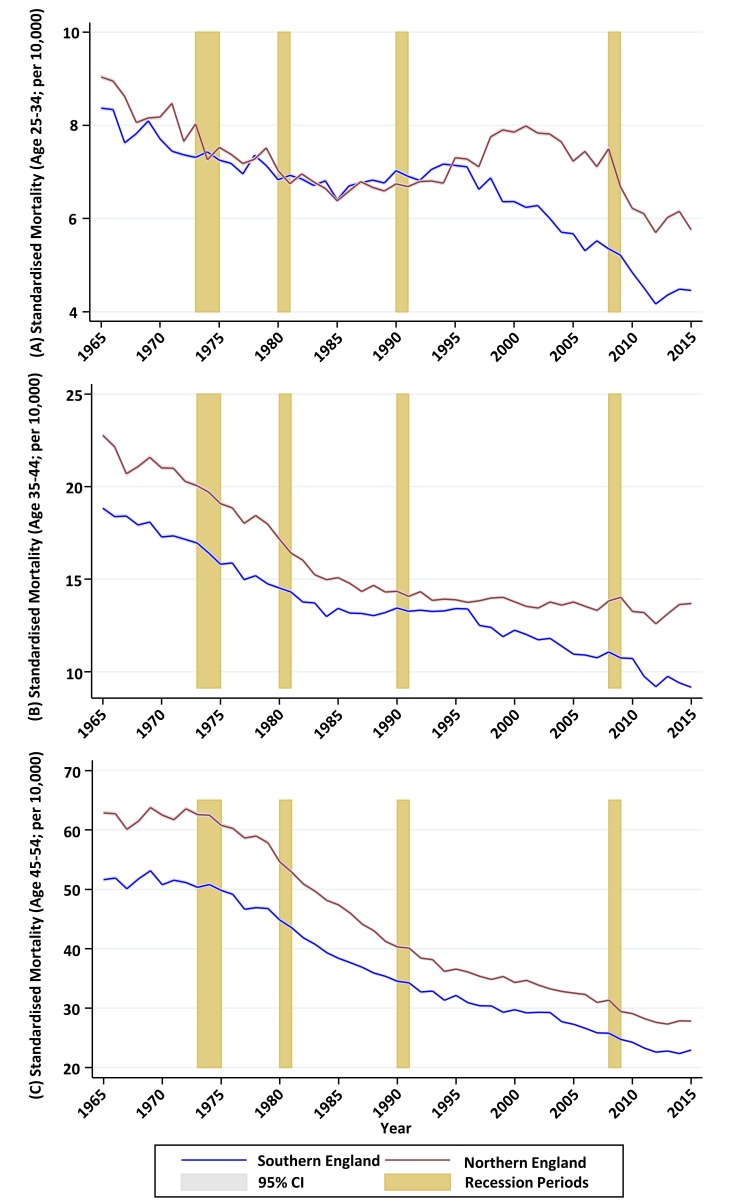
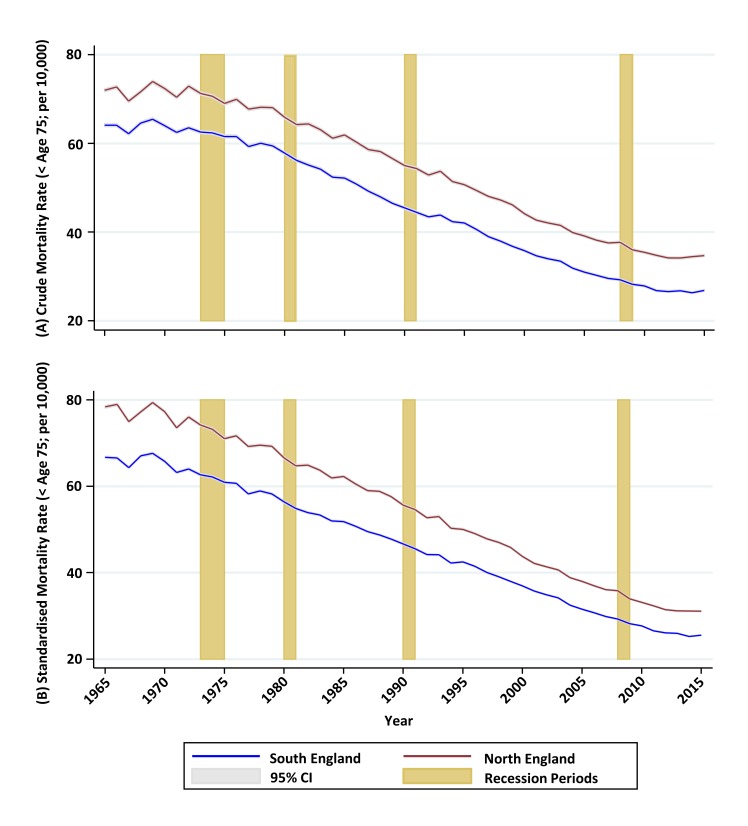
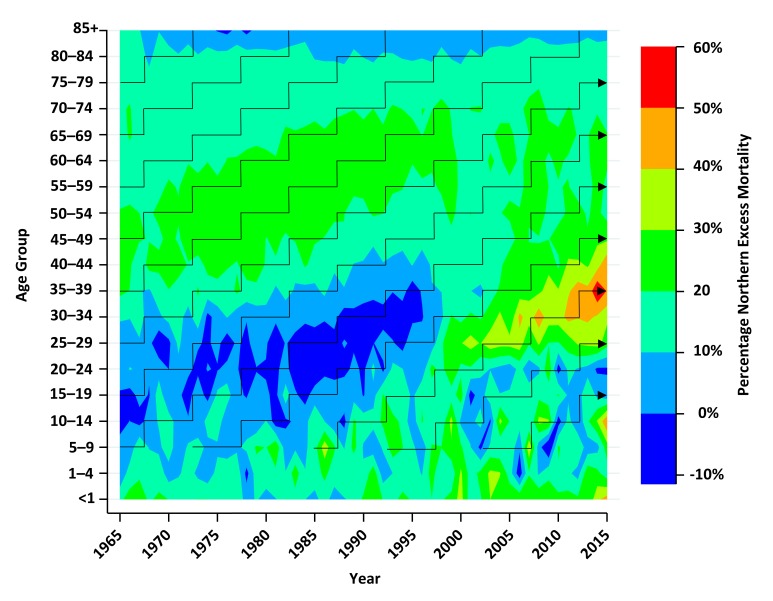
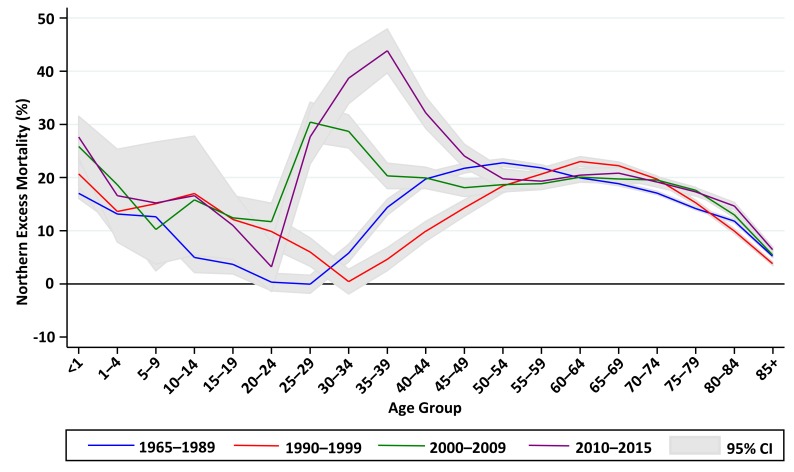
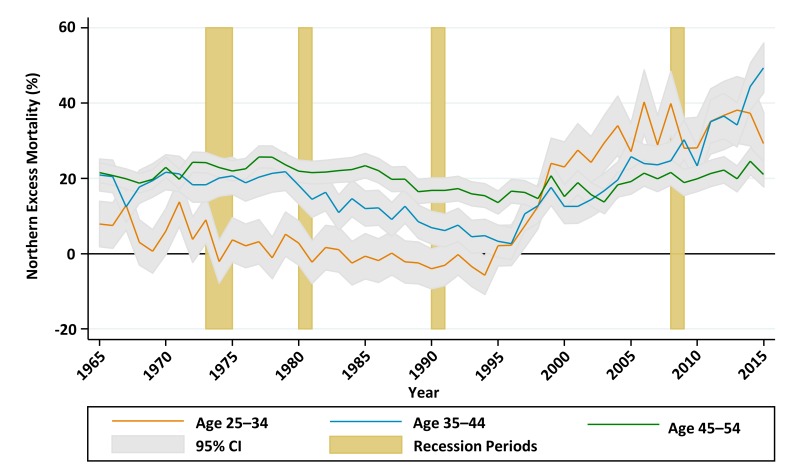
From 1965 to 2010, premature mortality (deaths per 10 000 aged <75 years) declined from 64 to 28 in southern versus 72 to 35 in northern England. From 2010 to 2015 the rate of decline in premature mortality plateaued in northern and southern England. For most age groups, northern excess mortality remained consistent from 1965 to 2015. For 25-34 and 35-44 age groups, however, northern excess mortality increased sharply between 1995 and 2015: from 2.2% (95% CI -3.2% to 7.6%) to 29.3% (95% CI 21.0% to 37.6%); and 3.3% (95% CI -1.0% to 7.6%) to 49.4% (95% CI 42.8% to 55.9%), respectively. This was due to northern mortality increasing (ages 25-34) or plateauing (ages 35-44) from the mid-1990s while southern mortality mainly declined.
England's northern excess mortality has been consistent among those aged <25 and 45+ for the past five decades but risen alarmingly among those aged 25-44 since the mid-90s, long before the Great Recession. This profound and worsening structural inequality requires more equitable economic, social and health policies, including potential reactions to the England-wide loss of improvement in premature mortality.
尽管政府出台了旨在减少英格兰北部和南部之间社会、经济和健康差距的政策,但这些差距依然存在。我们研究了英格兰北部和南部各年龄组过早死亡率的长期趋势,以及2008 - 2009年大衰退后死亡率模式是否发生了变化。
对英格兰最北部的五个与最南部的四个政府办公区(占总人口的一半)进行全人群纵向(1965 - 2015年)死亡率研究。
直接按年龄 - 性别调整的死亡率;北部超额死亡率(经年龄 - 性别调整后,北部死亡人数比南部多的百分比)。
1965年至2010年,过早死亡率(每10000名75岁以下人群中的死亡人数)在英格兰南部从64降至28,在北部从72降至35。2010年至2015年,英格兰北部和南部过早死亡率的下降速度趋于平稳。在大多数年龄组中,1965年至2015年期间北部超额死亡率保持稳定。然而,在25 - 34岁和35 - 44岁年龄组中,1995年至2015年期间北部超额死亡率急剧上升:分别从2.2%(95%置信区间 - 3.2%至7.6%)升至29.3%(95%置信区间21.0%至37.6%);以及从3.3%(95%置信区间 - 1.0%至7.6%)升至49.4%(95%置信区间42.8%至55.9%)。这是由于自20世纪90年代中期起,北部死亡率上升(25 - 34岁年龄组)或趋于平稳(35 - 44岁年龄组),而南部死亡率主要呈下降趋势。
在过去五十年中,英格兰25岁以下和45岁以上人群的北部超额死亡率一直保持稳定,但自90年代中期以来,25 - 44岁人群的北部超额死亡率急剧上升,这远早于大衰退。这种严重且不断恶化的结构性不平等需要更公平的经济、社会和健康政策,包括应对英格兰过早死亡率改善情况停滞不前的潜在措施。