School of Health and Related Research, University of Sheffield, Sheffield, UK.
Centre for Health Economics, University of York, York, UK.
Health Qual Life Outcomes. 2022 Aug 2;20(1):121. doi: 10.1186/s12955-022-02024-7.
Socioeconomic status is a key predictor of lifetime health: poorer people can expect to live shorter lives with lower average health-related quality-of-life (HRQoL) than richer people. In this study, we aimed to improve understanding of the socioeconomic gradient in HRQoL by exploring how inequalities in different dimensions of HRQoL differ by age.
Data were derived from the Health Survey for England for 2017 and 2018 (14,412 participants). HRQoL was measured using the EQ-5D-5L instrument. We estimated mean EQ-5D utility scores and reported problems on five HRQoL dimensions (mobility, self-care, usual activities, pain/discomfort, anxiety/depression) for ages 16 to 90+ and stratified by neighbourhood deprivation quintiles. Relative and absolute measures of inequality were assessed.
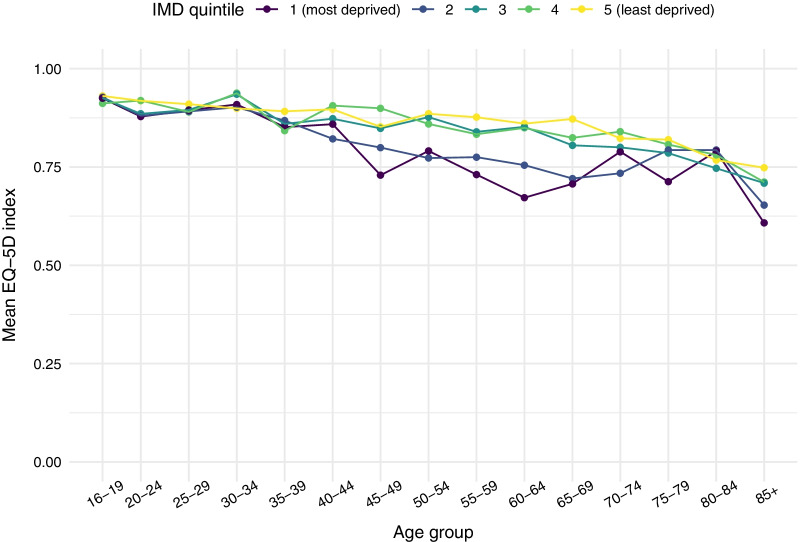
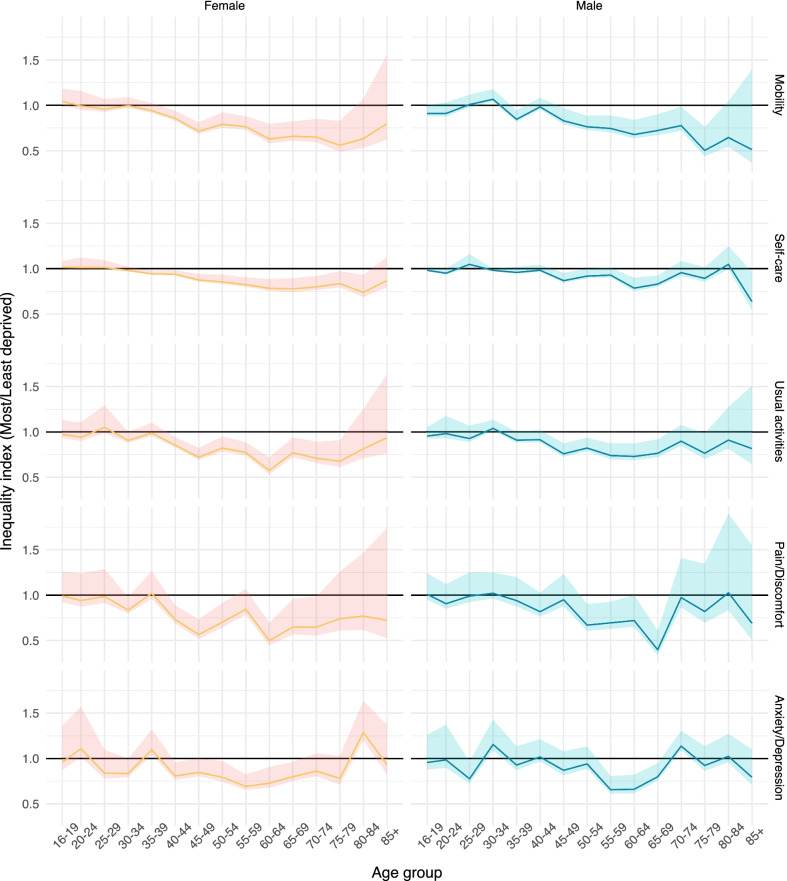
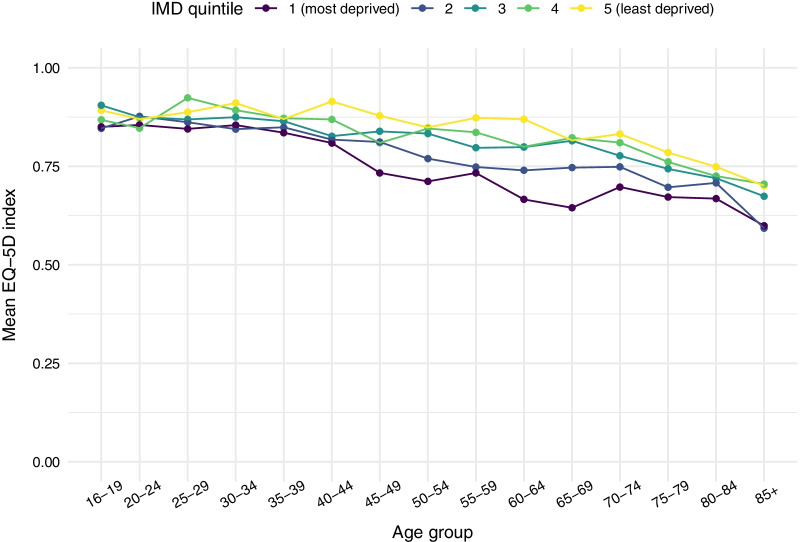
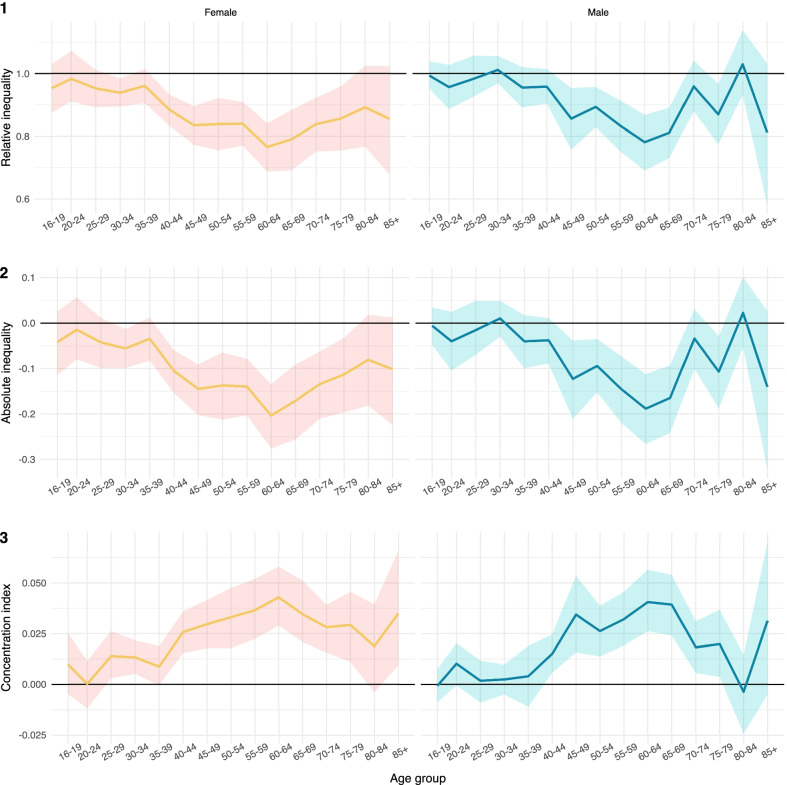
Mean EQ-5D utility scores declined with age and followed a socioeconomic gradient, with the lowest scores in the most deprived areas. Gaps between the most and least deprived quintiles emerged around the age of 35, reached their greatest extent at age 60 to 64 (relative HRQoL of most deprived compared to least deprived quintile: females = 0.77 (95% CI: 0.68-0.85); males = 0.78 (95% CI: 0.69-0.87)) before closing again in older age groups. Gaps were apparent for all five EQ-5D dimensions but were greatest for mobility and self-care.
There are stark socioeconomic inequalities in all dimensions of HRQoL in England. These inequalities start to develop from early adulthood and increase with age but reduce again around retirement age.
社会经济地位是预测终身健康的关键因素:较贫穷的人预计寿命较短,健康相关生活质量(HRQoL)平均水平较低,比富裕的人。在这项研究中,我们旨在通过探索不同维度的 HRQoL 不平等如何因年龄而异,来提高对 HRQoL 中社会经济梯度的理解。
数据来自 2017 年和 2018 年的英国健康调查(14412 名参与者)。使用 EQ-5D-5L 工具测量 HRQoL。我们估计了平均 EQ-5D 效用评分,并报告了五个 HRQoL 维度(移动性、自我护理、日常活动、疼痛/不适、焦虑/抑郁)的问题,年龄为 16 至 90 岁以上,并按邻里贫困五分位数分层。评估了相对和绝对不平等措施。
平均 EQ-5D 效用评分随年龄下降,并遵循社会经济梯度,在最贫困地区得分最低。最贫困和最不贫困五分位数之间的差距出现在 35 岁左右,在 60 至 64 岁达到最大(最贫困五分位数与最不贫困五分位数相比的相对 HRQoL:女性=0.77(95%CI:0.68-0.85);男性=0.78(95%CI:0.69-0.87)),然后在老年组再次缩小。所有五个 EQ-5D 维度都存在差距,但移动性和自我护理方面的差距最大。
在英国,HRQoL 的所有维度都存在明显的社会经济不平等。这些不平等从成年早期开始发展,并随年龄增长而增加,但在退休年龄左右再次减少。