
弹性蛋白酶B通过靶向肺上皮囊性纤维化跨膜调节因子-白细胞介素-6-抗菌-修复途径损害小鼠和人类的先天免疫。
LasB protease impairs innate immunity in mice and humans by targeting a lung epithelial cystic fibrosis transmembrane regulator-IL-6-antimicrobial-repair pathway.
作者信息
Saint-Criq Vinciane, Villeret Bérengère, Bastaert Fabien, Kheir Saadé, Hatton Aurélie, Cazes Aurélie, Xing Zhou, Sermet-Gaudelus Isabelle, Garcia-Verdugo Ignacio, Edelman Aleksander, Sallenave Jean-Michel
机构信息
INSERM U1152, Laboratoire d'Excellence Inflamex, Département Hospitalo-Universtaire FIRE (Fibrosis, Inflammation and Remodeling), Université Paris Diderot, Sorbonne Paris Cité, Hopital Bichat - Claude-Bernard, Paris, France.
INSERM U1151, Faculté de Médecine, site Necker, Université Paris Descartes, Paris, France.
出版信息
Thorax. 2018 Jan;73(1):49-61. doi: 10.1136/thoraxjnl-2017-210298. Epub 2017 Aug 8.
BACKGROUND
lung infections are a huge problem in ventilator-associated pneumonia, cystic fibrosis (CF) and in chronic obstructive pulmonary disease (COPD) exacerbations. This bacterium secretes virulence factors that may subvert host innate immunity.
OBJECTIVE
We evaluated the effect of elastase LasB, an important virulence factor secreted by the type II secretion system, on ion transport, innate immune responses and epithelial repair, both in vitro and in vivo.
METHODS
Wild-type (WT) or cystic fibrosis transmembrane conductance regulator (CFTR)-mutated epithelial cells (cell lines and primary cells from patients) were treated with WT or ΔLasB pseudomonas aeruginosa O1 (PAO1) secretomes. The effect of LasB and PAO1 infection was also assessed in vivo in murine models.
RESULTS
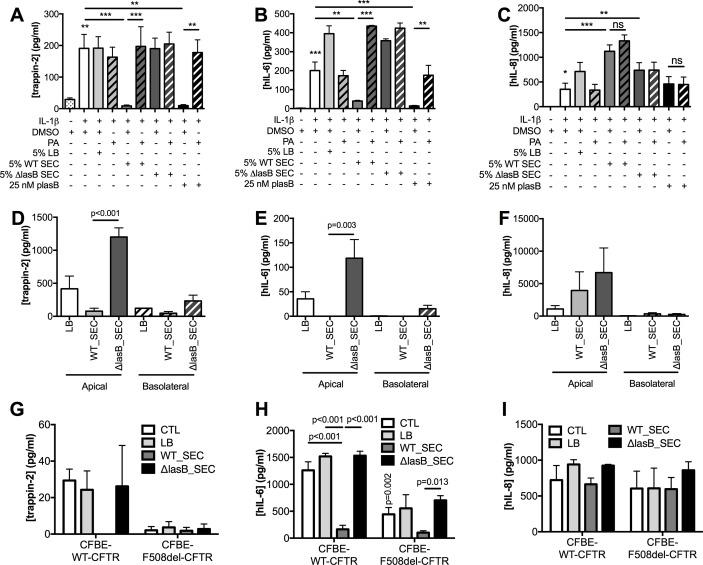
We showed that LasB was the most abundant protein in WT PAO1 secretomes and that it decreased epithelial CFTR expression and activity. In airway epithelial cell lines and primary bronchial epithelial cells, LasB degraded the immune mediators interleukin (IL)-6 and trappin-2, an important epithelial-derived antimicrobial molecule. We further showed that an IL-6/STAT3 signalling pathway was downregulated by LasB, resulting in inhibition of epithelial cell repair. In mice, intranasally instillated LasB induced significant weight loss, inflammation, injury and death. By contrast, we showed that overexpression of IL-6 and trappin-2 protected mice against WT-PAO1-induced death, by upregulating IL-17/IL-22 antimicrobial and repair pathways.
CONCLUSIONS
Our data demonstrate that PAO1 LasB is a major secreted factor that modulates ion transport, immune response and tissue repair. Targeting this virulence factor or upregulating protective factors such as IL-6 or antimicrobial molecules such as trappin-2 could be beneficial in infected individuals.
背景
肺部感染是呼吸机相关性肺炎、囊性纤维化(CF)和慢性阻塞性肺疾病(COPD)急性加重期的一个巨大问题。这种细菌分泌的毒力因子可能会破坏宿主的先天免疫。
目的
我们在体外和体内评估了由II型分泌系统分泌的一种重要毒力因子弹性蛋白酶LasB对离子转运、先天免疫反应和上皮修复的影响。
方法
用野生型(WT)或囊性纤维化跨膜传导调节因子(CFTR)突变的上皮细胞(细胞系和患者的原代细胞)处理野生型或缺失LasB的铜绿假单胞菌O1(PAO1)分泌蛋白组。还在小鼠模型中体内评估了LasB和PAO1感染的影响。
结果
我们发现LasB是野生型PAO1分泌蛋白组中含量最丰富的蛋白质,它降低了上皮CFTR的表达和活性。在气道上皮细胞系和原代支气管上皮细胞中,LasB降解了免疫介质白细胞介素(IL)-6和trappin-2,后者是一种重要的上皮来源抗菌分子。我们进一步表明,IL-6/STAT3信号通路被LasB下调,导致上皮细胞修复受到抑制。在小鼠中,经鼻滴注LasB会导致显著体重减轻、炎症、损伤和死亡。相比之下,我们发现IL-6和trappin-2的过表达通过上调IL-17/IL-22抗菌和修复途径来保护小鼠免受野生型PAO1诱导的死亡。
结论
我们的数据表明,PAO1 LasB是一种主要的分泌因子,可调节离子转运、免疫反应和组织修复。针对这种毒力因子或上调保护性因子如IL-6或抗菌分子如trappin-2可能对受感染个体有益。




 Zotero 插件