Duenk R G, Verhagen C, Bronkhorst E M, Djamin R S, Bosman G J, Lammers E, Dekhuijzen Pnr, Vissers Kcp, Engels Y, Heijdra Y
Department of Anesthesiology, Pain and Palliative Medicine.
Department of Health Evidence, Radboud University Medical Center, Nijmegen.
Int J Chron Obstruct Pulmon Dis. 2017 Jul 20;12:2121-2128. doi: 10.2147/COPD.S140037. eCollection 2017.
Our objective was to develop a tool to identify patients with COPD for proactive palliative care. Since palliative care needs increase during the disease course of COPD, the prediction of mortality within 1 year, measured during hospitalizations for acute exacerbation COPD (AECOPD), was used as a proxy for the need of proactive palliative care.
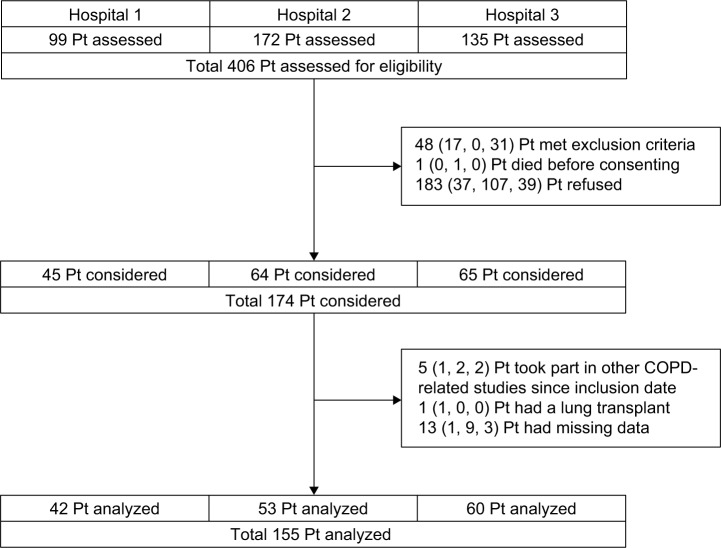
Patients were recruited from three general hospitals in the Netherlands in 2014. Data of 11 potential predictors, a priori selected based on literature, were collected during hospitalization for AECOPD. After 1 year, the medical files were explored for the date of death. An optimal prediction model was assessed by Lasso logistic regression, with 20-fold cross-validation for optimal shrinkage. Missing data were handled using complete case analysis.
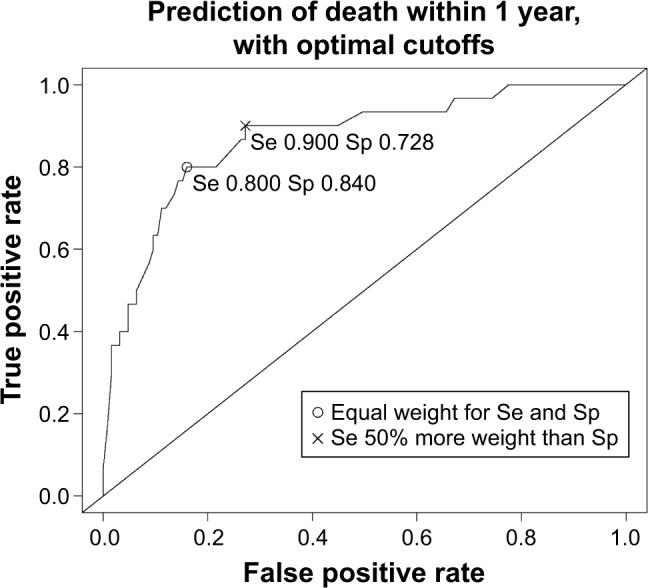
Of 174 patients, 155 patients were included; of those 30 (19.4%) died within 1 year. The optimal prediction model was internally validated and had good discriminating power (AUC =0.82, 95% CI 0.81-0.82). This model relied on the following seven predictors: the surprise question, Medical Research Council dyspnea questionnaire (MRC dyspnea), Clinical COPD Questionnaire (CCQ), FEV% of predicted value, body mass index, previous hospitalizations for AECOPD and specific comorbidities. To ensure minimal miss out of patients in need of proactive palliative care, we proposed a cutoff in the model that prioritized sensitivity over specificity (0.90 over 0.73, respectively). Our model (ProPal-COPD tool) was a stronger predictor of mortality within 1 year than the CODEX (comorbidity, age, obstruction, dyspnea, and previous severe exacerbations) index.
The ProPal-COPD tool is a promising multivariable prediction tool to identify patients with COPD for proactive palliative care.
我们的目标是开发一种工具,用于识别慢性阻塞性肺疾病(COPD)患者,以便进行积极的姑息治疗。由于在COPD病程中姑息治疗需求会增加,因此在慢性阻塞性肺疾病急性加重期(AECOPD)住院期间测量的1年内死亡率预测被用作积极姑息治疗需求的替代指标。
2014年从荷兰的三家综合医院招募患者。基于文献预先选择的11个潜在预测因素的数据在AECOPD住院期间收集。1年后,查阅医疗档案以确定死亡日期。通过套索逻辑回归评估最佳预测模型,并进行20倍交叉验证以实现最佳收缩。使用完整病例分析处理缺失数据。
174例患者中,155例被纳入研究;其中30例(19.4%)在1年内死亡。最佳预测模型经过内部验证,具有良好的区分能力(AUC = 0.82,95% CI 0.81 - 0.82)。该模型依赖以下七个预测因素:意外问题、医学研究委员会呼吸困难问卷(MRC呼吸困难)、临床COPD问卷(CCQ)、预测值的FEV%、体重指数、既往AECOPD住院史和特定合并症。为确保尽量不遗漏需要积极姑息治疗的患者,我们在模型中提出了一个截断值,该截断值优先考虑敏感性而非特异性(分别为0.90对0.73)。我们的模型(ProPal - COPD工具)在预测1年内死亡率方面比CODEX(合并症、年龄、阻塞、呼吸困难和既往严重加重)指数更强。
ProPal - COPD工具是一种有前景的多变量预测工具,可用于识别COPD患者以进行积极的姑息治疗。