Lejay Anne, Laverny Gilles, Paradis Stéphanie, Schlagowski Anna-Isabel, Charles Anne-Laure, Singh François, Zoll Joffrey, Thaveau Fabien, Lonsdorfer Evelyne, Dufour Stéphane, Favret Fabrice, Wolff Valérie, Metzger Daniel, Chakfe Nabil, Geny Bernard
Université de Strasbourg, Fédération de Médecine Translationnnelle, Equipe d'Accueil 3072, Mitochondrie, Stress Oxydant et Protection Musculaire, Institut de PhysiologieStrasbourg, France.
Service de Physiologie et Explorations Fonctionnelles Respiratoires, Hôpitaux Universitaires de StrasbourgStrasbourg, France.
Front Physiol. 2017 Jul 25;8:523. doi: 10.3389/fphys.2017.00523. eCollection 2017.
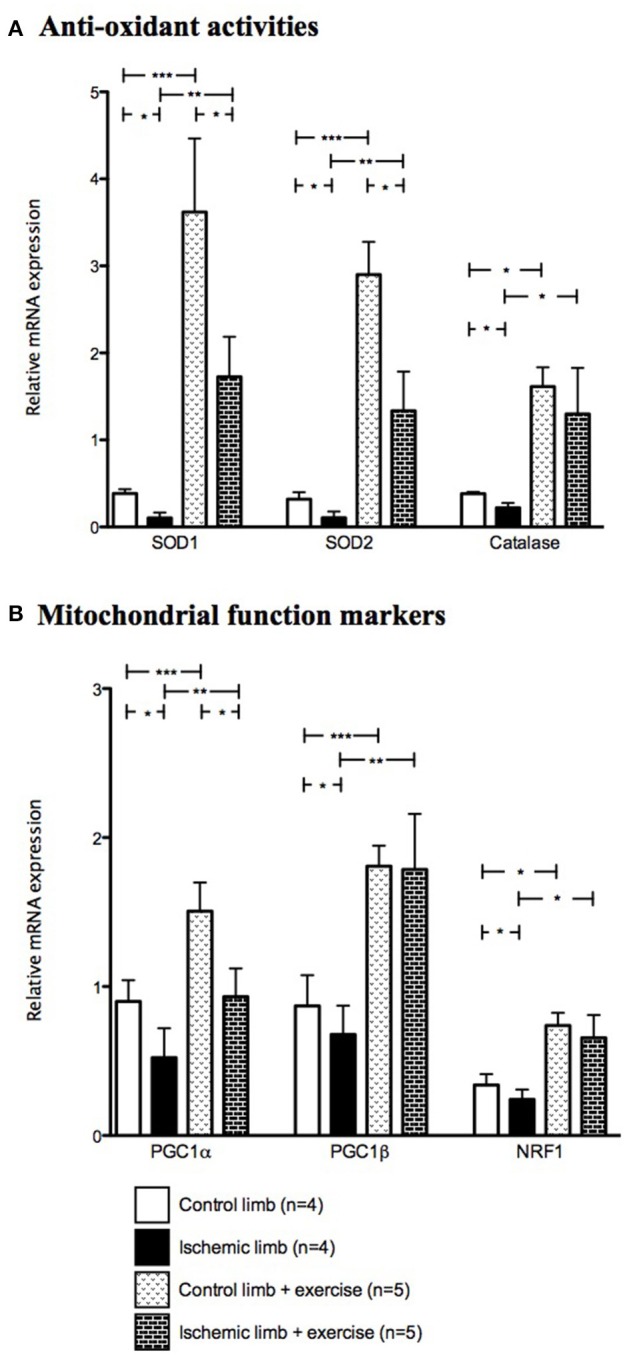
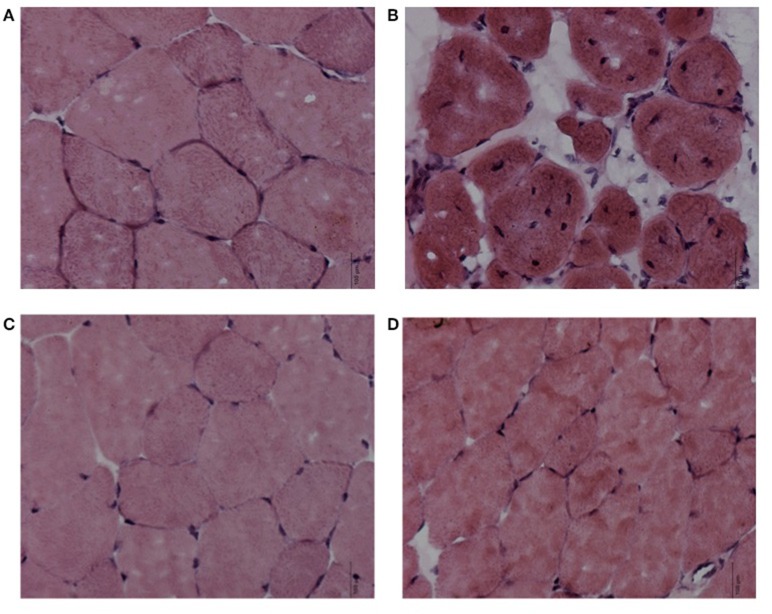
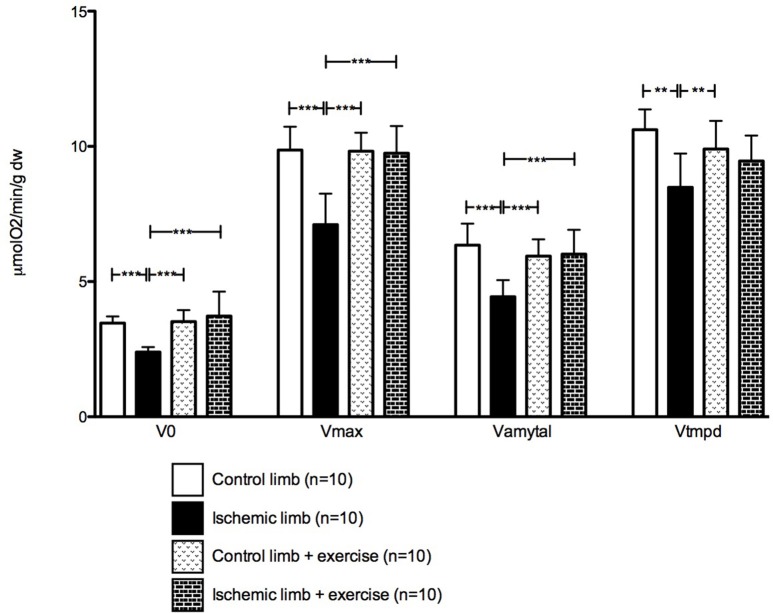
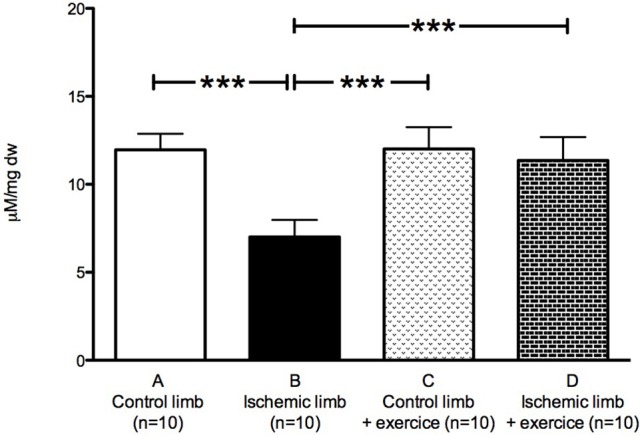
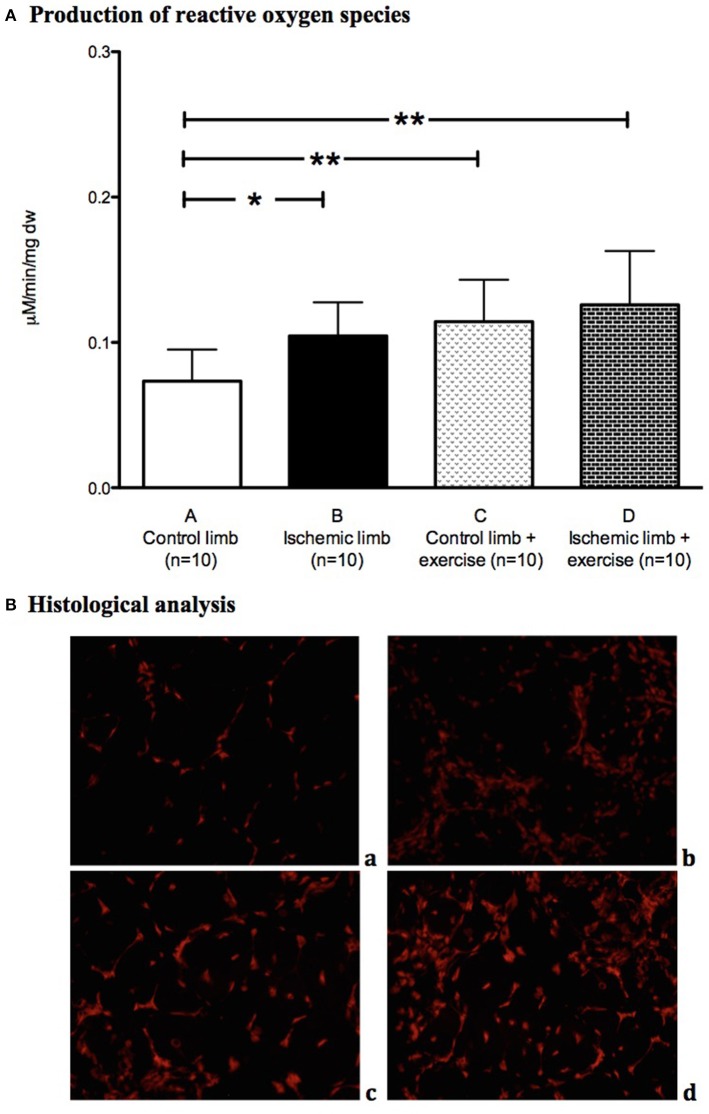
Whether and how moderate exercise might allow for accelerated limb recovery in chronic critical limb ischemia (CLI) remains to be determined. Chronic CLI was surgically induced in mice, and the effect of moderate exercise (training five times per week over a 3-week period) was investigated. Tissue damages and functional scores were assessed on the 4th, 6th, 10th, 20th, and 30th day after surgery. Mice were sacrificed 48 h after the last exercise session in order to assess muscle structure, mitochondrial respiration, calcium retention capacity, oxidative stress and transcript levels of genes encoding proteins controlling mitochondrial functions (PGC1α, PGC1β, NRF1) and anti-oxidant defenses markers (SOD1, SOD2, catalase). CLI resulted in tissue damages and impaired functional scores. Mitochondrial respiration and calcium retention capacity were decreased in the ischemic limb of the non-exercised group (V = 7.11 ± 1.14 vs. 9.86 ± 0.86 mmol 02/min/g dw, < 0.001; CRC = 7.01 ± 0.97 vs. 11.96 ± 0.92 microM/mg dw, < 0.001, respectively). Moderate exercise reduced tissue damages, improved functional scores, and restored mitochondrial respiration and calcium retention capacity in the ischemic limb (V = 9.75 ± 1.00 vs. 9.82 ± 0.68 mmol 02/min/g dw; CRC = 11.36 ± 1.33 vs. 12.01 ± 1.24 microM/mg dw, respectively). Exercise also enhanced the transcript levels of PGC1α, PGC1β, NRF1, as well as SOD1, SOD2, and catalase. Moderate exercise restores mitochondrial respiration and calcium retention capacity, and it has beneficial functional effects in chronic CLI, likely by stimulating reactive oxygen species-induced biogenesis and anti-oxidant defenses. These data support further development of exercise therapy even in advanced peripheral arterial disease.
适度运动是否以及如何能促进慢性严重肢体缺血(CLI)患者肢体的恢复仍有待确定。通过手术诱导小鼠患上慢性CLI,并研究适度运动(在3周内每周训练5次)的效果。在手术后第4、6、10、20和30天评估组织损伤和功能评分。在最后一次运动 session 后48小时处死小鼠,以评估肌肉结构、线粒体呼吸、钙保留能力、氧化应激以及编码控制线粒体功能的蛋白质(PGC1α、PGC1β、NRF1)和抗氧化防御标志物(SOD1、SOD2、过氧化氢酶)的基因的转录水平。CLI导致组织损伤和功能评分受损。未运动组缺血肢体的线粒体呼吸和钙保留能力降低(V = 7.11±1.14 vs. 9.86±0.86 mmol 02/min/g dw,<0.001;CRC = 7.01±0.97 vs. 11.96±0.92 microM/mg dw,分别<0.001)。适度运动减少了组织损伤,改善了功能评分,并恢复了缺血肢体的线粒体呼吸和钙保留能力(V = 9.75±1.00 vs. 9.82±0.68 mmol 02/min/g dw;CRC = 11.36±1.33 vs. 12.01±1.24 microM/mg dw,分别)。运动还提高了PGC1α、PGC1β、NRF1以及SOD1、SOD2和过氧化氢酶的转录水平。适度运动恢复了线粒体呼吸和钙保留能力,并且在慢性CLI中具有有益的功能作用,可能是通过刺激活性氧诱导的生物合成和抗氧化防御。这些数据支持即使在晚期外周动脉疾病中进一步开展运动疗法。