Quinzii Catarina M, Luna-Sanchez Marta, Ziosi Marcello, Hidalgo-Gutierrez Agustin, Kleiner Giulio, Lopez Luis C
Department of Neurology, Columbia University Medical CenterNew York, NY, United States.
Department of Physiology, Faculty of Medicine, University of GranadaGranada, Spain.
Front Physiol. 2017 Jul 25;8:525. doi: 10.3389/fphys.2017.00525. eCollection 2017.
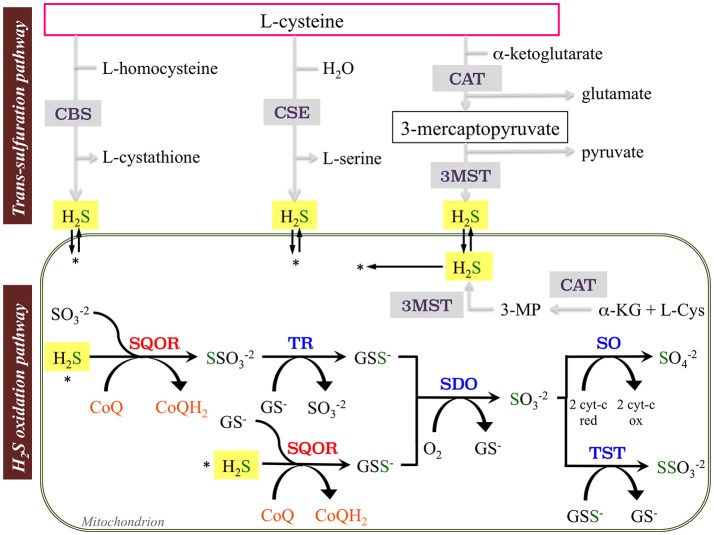
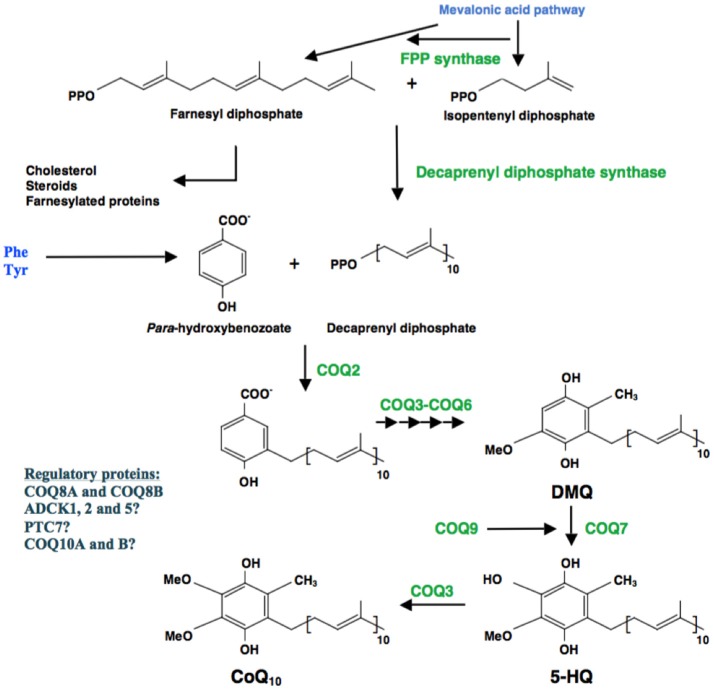
Coenzyme Q (CoQ) is a lipid present in all cell membranes. One of the multiple metabolic functions of CoQ is to transport electrons in the reaction catalyzed by sulfide:quinone oxidoreductase (SQOR), the first enzyme of the oxidation pathway of sulfides (hydrogen sulfide, HS). Early evidence of a defect in the metabolism of HS in primary CoQ deficiency came from yeast studies in strains defective for and (homologs of and , respectively), which have HS accumulation. Our recent studies in human skin fibroblasts and in murine models of primary CoQ deficiency show that, also in mammals, decreased CoQ levels cause impairment of HS oxidation. Patient fibroblasts carrying different mutations in genes encoding proteins involved in CoQ biosynthesis show reduced SQOR activity and protein levels proportional to the levels of CoQ. In mice, kidney, the only organ clinically affected, shows reduced SQOR levels and downstream enzymes, accumulation of HS, and glutathione depletion. mice have also low levels of thiosulfate in plasma and urine, and increased C4-C6 acylcarnitines in blood, due to inhibition of short-chain acyl-CoA dehydrogenase. Also in mice, the symptomatic organ, cerebrum, shows accumulation of HS, reduced SQOR, increase in thiosulfate sulfurtransferase and sulfite oxidase, and reduction in the levels of glutathione and glutathione enzymes, leading to alteration of the biosynthetic pathways of glutamate, serotonin, and catecholamines. mice have also reduced blood pressure, possible consequence of HS-induced vasorelaxation. Since liver is not clinically affected in and mutant mice, the effects of the impairment of HS oxidation in this organ were not investigated, despite its critical role in metabolism. In conclusion, and studies of CoQ deficient models provide evidence of tissue-specific HS oxidation impairment, an additional pathomechanism that should be considered in the understanding and treatment of primary CoQ deficiency.
辅酶Q(CoQ)是一种存在于所有细胞膜中的脂质。CoQ的多种代谢功能之一是在由硫化物:醌氧化还原酶(SQOR)催化的反应中传递电子,SQOR是硫化物(硫化氢,HS)氧化途径的第一种酶。原发性CoQ缺乏症中HS代谢缺陷的早期证据来自对酵母菌株的研究,这些菌株分别对CoQ生物合成途径中的蛋白质编码基因存在缺陷(分别是CoQ生物合成途径中相关蛋白的同源物),会出现HS积累。我们最近对人类皮肤成纤维细胞和原发性CoQ缺乏症小鼠模型的研究表明,在哺乳动物中,CoQ水平降低也会导致HS氧化受损。携带参与CoQ生物合成的蛋白质编码基因不同突变的患者成纤维细胞显示SQOR活性降低,且蛋白质水平与CoQ水平成比例。在特定小鼠中,临床上唯一受影响的器官肾脏显示SQOR水平和下游酶减少、HS积累以及谷胱甘肽耗竭。特定小鼠血浆和尿液中的硫代硫酸盐水平也较低,由于短链酰基辅酶A脱氢酶受到抑制,血液中C4 - C6酰基肉碱增加。同样在特定小鼠中,有症状的器官大脑显示HS积累、SQOR减少、硫代硫酸盐硫转移酶和亚硫酸盐氧化酶增加,以及谷胱甘肽和谷胱甘肽酶水平降低,导致谷氨酸、血清素和儿茶酚胺生物合成途径改变。特定小鼠还出现血压降低,这可能是HS诱导血管舒张的结果。由于肝脏在特定和特定突变小鼠中未受到临床影响,尽管肝脏在代谢中起关键作用,但未研究该器官中HS氧化受损的影响。总之,对CoQ缺乏模型的特定和特定研究提供了组织特异性HS氧化受损的证据,这是在理解和治疗原发性CoQ缺乏症时应考虑的另一种病理机制。