Department of Biological Chemistry, University of Michigan Medical School, Ann Arbor, Michigan, USA.
Department of Molecular and Integrative Physiology, Michigan Medicine, University of Michigan, Ann Arbor, Michigan, USA.
J Biol Chem. 2022 Jan;298(1):101435. doi: 10.1016/j.jbc.2021.101435. Epub 2021 Nov 19.
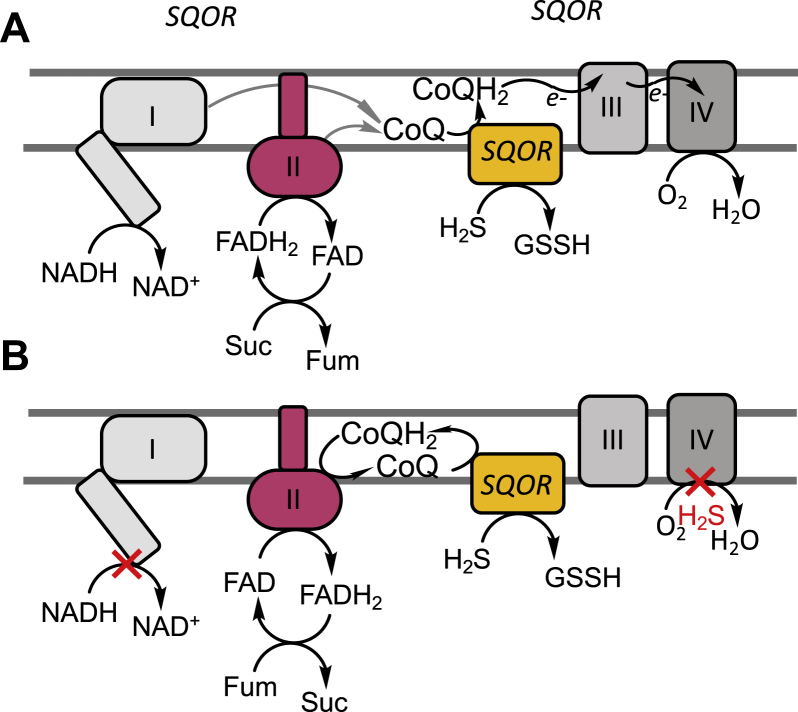
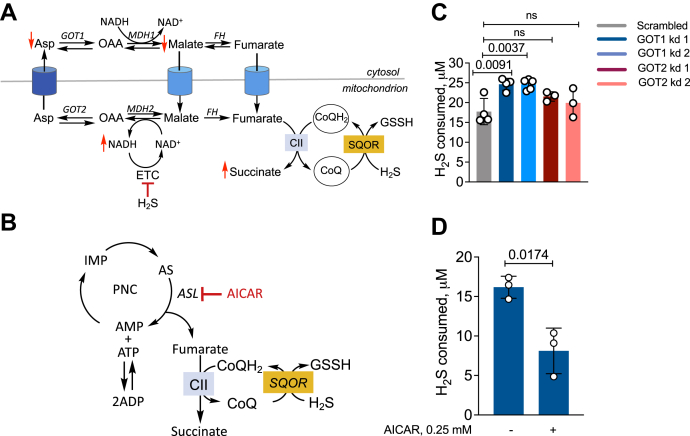
The dual roles of HS as an endogenously synthesized respiratory substrate and as a toxin raise questions as to how it is cleared when the electron transport chain is inhibited. Sulfide quinone oxidoreductase (SQOR) catalyzes the first step in the mitochondrial HS oxidation pathway, using CoQ as an electron acceptor, and connects to the electron transport chain at the level of complex III. We have discovered that at high HS concentrations, which are known to inhibit complex IV, a new redox cycle is established between SQOR and complex II, operating in reverse. Under these conditions, the purine nucleotide cycle and the malate aspartate shuttle furnish fumarate, which supports complex II reversal and leads to succinate accumulation. Complex II knockdown in colonocytes decreases the efficiency of HS clearance while targeted knockout of complex II in intestinal epithelial cells significantly decreases the levels of thiosulfate, a biomarker of HS oxidation, to approximately one-third of the values seen in serum and urine samples from control mice. These data establish the physiological relevance of this newly discovered redox circuitry between SQOR and complex II for prioritizing HS oxidation and reveal the quantitatively significant contribution of intestinal epithelial cells to systemic HS metabolism.
HS 作为内源性合成的呼吸底物和毒素的双重作用提出了一个问题,即在电子传递链被抑制时,HS 是如何被清除的。硫醌氧化还原酶 (SQOR) 催化线粒体 HS 氧化途径的第一步,使用 CoQ 作为电子受体,并在复合物 III 水平与电子传递链连接。我们发现,在高 HS 浓度下,已知会抑制复合物 IV,SQOR 和复合物 II 之间会建立一个新的氧化还原循环,以相反的方式运作。在这些条件下,嘌呤核苷酸循环和苹果酸天冬氨酸穿梭提供延胡索酸,支持复合物 II 的反转,并导致琥珀酸积累。结肠细胞中的复合物 II 敲低会降低 HS 清除的效率,而肠道上皮细胞中复合物 II 的靶向敲除会显著降低硫代硫酸盐的水平,约为对照组小鼠血清和尿液样本中硫代硫酸盐水平的三分之一。这些数据确立了 SQOR 和复合物 II 之间新发现的氧化还原电路对于优先进行 HS 氧化的生理相关性,并揭示了肠道上皮细胞对全身 HS 代谢的定量重要贡献。