Royo-Llonch Marta, Ferrera Isabel, Cornejo-Castillo Francisco M, Sánchez Pablo, Salazar Guillem, Stepanauskas Ramunas, González José M, Sieracki Michael E, Speich Sabrina, Stemmann Lars, Pedrós-Alió Carlos, Acinas Silvia G
Department of Marine Biology and Oceanography, Institut de Ciències del Mar, Consejo Superior de Investigaciones CientíficasBarcelona, Spain.
Bigelow Laboratory for Ocean Sciences, East BoothbayME, United States.
Front Microbiol. 2017 Jul 25;8:1317. doi: 10.3389/fmicb.2017.01317. eCollection 2017.
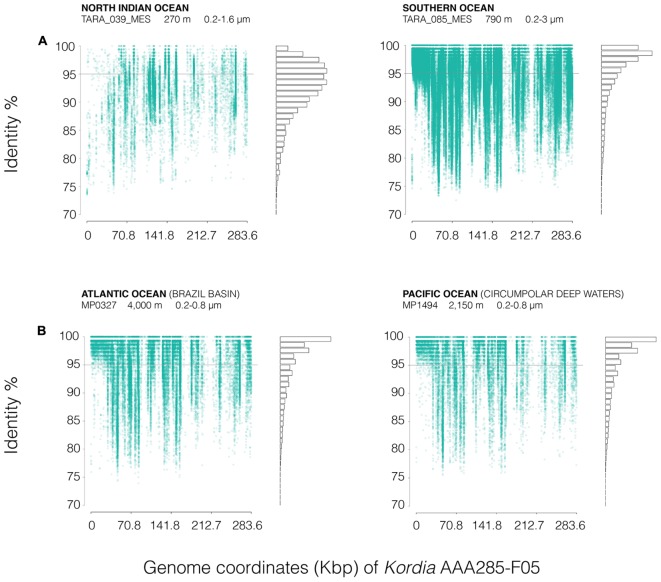
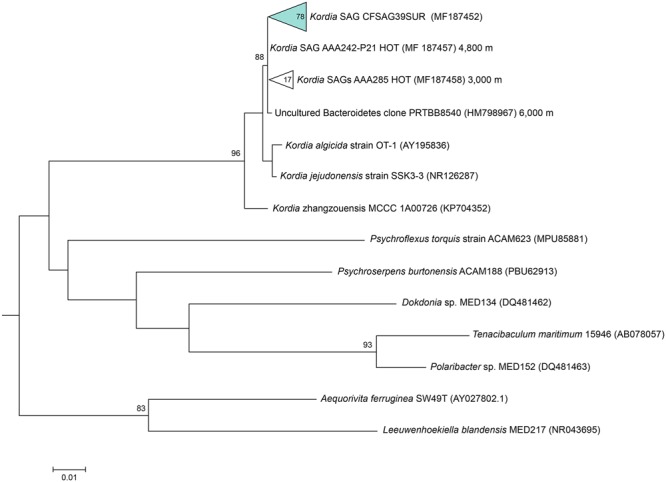
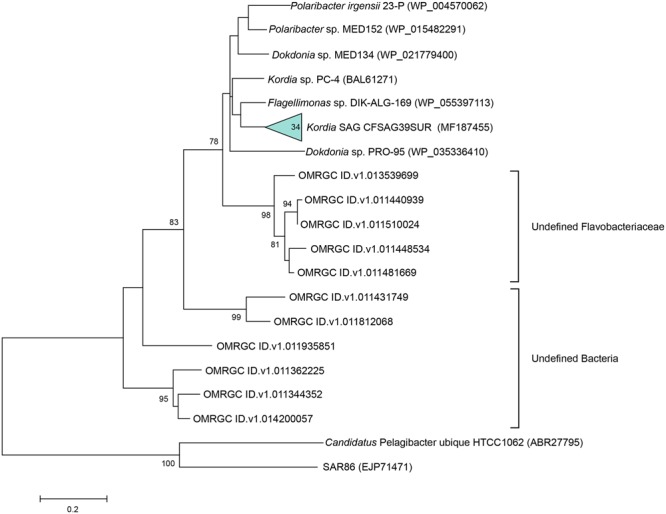
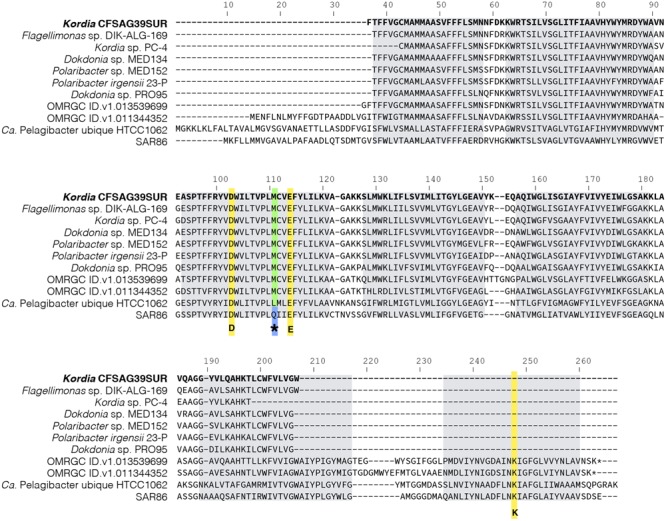
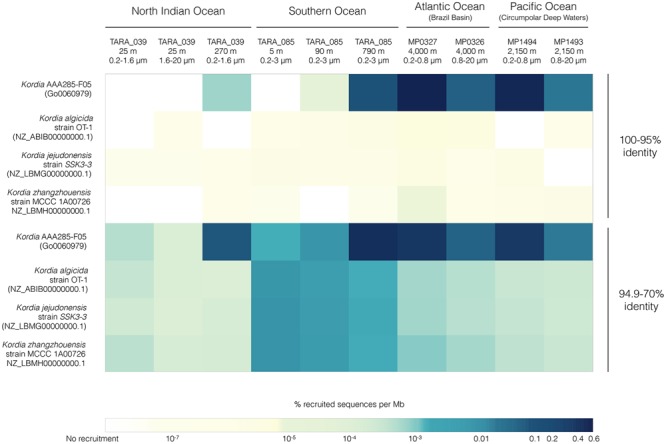
Marine Bacteroidetes constitute a very abundant bacterioplankton group in the oceans that plays a key role in recycling particulate organic matter and includes several photoheterotrophic members containing proteorhodopsin. Relatively few marine Bacteroidetes species have been described and, moreover, they correspond to cultured isolates, which in most cases do not represent the actual abundant or ecologically relevant microorganisms in the natural environment. In this study, we explored the microdiversity of 98 Single Amplified Genomes (SAGs) retrieved from the surface waters of the underexplored North Indian Ocean, whose most closely related isolate is OT-1. Using Multi Locus Sequencing Analysis (MLSA) we found no microdiversity in the tested conserved phylogenetic markers (16S rRNA and 23S rRNA genes), the fast-evolving Internal Transcribed Spacer and the functional markers proteorhodopsin and the beta-subunit of RNA polymerase. Furthermore, we carried out a Fragment Recruitment Analysis (FRA) with marine metagenomes to learn about the distribution and dynamics of this microorganism in different locations, depths and size fractions. This analysis indicated that this taxon belongs to the rare biosphere, showing its highest abundance after upwelling-induced phytoplankton blooms and sinking to the deep ocean with large organic matter particles. This uncultured lineage likely represents a novel species ( sp. CFSAG39SUR) that contains the proteorhodopsin gene and has a widespread spatial and vertical distribution. The combination of SAGs and MLSA makes a valuable approach to infer putative ecological roles of uncultured abundant microorganisms.
海洋拟杆菌是海洋中数量极为丰富的浮游细菌类群,在颗粒有机物的循环中发挥着关键作用,其中包括几种含有视紫红质的光能异养成员。目前已描述的海洋拟杆菌物种相对较少,而且它们都是培养分离株,在大多数情况下并不代表自然环境中实际丰富或具有生态相关性的微生物。在本研究中,我们探索了从鲜少被研究的北印度洋表层水体中获取的98个单扩增基因组(SAG)的微观多样性,其与最接近的分离株是OT-1。通过多位点测序分析(MLSA),我们发现在测试的保守系统发育标记(16S rRNA和23S rRNA基因)、快速进化的内部转录间隔区以及功能标记视紫红质和RNA聚合酶的β亚基中没有微观多样性。此外,我们对海洋宏基因组进行了片段招募分析(FRA),以了解这种微生物在不同位置、深度和粒径组分中的分布和动态。该分析表明,这个分类单元属于稀有生物圈,在上升流诱导的浮游植物大量繁殖后丰度最高,并随着大的有机物质颗粒沉入深海。这种未培养的谱系可能代表一个新物种(CFSAG39SUR种),它含有视紫红质基因,具有广泛的空间和垂直分布。SAG和MLSA的结合为推断未培养的丰富微生物的假定生态作用提供了一种有价值的方法。