Breyne Koen, Steenbrugge Jonas, Demeyere Kristel, Vanden Berghe Tom, Meyer Evelyne
Biochemistry, Faculty of Veterinary Medicine, Department of Pharmacology, Toxicology and Biochemistry, Ghent University, Merelbeke, Belgium.
Peter Vandenabeele Lab, Inflammation Research Center, Department of Biomedical Molecular Biology, VIB, Ghent University, Zwijnaarde, Belgium.
Front Immunol. 2017 Jul 24;8:833. doi: 10.3389/fimmu.2017.00833. eCollection 2017.
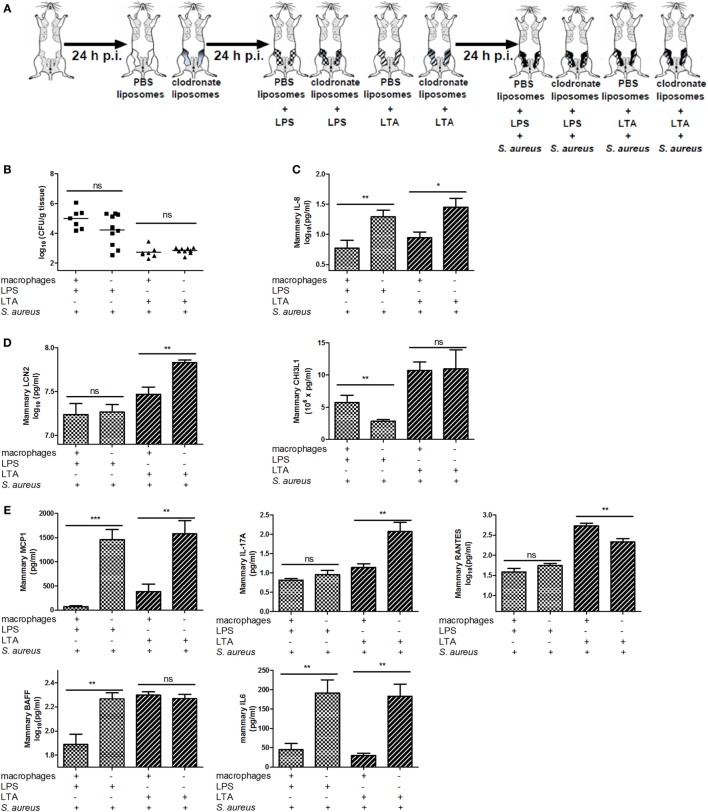
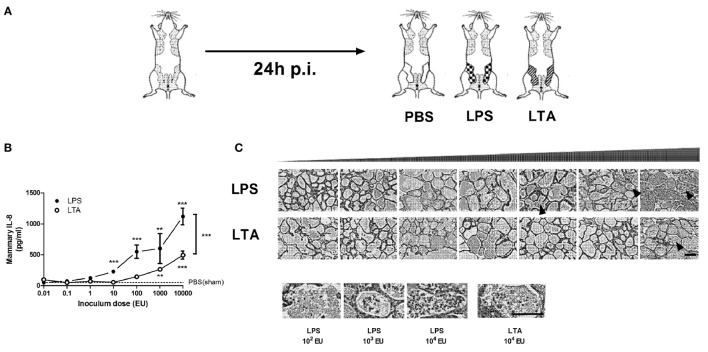
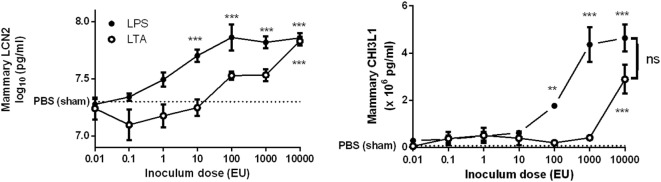
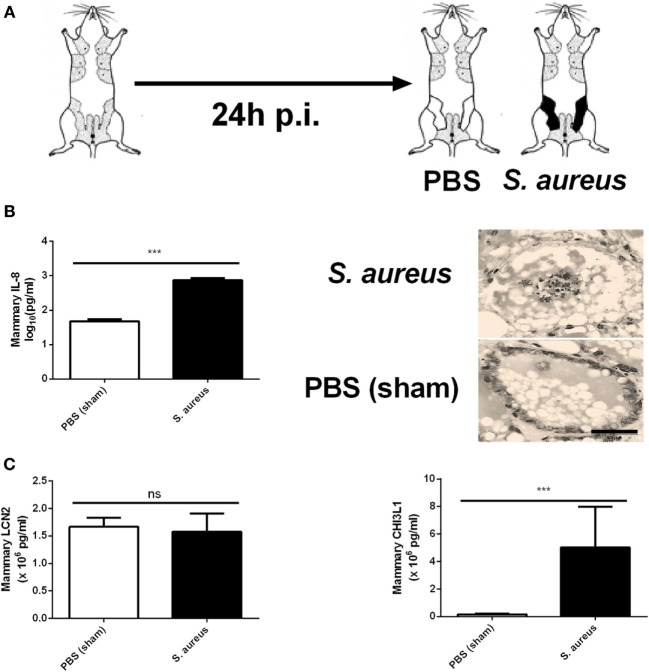
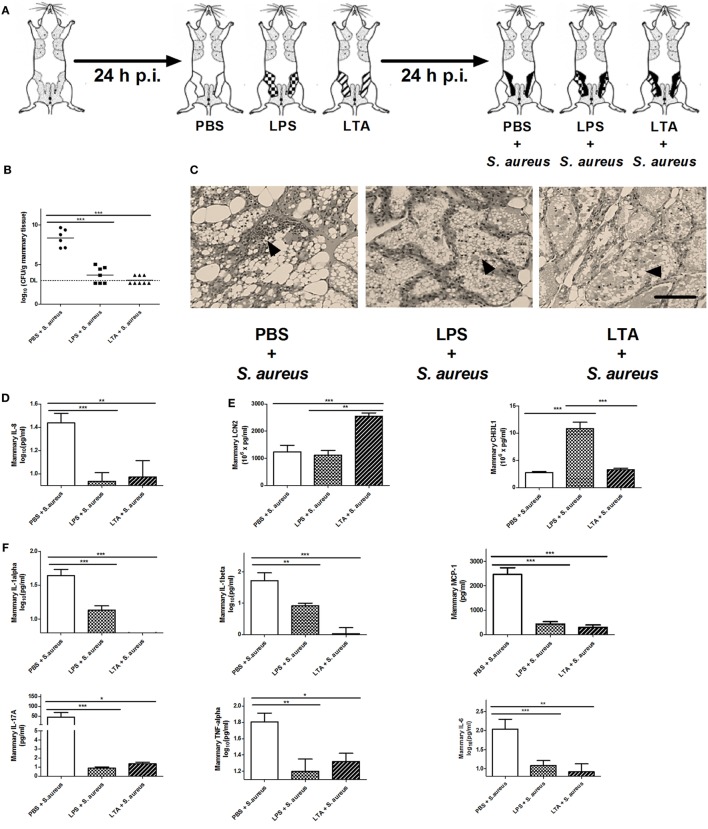
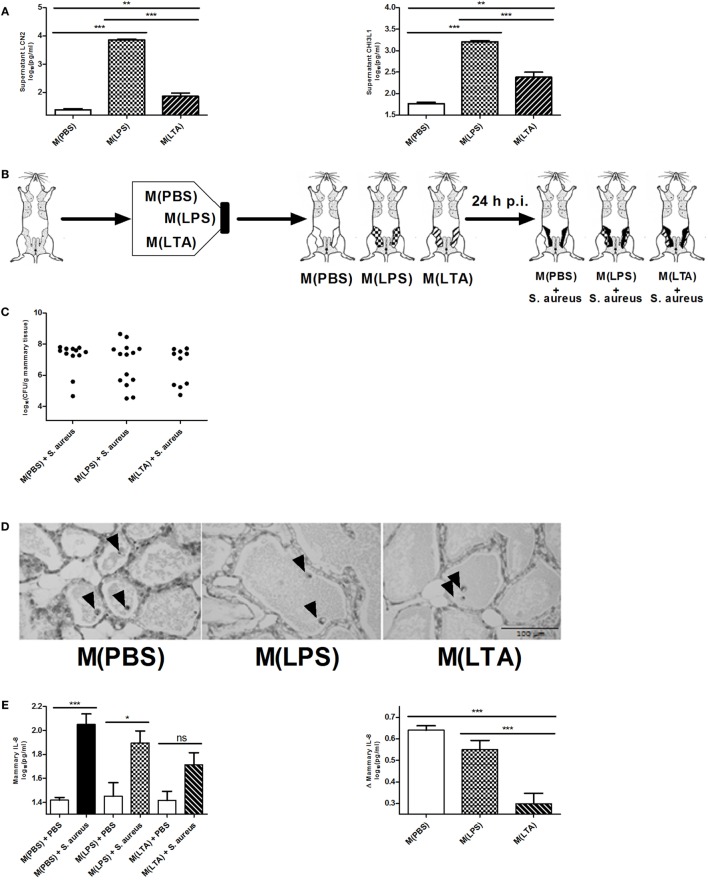
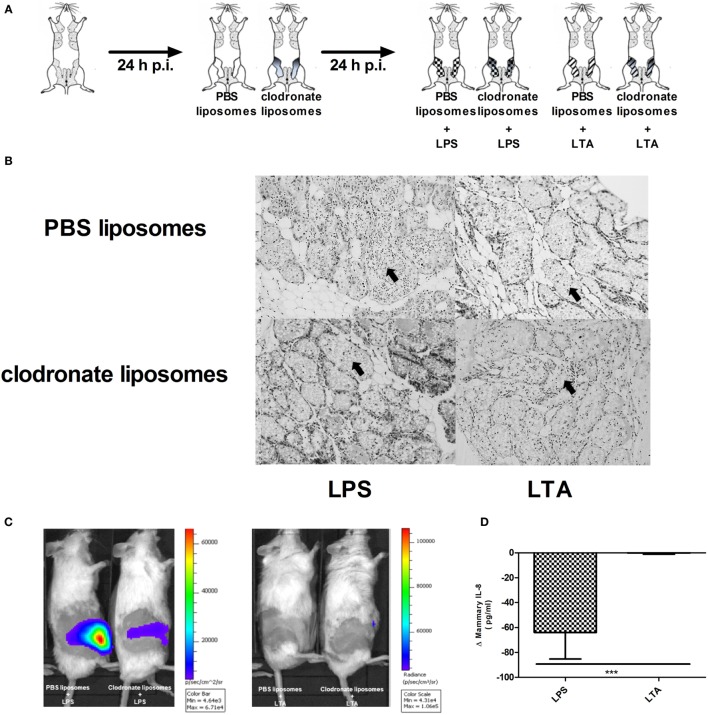
is one of the most causative agents of mastitis and is associated with chronic udder infections. The persistency of the pathogen is believed to be the result of an insufficient triggering of local inflammatory signaling. In this study, the preclinical mastitis model was used, aiming to evaluate if lipopolysaccharide (LPS) or lipoteichoic acid (LTA) preconditioning could aid the host in more effectively clearing or at least limiting a subsequent infection. A prototypic Gram-negative virulence factor, i.e., LPS and Gram-positive virulence factor, i.e., LTA were screened whether they were able to boost the local immune compartment. Compared to -induced inflammation, both toxins had a remarkable high potency to efficiently induce two novel selected innate immunity biomarkers i.e., lipocalin 2 (LCN2) and chitinase 3-like 1 (CHI3L1). When combining mammary inoculation of LPS or LTA prior to a local infection, we were able to modulate the innate immune response, reduce local bacterial loads, and induce either LCN2 or CHI3L1 at 24 h post-infection. Clodronate depletion of mammary macrophages also identified that macrophages contribute only to a limited extend to the LPS/LTA-induced immunomodulation upon infection. Based on histological neutrophil influx evaluation, concomitant local cytokine profiles and LCN2/CHI3L1 patterns, the macrophage-independent signaling plays a major role in the LPS- or LTA-pretreated -infected mouse mammary gland. Our results highlight the importance of a vigilant microenvironment during the innate immune response of the mammary gland and offer novel insights for new approaches concerning effective immunomodulation against a local bacterial infection.
是乳腺炎最主要的致病因子之一,与慢性乳房感染有关。病原体的持续性被认为是局部炎症信号触发不足的结果。在本研究中,使用了临床前乳腺炎模型,旨在评估脂多糖(LPS)或脂磷壁酸(LTA)预处理是否能帮助宿主更有效地清除或至少限制随后的感染。筛选了一种典型的革兰氏阴性毒力因子即LPS和革兰氏阳性毒力因子即LTA,看它们是否能够增强局部免疫区室。与诱导的炎症相比,两种毒素都具有显著的高效力,能有效诱导两种新选择的先天免疫生物标志物,即脂钙蛋白2(LCN2)和几丁质酶3样1(CHI3L1)。在局部感染前联合进行LPS或LTA的乳腺接种时,我们能够调节先天免疫反应,降低局部细菌载量,并在感染后24小时诱导LCN2或CHI3L1。用氯膦酸盐清除乳腺巨噬细胞也表明,巨噬细胞在感染时对LPS/LTA诱导的免疫调节作用仅占有限比例。基于组织学中性粒细胞浸润评估、局部细胞因子谱和LCN2/CHI3L1模式,不依赖巨噬细胞的信号传导在LPS或LTA预处理的感染小鼠乳腺中起主要作用。我们的结果突出了乳腺先天免疫反应期间警惕的微环境的重要性,并为针对局部细菌感染的有效免疫调节新方法提供了新见解。