Freitas-Junior Ruffo, Ribeiro Luís Fernando Jubé, Moreira Marise Amaral Rebouças, Queiroz Geraldo Silva, Esperidião Maurício Duarte, Silva Marco Aurélio Costa, Pereira Rubens José, Zampronha Rossana Araújo Catão, Rahal Rosemar Macedo Sousa, Soares Leonardo Ribeiro, Dos Santos Danielle Laperche, Thomazini Maria Virginia, de Faria Cassiana Ferreira Silva, Paulinelli Régis Resende
Gynecology and Breast Unit, Hospital Araújo Jorge, Goiás Anticancer Association, Goiânia, GO, BR.
Breast Program, Department of Gynecology and Obstetrics, School of Medicine, Federal University of Goiás, Goiânia, GO, BR.
Clinics (Sao Paulo). 2017 Jul;72(7):426-431. doi: 10.6061/clinics/2017(07)07.
: This randomized clinical trial evaluated the possibility of not draining the axilla following axillary dissection.
: The study included 240 breast cancer patients who underwent axillary dissection as part of conservative treatment. The patients were divided into two groups depending on whether or not they were subjected to axillary drainage. ClinicalTrials.gov: NCT01267552.
: The median volume of fluid aspirated was significantly lower in the axillary drainage group (0.00 ml; 0.00 - 270.00) compared to the no drain group (522.50 ml; 130.00 - 1148.75). The median number of aspirations performed during conservative breast cancer treatment was significantly lower in the drainage group (0.5; 0.0 - 4.0) compared to the no drain group (5.0; 3.0 - 7.0). The total volume of serous fluid produced (the volume of fluid obtained from drainage added to the volume of aspirated fluid) was similar in the two groups. Regarding complications, two cases (2.4%) of wound dehiscence occurred in the drainage group compared to 13 cases (13.5%) in the group in which drainage was not performed, with this difference being statistically significant. Rates of infection, necrosis and hematoma were similar in both groups.
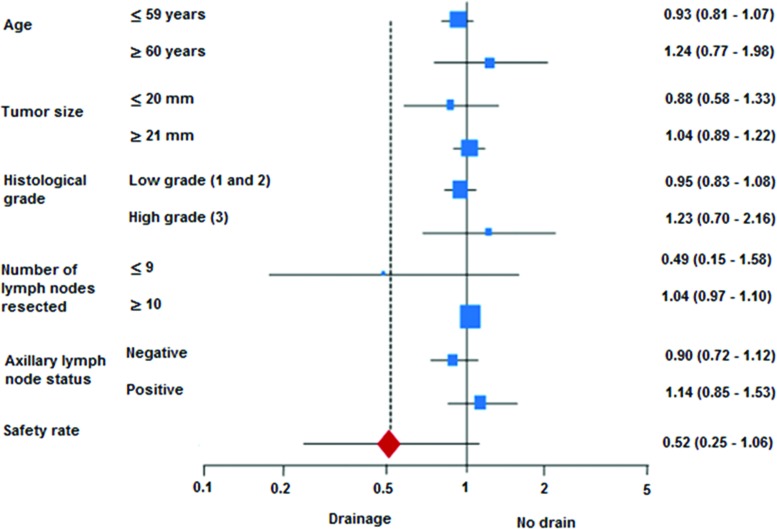
: Safety rates were similar in both study groups; hence, axillary dissection can feasibly be performed without drainage. However, more needle aspirations could be required, and there could be more cases of wound dehiscence in patients who do not undergo auxiliary drainage.
本随机临床试验评估了腋窝清扫术后不进行腋窝引流的可能性。
该研究纳入了240例接受腋窝清扫作为保守治疗一部分的乳腺癌患者。根据是否进行腋窝引流,将患者分为两组。ClinicalTrials.gov标识符:NCT01267552。
与不引流组(522.50 ml;130.00 - 1148.75)相比,腋窝引流组吸出的液体中位数体积显著更低(0.00 ml;0.00 - 270.00)。在乳腺癌保守治疗期间进行的抽吸中位数次数,引流组(0.5;0.0 - 4.0)显著低于不引流组(5.0;3.0 - 7.0)。两组产生的浆液性液体总量(从引流获得的液体体积加上吸出的液体体积)相似。关于并发症,引流组发生2例(2.4%)伤口裂开,而未进行引流的组发生13例(13.5%),差异具有统计学意义。两组的感染、坏死和血肿发生率相似。
两个研究组的安全率相似;因此,腋窝清扫术可行不进行引流。然而,不进行腋窝引流的患者可能需要更多次穿刺抽吸,且伤口裂开的病例可能更多。