Cho Young-Dan, Shin Ji-Cheol, Yoon Hyung-In, Ku Young, Ryoo Hyun-Mo, Kim Dae-Joon, Kim Do-Gyoon, Han Jung-Suk
Department of Periodontology, School of Dentistry, Seoul National University, Seoul 110-749,.
Department of Prosthodontics, School of Dentistry, Seoul National University, Seoul 110-749,.
Materials (Basel). 2015 Sep 10;8(9):6018-6028. doi: 10.3390/ma8095288.
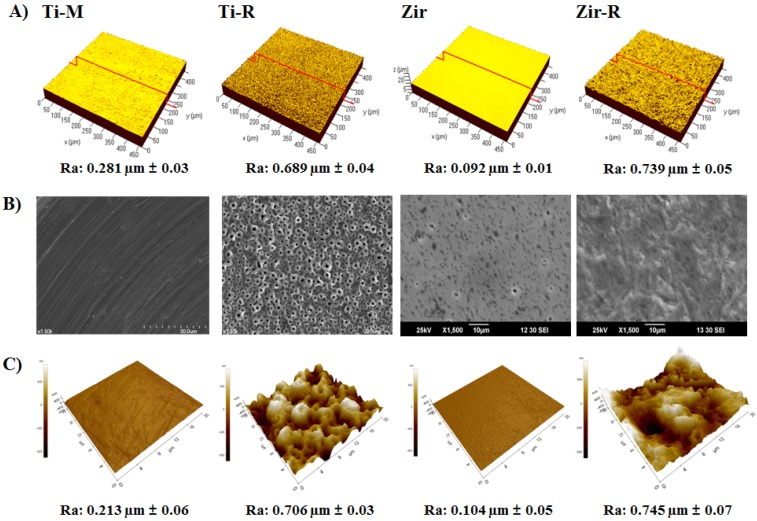
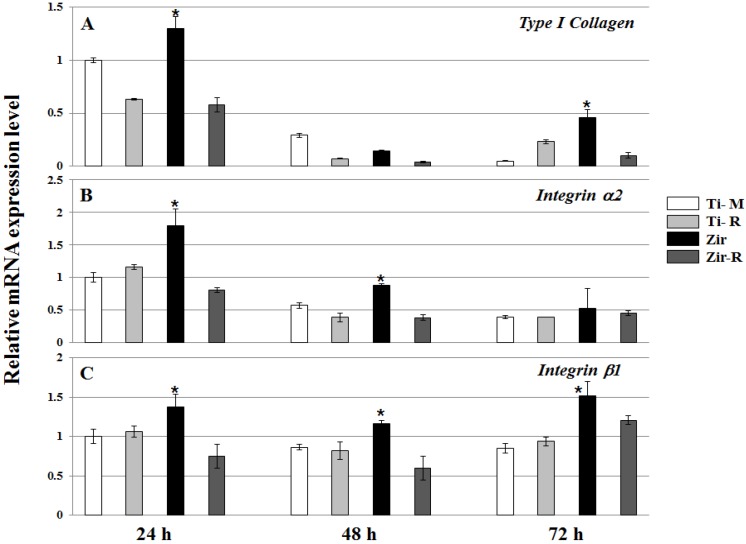
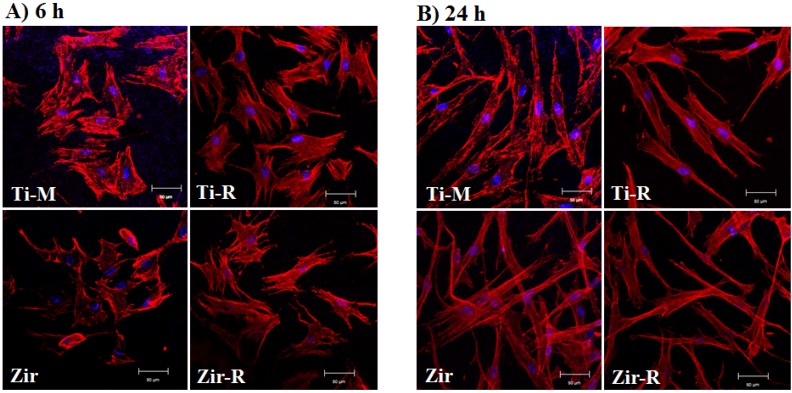
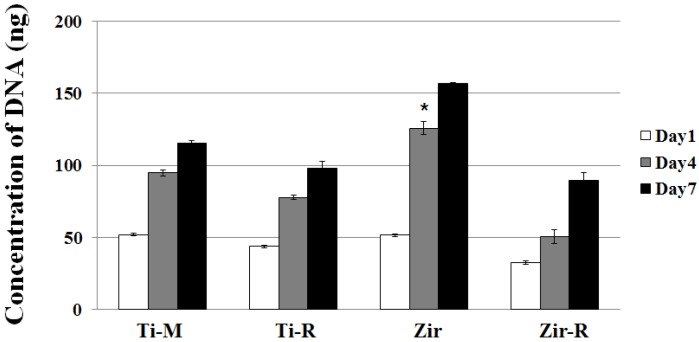
It was indicated that tetragonal zirconia polycrystal (TZP) containing yttria (Y₂O₃) and niobium oxide (Nb₂O₅) ((Y,Nb)-TZP) could be an adequate dental material to be used at esthetically important sites. The (Y,Nb)-TZP was also proved to possess its osteogenic potential comparable with those conventional dental implant material, titanium (Ti). The objective of the current study was to characterize cellular response of human gingival fibroblasts (HGFs) to smooth and rough surfaces of the (Y,Nb)-TZP disc, which were obtained by polishing and sandblasting, respectively. Various microscopic, biochemical, and molecular techniques were used to investigate the disc surfaces and cellular responses for the experimental (Y,Nb)-TZP and the comparing Ti groups. Sandblasted rough (Y,Nb)-TZP (Zir-R) discs had the highest surface roughness. HGFs cultured on polished (Y,Nb)-TZP (Zir) showed a rounded cell morphology and light spreading at 6 h after seeding and its proliferation rate significantly increased during seven days of culture compared to other surfaces. The mRNA expressions of type I collagen, integrin α2 and β1 were significantly stimulated for the Zir group at 24 h after seeding. The current findings, combined with the previous results, indicate that (Y,Nb)-TZP provides appropriate surface condition for osseointegration at the fixture level and for peri-implant mucosal sealing at the abutment level producing a suitable candidate for dental implantation with an expected favorable clinical outcome.
研究表明,含有氧化钇(Y₂O₃)和氧化铌(Nb₂O₅)的四方多晶氧化锆(TZP)((Y,Nb)-TZP)可能是一种适用于美学重要部位的牙科材料。(Y,Nb)-TZP还被证明具有与传统牙科植入材料钛(Ti)相当的成骨潜力。本研究的目的是表征人牙龈成纤维细胞(HGFs)对(Y,Nb)-TZP圆盘光滑和粗糙表面的细胞反应,这些表面分别通过抛光和喷砂获得。使用各种显微镜、生化和分子技术来研究实验性(Y,Nb)-TZP组和对照Ti组的圆盘表面和细胞反应。喷砂粗糙的(Y,Nb)-TZP(Zir-R)圆盘具有最高的表面粗糙度。接种后6小时,在抛光的(Y,Nb)-TZP(Zir)上培养的HGFs呈现圆形细胞形态且铺展较轻,与其他表面相比,其在培养7天期间的增殖率显著增加。接种后24小时,Zir组I型胶原蛋白、整合素α2和β1的mRNA表达受到显著刺激。目前的研究结果与先前的结果相结合,表明(Y,Nb)-TZP在种植体水平为骨结合以及在基台水平为种植体周围黏膜封闭提供了合适的表面条件,从而为牙科植入提供了一个合适的候选材料,并有望获得良好的临床结果。