Rizo-Gorrita María, Herráez-Galindo Cristina, Torres-Lagares Daniel, Serrera-Figallo María-Ángeles, Gutiérre-Pérez José-Luis
Department of Oral Surgery, College of Dentistry, Seville University, Calle de Avicena, s/n, 41009 Seville, Spain.
Polymers (Basel). 2019 Sep 3;11(9):1446. doi: 10.3390/polym11091446.
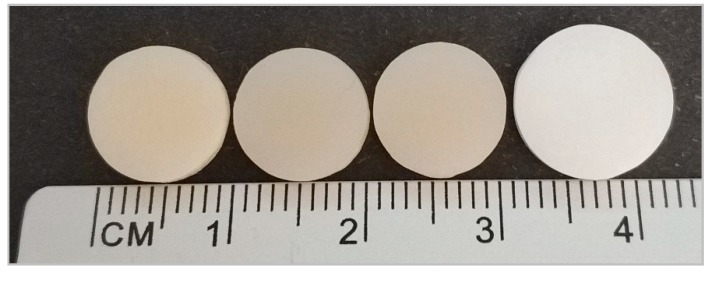
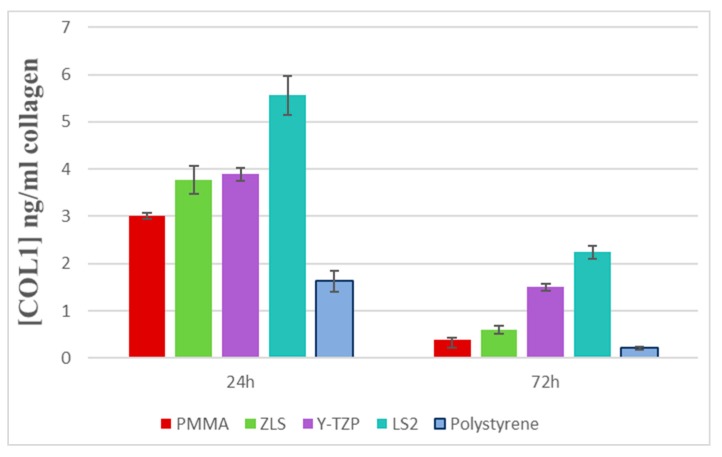
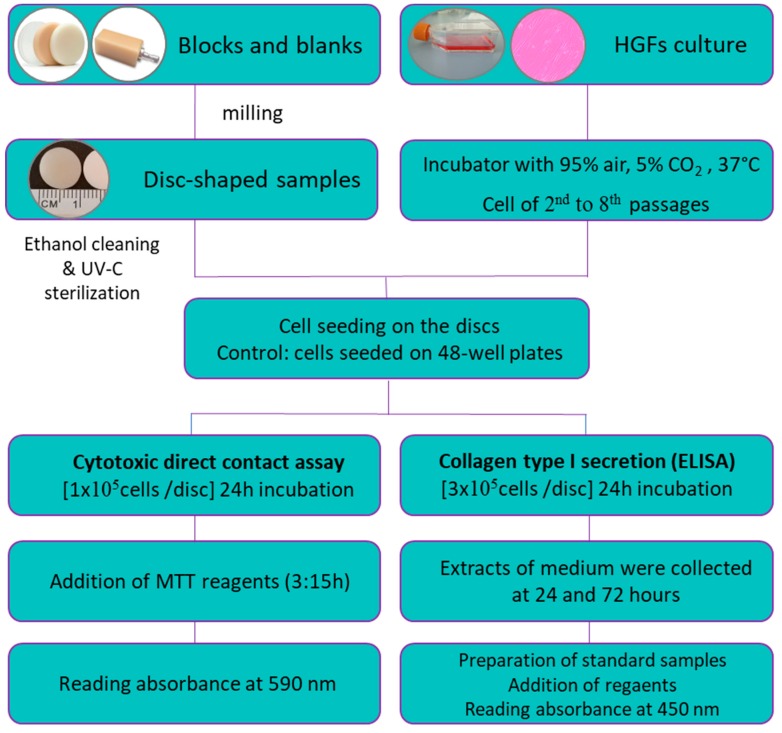
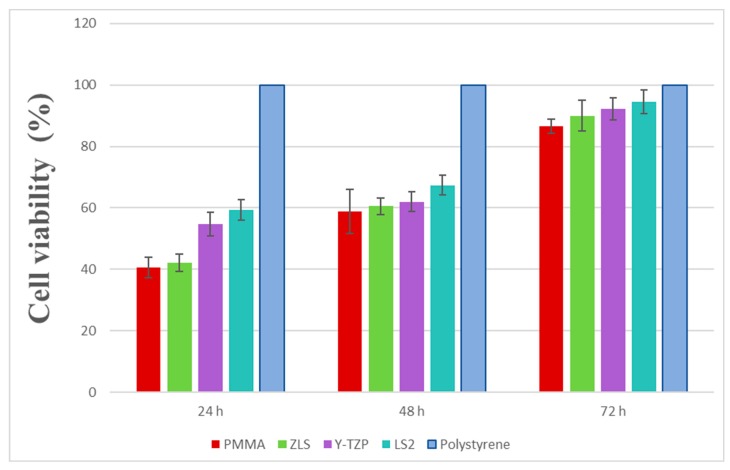
Four polymer and ceramic computer-aided design/computer-aided manufacturing (CAD/CAM) materials from different manufacturers (VITA CAD-Temp (polymethyl methacrylate, PMMA), Celtra Duo (zirconia-reinforced lithium silicate ceramic, ZLS), IPS e.max CAD (lithium disilicate (LS)), and VITA YZ (yttrium-tetragonal zirconia polycrystal, Y-TZP)) were tested to evaluate the cytotoxic effects and collagen type I secretions on human gingival fibroblasts (HGFs). A total of 160 disc-shaped samples (Ø: 10 ± 2 mm; h: 2 mm) were milled from commercial blanks and blocks. Direct-contact cytotoxicity assays were evaluated at 24, 48, and 72 h, and collagen type I (COL1) secretions were analysed by cell-based ELISA at 24 and 72 h. Both experiments revealed statistically significant differences ( < 0.05). At 24 and 48 h of contact, cytotoxic potential was observed for all materials. Later, at 72 h, all groups reached biologically acceptable levels. LS showed the best results regarding cell viability and collagen secretion in all of the time evaluations, while Y-TZP and ZLS revealed intermediate results, and PMMA exhibited the lowest values in both experiments. At 72 h, all groups showed sharp decreases in COL1 secretion regarding the 24-h values. According to the results obtained and the limitations of the present in vitro study, it may be concluded that the ceramic materials revealed a better cell response than the polymers. Nevertheless, further studies are needed to consolidate these findings and thus extrapolate the results into clinical practice.
对来自不同制造商的四种聚合物和陶瓷计算机辅助设计/计算机辅助制造(CAD/CAM)材料(维他CAD-Temp(聚甲基丙烯酸甲酯,PMMA)、Celtra Duo(氧化锆增强硅酸锂陶瓷,ZLS)、IPS e.max CAD(二硅酸锂(LS))和维他YZ(钇四方多晶氧化锆,Y-TZP))进行了测试,以评估其对人牙龈成纤维细胞(HGFs)的细胞毒性作用和I型胶原蛋白分泌情况。从商业坯料和块材中铣削出总共160个圆盘形样品(直径:10±2毫米;高度:2毫米)。在24、48和72小时评估直接接触细胞毒性试验,并在24和72小时通过基于细胞的酶联免疫吸附测定法分析I型胶原蛋白(COL1)分泌情况。两个实验均显示出统计学上的显著差异(<0.05)。在接触24和48小时时,观察到所有材料都具有细胞毒性潜力。后来,在72小时时,所有组均达到生物学可接受水平。在所有时间评估中,LS在细胞活力和胶原蛋白分泌方面显示出最佳结果,而Y-TZP和ZLS显示出中等结果,PMMA在两个实验中均表现出最低值。在72小时时,所有组的COL1分泌相对于24小时的值均急剧下降。根据获得的结果和本体外研究的局限性,可以得出结论,陶瓷材料比聚合物显示出更好的细胞反应。然而,需要进一步的研究来巩固这些发现,从而将结果外推到临床实践中。