Adachi Takeya, Kawamura Kazuo, Furusawa Yoshihiko, Nishizaki Yuji, Imanishi Noriaki, Umehara Senkei, Izumi Kazuo, Suematsu Makoto
Japan Agency for Medical Research and Development (AMED), Tokyo, Japan.
Eur J Hum Genet. 2017 Sep;25(9):1025-1028. doi: 10.1038/ejhg.2017.106. Epub 2017 Jul 5.
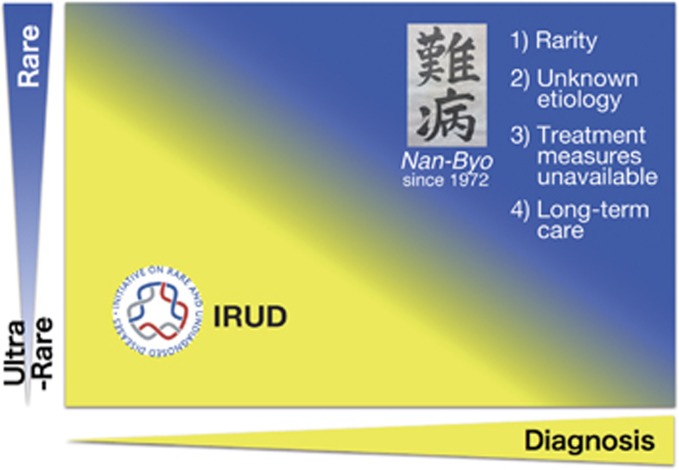
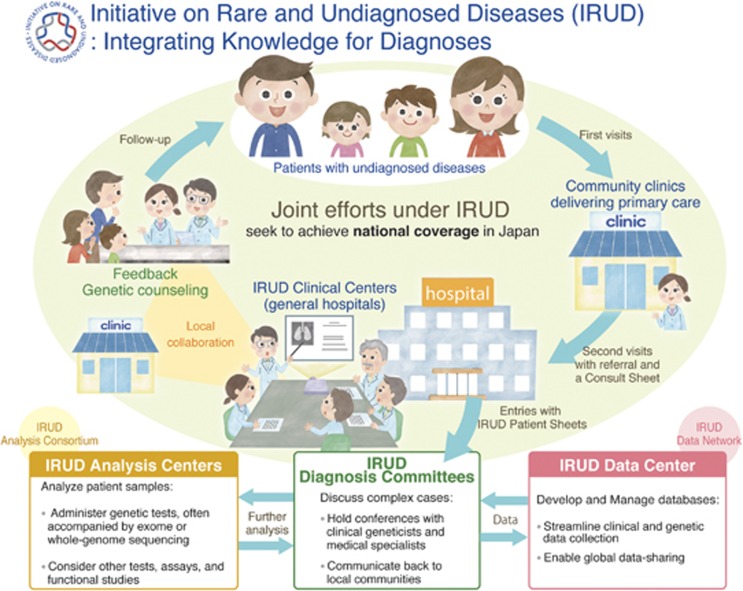
Japan has been facing challenges relating to specifically defined rare diseases, called Nan-Byo in Japanese (literally 'difficult'+'illness'), and has already taken measures for them since 1972. This governmental support has surely benefited Nan-Byo patients; however, those suffering from medically unidentified conditions do not fall into this scheme and thus still confront difficulty in obtaining an examination, a diagnosis, and a treatment. To identify such rare and often undiagnosed diseases, we must integrate systematic diagnosis by medical experts with phenotypic and genetic data matching. Thus, in collaboration with Nan-Byo researchers and the Japanese universal healthcare system, the Japan Agency for Medical Research and Development launched the Initiative on Rare and Undiagnosed Diseases (IRUD) in 2015. IRUD is an ambitious challenge to construct a comprehensive medical network and an internationally compatible data-sharing framework. Synergizing with existing next-generation sequencing capabilities and other infrastructure, the nationwide medical research consortium has successfully grown to accept more than 2000 undiagnosed registrants by December 2016. We also aim at expanding the concept of microattribution throughout the initiative; that is, proper credit as collaborators shall be given to local primary care physicians, nurses and paramedics, patients, their family members, and those supporting the affected individuals whenever appropriate. As it shares many challenges among similar global efforts, IRUD's future successes and lessons learned will significantly contribute to ongoing international endeavors, involving players in basic research, applied research, and societal implementation.
日本一直面临与特定定义的罕见疾病相关的挑战,日语中称为“难病”(字面意思是“困难”+“疾病”),自1972年以来就已针对这些疾病采取了措施。这种政府支持无疑使难病患者受益;然而,那些患有医学上无法确诊病症的患者并不在该计划范围内,因此在获得检查、诊断和治疗方面仍然面临困难。为了识别此类罕见且往往未被诊断出的疾病,我们必须将医学专家的系统诊断与表型和基因数据匹配相结合。因此,日本医疗研究与开发机构与难病研究人员以及日本全民医疗保健系统合作,于2015年发起了罕见和未确诊疾病倡议(IRUD)。IRUD是一项雄心勃勃的挑战,旨在构建一个全面的医疗网络和一个国际兼容的数据共享框架。通过与现有的下一代测序能力和其他基础设施协同合作,到2016年12月,全国性的医学研究联盟已成功发展到接纳了2000多名未确诊的登记患者。我们还旨在将微归因的概念扩展到整个倡议中;也就是说,在任何适当的时候,都应给予当地初级保健医生、护士和护理人员、患者、他们的家庭成员以及那些支持受影响个体的人作为合作者的适当认可。由于IRUD在类似的全球努力中面临许多共同挑战,其未来的成功和经验教训将极大地促进正在进行的国际努力,涉及基础研究、应用研究和社会实施等领域的参与者。