Universidade Estadual Paulista (Unesp), Faculdade de Ciências e Letras (FCL), Câmpus de Assis, Laboratório de Matemática Aplicada, Assis, SP, Brazil.
Institut de Biologie de l'École Normale Supérieure de Paris, Paris, France.
Sci Rep. 2017 Aug 9;7(1):7659. doi: 10.1038/s41598-017-08104-9.
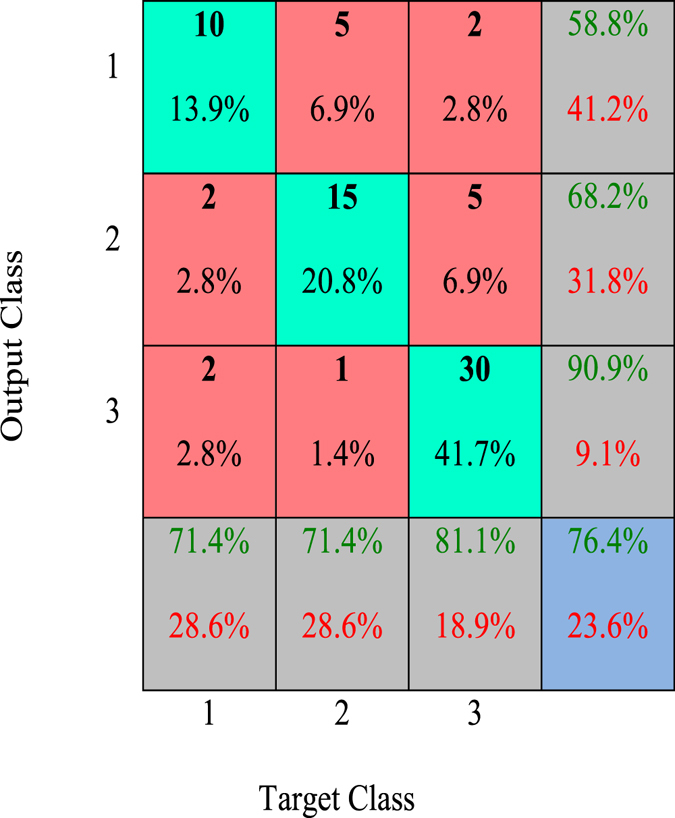
Morphological analysis is the standard method of assessing embryo quality; however, its inherent subjectivity tends to generate discrepancies among evaluators. Using genetic algorithms and artificial neural networks (ANNs), we developed a new method for embryo analysis that is more robust and reliable than standard methods. Bovine blastocysts produced in vitro were classified as grade 1 (excellent or good), 2 (fair), or 3 (poor) by three experienced embryologists according to the International Embryo Technology Society (IETS) standard. The images (n = 482) were subjected to automatic feature extraction, and the results were used as input for a supervised learning process. One part of the dataset (15%) was used for a blind test posterior to the fitting, for which the system had an accuracy of 76.4%. Interestingly, when the same embryologists evaluated a sub-sample (10%) of the dataset, there was only 54.0% agreement with the standard (mode for grades). However, when using the ANN to assess this sub-sample, there was 87.5% agreement with the modal values obtained by the evaluators. The presented methodology is covered by National Institute of Industrial Property (INPI) and World Intellectual Property Organization (WIPO) patents and is currently undergoing a commercial evaluation of its feasibility.
形态分析是评估胚胎质量的标准方法;然而,其内在的主观性往往会导致评估者之间存在差异。我们使用遗传算法和人工神经网络(ANNs)开发了一种新的胚胎分析方法,比标准方法更稳健、可靠。根据国际胚胎技术学会(IETS)标准,将体外培养的牛囊胚分为 1 级(优秀或良好)、2 级(一般)或 3 级(较差)。对 3 名经验丰富的胚胎学家评估的 482 张图像(n=482)进行自动特征提取,将结果作为监督学习过程的输入。数据集的一部分(15%)用于拟合后的盲测,系统的准确率为 76.4%。有趣的是,当同 3 名胚胎学家评估数据集的一个子样本(10%)时,与标准(等级模式)的一致性仅为 54.0%。然而,当使用 ANN 评估该子样本时,与评估者获得的模式值的一致性为 87.5%。所提出的方法已获得国家工业产权研究所(INPI)和世界知识产权组织(WIPO)的专利,并正在对其可行性进行商业评估。