Li Dong-Kai, Wang Xiao-Ting, Liu Da-Wei
Department of Critical Care Medicine, Peking Union Medical College Hospital, Peking Union Medical College, Chinese Academy of Medical Science, 1 Shuaifuyuan, Dongcheng District, Beijing, 100730, China.
Ann Intensive Care. 2017 Aug 9;7(1):83. doi: 10.1186/s13613-017-0306-1.
Some prior studies have shown that elevated mean central venous pressure in certain patient populations and disease processes may lead to poor prognosis. However, these studies failed to generalize the concept of elevated central venous pressure (ECVP) load to all patients in critical care settings because of the limited cases and exclusive cohorts. The aim of the study was to investigate the association between elevated central venous pressure and outcomes in critical care.
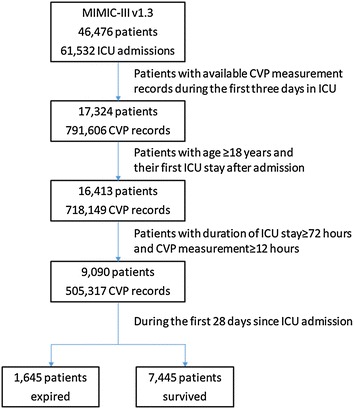
We performed a retrospective analysis on a single-center public database (MIMIC) of more than 9000 patients and more than 500,000 records of central venous pressure measurement. We evaluated the association between mean central venous pressure level and 28-day mortality after intensive care unit admission. The secondary outcomes were duration of mechanical ventilation, vasoactive drug use, laboratory results related to organ dysfunction and length of intensive care unit hospitalization. Accordingly, we proposed the concept of ECVP (the time sum of CVP above 10 mmHg) and investigated its association with outcome.
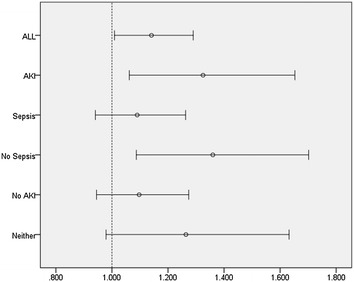
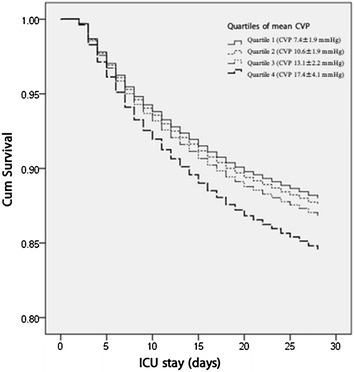
There were 1645 deaths at 28 days after admission. Compared with the lowest quartile of mean central venous pressure [mean (SD) 7.4 (1.9) mmHg], the highest quartile [17.4 (4.1) mmHg] was associated with a 33.6% (95% CI 1.117-1.599) higher adjusted risk of death. Poor secondary outcomes were also associated with higher quartiles of elevated mean central venous pressure. After stratification by mean central venous pressure, elevated duration of central venous pressure above 10 mmHg was significantly higher in the non-survival group than in the survival group.
Elevated central venous pressure level correlated with poor outcomes and prolonged treatment in critical care settings. Level and duration of elevated central venous pressure should be both evaluated to establish its cause and apply appropriate treatment.
一些先前的研究表明,特定患者群体和疾病过程中平均中心静脉压升高可能导致预后不良。然而,由于病例有限且队列排他,这些研究未能将中心静脉压升高(ECVP)负荷的概念推广到所有重症监护患者。本研究的目的是调查重症监护中中心静脉压升高与预后之间的关联。
我们对一个包含9000多名患者和50多万条中心静脉压测量记录的单中心公共数据库(MIMIC)进行了回顾性分析。我们评估了平均中心静脉压水平与重症监护病房入院后28天死亡率之间的关联。次要结局包括机械通气时间、血管活性药物使用情况、与器官功能障碍相关的实验室检查结果以及重症监护病房住院时间。据此,我们提出了ECVP(中心静脉压高于10 mmHg的时间总和)的概念,并研究了其与结局的关联。
入院后28天有1645例死亡。与平均中心静脉压最低四分位数[平均(标准差)7.4(1.9)mmHg]相比,最高四分位数[17.4(4.1)mmHg]的校正死亡风险高33.6%(95%可信区间1.117 - 1.599)。次要结局不良也与平均中心静脉压升高的较高四分位数相关。按平均中心静脉压分层后,中心静脉压高于10 mmHg的升高持续时间在非存活组显著高于存活组。
重症监护环境中中心静脉压升高与不良结局和治疗时间延长相关。应同时评估中心静脉压升高的水平和持续时间,以确定其原因并采取适当治疗。