Swiss Tropical and Public Health Institute, Basel, Switzerland.
University of Basel, Basel, Switzerland.
Matern Child Nutr. 2018 Jan;14(1). doi: 10.1111/mcn.12497. Epub 2017 Aug 10.
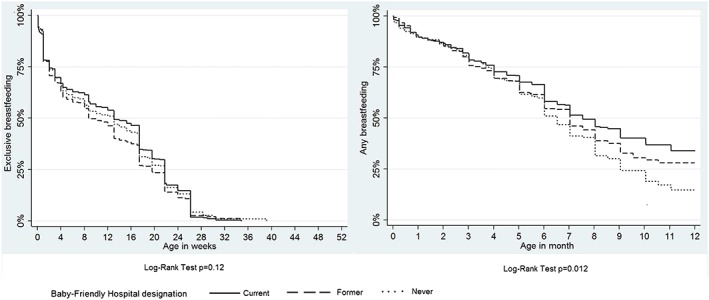
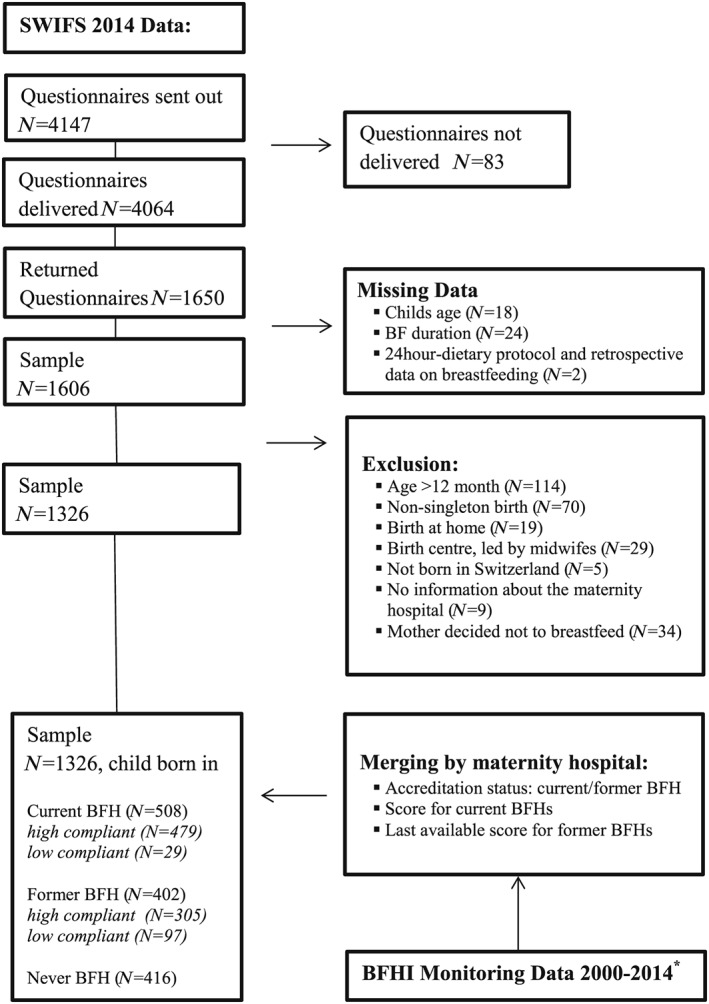
The Baby-Friendly Hospital (BFH) Initiative has led to an increase in breastfeeding rates and duration worldwide. But little is known about whether the beneficial effects persist beyond a facility's designation as a BFH. To investigate the association of BFH designation (current, former, and never) and compliance with Baby-Friendly (BF) practices on breastfeeding in Switzerland, this study combined nationwide survey data on breastfeeding with BFH monitoring data. In this cross-sectional study, 1,326 children were born in 34 current (N = 508), 28 former (N = 425), and 34 never designated BFHs (N = 393). We compared exclusive and any breastfeeding according to BFH designation over the first year of life, using Kaplan-Meyer Survival curves. Logistic regression models were applied to analyse breastfeeding prevalence, and Cox-regression models were used for exclusive (0-6 months) and continued (6-12 months) breastfeeding duration. Average duration of exclusive breastfeeding (13.1 weeks, 95% confidence interval [12.0, 17.4]) and any breastfeeding (32.7 weeks, 95% confidence interval [30.5, 39.2]) were the longest for babies born in currently accredited BFHs. Exclusive breastfeeding was associated with high compliance with monitored BF practices in current BFHs and with the number of BF practices experienced in all hospitals. Continued breastfeeding was significantly longer when babies were born in current BFHs (cessation hazard ratio 0.60, 95% confidence interval [0.42, 0.84]) or in former BFHs (cessation hazard ratio 0.68, 95% confidence interval [0.48, 0.97]). Overall, the results support continued investment into BFHs, because babies born in current BFHs are breastfed the most and the longest, whereas a former BFH designation shows a sustained effect on continued breastfeeding.
婴儿友好医院(BFH)倡议已导致全球母乳喂养率和持续时间的增加。但对于 BFH 指定是否会对设施的母乳喂养产生有益影响,知之甚少。为了研究 BFH 指定(当前、以前和从未)与遵守婴儿友好(BF)实践之间的关联以及对瑞士母乳喂养的影响,本研究将全国母乳喂养调查数据与 BFH 监测数据相结合。在这项横断面研究中,34 家当前的(N=508)、28 家以前的(N=425)和 34 家从未指定的 BFH(N=393)中共有 1326 名儿童出生。我们使用 Kaplan-Meier 生存曲线比较了生命第一年的纯母乳喂养和任何母乳喂养。应用逻辑回归模型分析母乳喂养的流行率,应用 Cox 回归模型分析纯母乳喂养(0-6 个月)和持续母乳喂养(6-12 个月)的持续时间。在当前认可的 BFH 中出生的婴儿,纯母乳喂养的平均持续时间(13.1 周,95%置信区间[12.0,17.4])和任何母乳喂养(32.7 周,95%置信区间[30.5,39.2])最长。在当前的 BFH 中,纯母乳喂养与高符合监测 BF 实践相关,与在所有医院中经历的 BF 实践数量相关。当婴儿在当前的 BFH 中出生时,持续母乳喂养时间明显更长(停止风险比 0.60,95%置信区间[0.42,0.84])或在以前的 BFH 中出生(停止风险比 0.68,95%置信区间[0.48,0.97])。总的来说,这些结果支持对 BFH 的持续投资,因为在当前的 BFH 中出生的婴儿母乳喂养最多且时间最长,而以前的 BFH 指定对持续母乳喂养具有持续影响。